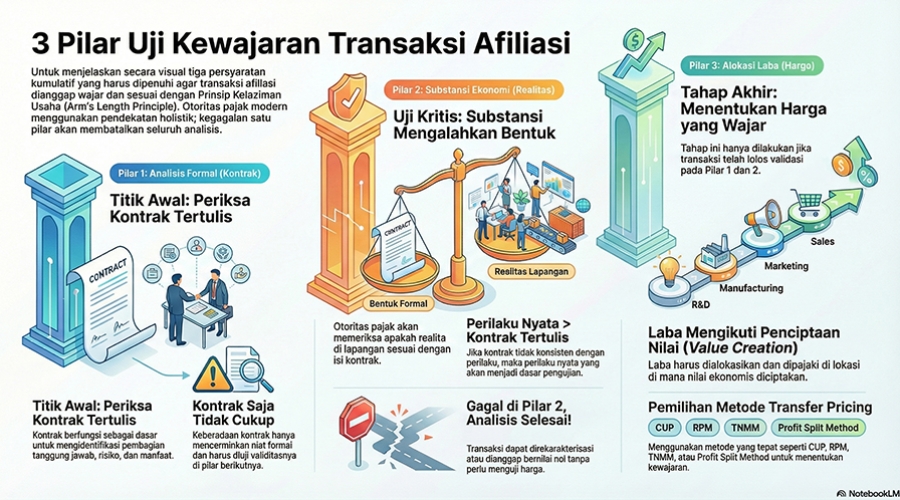
In the modern international taxation landscape, the application of the Principle of Fairness and Business Prevalence (Arm’s Length Principle or ALP) has evolved far beyond merely an arithmetic exercise of comparing prices. Tax authorities worldwide, including in Southeast Asia, are now adopting a more holistic and substance-based approach to prevent tax base erosion.
Based on the 2022 OECD Guidelines, 2021 UN TP Manual, as well as current regulations in Indonesia (PMK 172/2023), Singapore (IRAS TPG 8th Edition), and Malaysia (IRBM TPG 2024), an affiliated transaction can only be considered to meet the ALP if it fulfills three cumulative requirements. Failure to meet one of the initial stages will cause the collapse of the validity of the price analysis in the final stage.
Pillar 1: Formal Analysis (Arm's Length Contract)
The first step in every transfer pricing analysis always starts from legal documents. Written contracts serve as the starting point to identify how parties formally divide responsibilities, risks, and benefits in a transaction.
According to the OECD and UN, contractual terms are the starting point for delineating transactions. Contracts establish the division of responsibilities, obligations, and rights, as well as the assumption of risks intended by the parties at the time of entering into the transaction. At the regional level, domestic regulations adopt a similar approach:
- Malaysia: Malaysia Transfer Pricing Guidelines 2024 (Paragraph 2.21) affirms that written contracts provide the starting point for delineating transactions and identifying how risks are formally shared.
- Singapore: IRAS (Paragraph 5.18-5.20) states that written agreements provide the starting point for determining how transactions are priced and how responsibilities are divided.
- Indonesia: MoF Regulation (PMK) 172 of 2023 (Article 7) places "contractual terms" as the first factor in the analysis of transaction conditions.
However, it is important to note that the existence of a contract alone is not sufficient. Contracts only reflect "formal intent". Analysis must not stop here; the contract must be tested for validity in the second pillar.
Pillar 2: Economic Substance (Accurate Delineation, Risk Control, and Commercial Rationality)
This is the most critical stage and often becomes the main dispute area. Tax authorities have the authority to look behind the contract scenes and test whether the "paper" (contract) matches the "reality" (conduct). If the contract does not match the actual conduct, then the actual conduct prevails.
A. Accurate Delineation: Conduct vs. Contract
The main principle here is substance over form. The actual transaction (accurately delineated transaction) must be deduced from the actual conduct of the parties.
- OECD & UN: If the characteristics of the transaction are inconsistent with the contract, then the transaction is delineated based on the conduct of the parties.
- Singapore: IRAS explicitly (Par. 5.24) states the transaction is determined from actual conduct if there are material differences.
- Indonesia: PMK 172 affirms contractual terms cover written as well as unwritten matters executed according to the actual situation.
B. Risk Analysis: Control and Financial Capacity
For an entity to be considered as assuming risk, that entity must have:
- Control: The ability to make strategic decisions regarding that risk (not merely daily administration).
- Financial Capacity: Access to funding to bear the consequences if the risk actually materializes. Consequence: A "cash box" entity without research control functions is only entitled to a risk-free return.
C. Commercial Rationality and ORA (Options Realistically Available)
Independent parties will only enter into a transaction if the transaction does not leave them worse off compared to other realistic options (Options Realistically Available).
- OECD: Transactions can be disregarded if they differ from what rational independent enterprises would adopt.
- Malaysia: Paragraph 2.60 provides authority for recharacterization if the arrangement is not commercially rational.
- Indonesia: Through the "Preliminary Stage", Taxpayers must prove the business motive and economic benefit (benefit test).
Pillar 3: Arm's Length Profit Allocation
After Pillar 2 is validated, only then do we determine the fair price or profit through Value Alignment (Value Creation). Profits must be taxed where economic value is created, not merely based on legal asset ownership. Selection of Transfer Pricing Method:
- Traditional Methods (CUP, RPM, CP): Prioritized by Indonesia and Malaysia if reliable comparable data is available.
- Profit-Based Methods (TNMM): Applied to the tested party with the simplest functions.
- Profit Split Method (PSM): Used if both parties provide unique contributions or operations are highly integrated.
Validitas sebuah transaksi afiliasi diuji secara bertingkat: (1) Apakah kontraknya ada? (2) Apakah perilaku nyatanya sesuai kontrak dan masuk akal? (3) Apakah harganya wajar? Gagal di Pilar 2 berarti transaksi dianggap tidak ada (nilai nol) atau direkarakterisasi tanpa perlu masuk ke diskusi Pilar 3.
References
- OECD. (2022). OECD Transfer Pricing Guidelines for Multinational Enterprises and Tax Administrations 2022. OECD Publishing, Paris.
- United Nations. (2021). Practical Manual on Transfer Pricing for Developing Countries (2021).
- Republic of Indonesia. (1983). Law Number 7 of 1983 concerning Income Tax as several times amended, most recently by Law Number 7 of 2021 concerning Harmonization of Tax Regulations.
- Ministry of Finance of the Republic of Indonesia. (2023). Regulation of the Minister of Finance of the Republic of Indonesia Number 172 of 2023 concerning the Application of the Principle of Fairness and Business Prevalence in Transactions Influenced by a Special Relationship.
- Directorate General of Taxes. (2013). Regulation of the Director General of Taxes Number PER-22/PJ/2013 concerning Guidelines for Audit of Taxpayers Having a Special Relationship.
- Inland Revenue Board of Malaysia. (2024). Malaysia Transfer Pricing Guidelines 2024.
- Inland Revenue Authority of Singapore. (2025). IRAS Transfer Pricing Guidelines (Eighth Edition) (2025).





 tpc.consulting
  tpc.consulting
  info@taxindo.co.id