


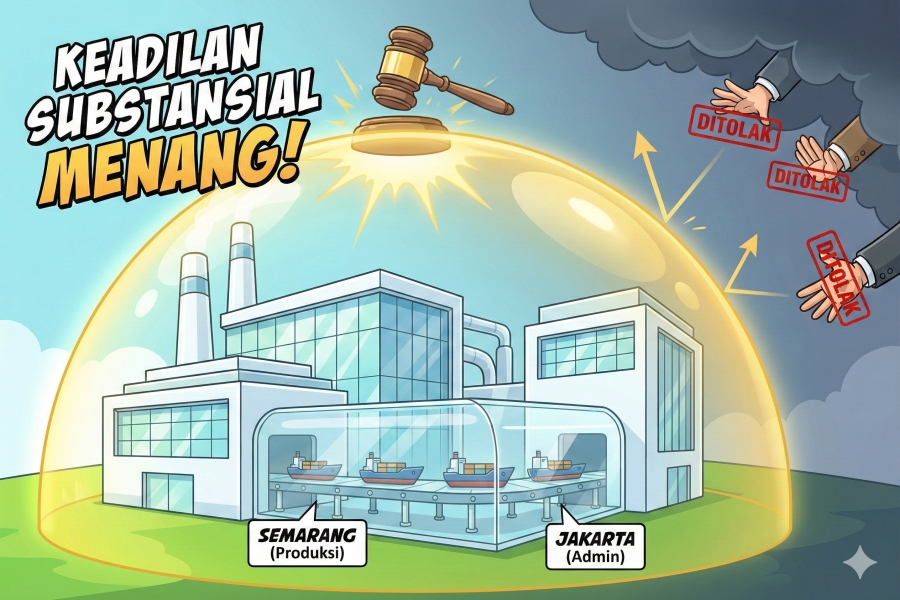
Tax disputes are often not about tax evasion, but rather a collision between rigid regulatory texts and business realities. The case of PT JMI versus the Directorate General of Taxes (DJP) is a classic example of how the absence of a single "Value-Added Tax (VAT) Centralization" permit can trigger a dispute worth IDR 4,156,429,802.00. This case offers crucial lessons on the importance of administrative order for multi-branch companies.
PT JMI is a shipbuilding company with a unique yet common structure: the Head Office in Jakarta handles contracts and administration, while the Branch Office in Semarang handles the physical production of ships. Business-wise, they are one entity. However, under the 2021 VAT law perspective, because they had not applied for a centralization permit, they were treated as two separate entities. Consequently, when the Semarang Branch sent finished/repaired ships to the Jakarta Head Office (to be delivered to clients), the DJP deemed it a "taxable delivery of goods" subject to VAT. The DJP issued a bill for billions of Rupiah because the Branch did not issue a Tax Invoice to the Head Office.
In court, the DJP insisted on Article 1A paragraph (1) letter f of the VAT Law (UU PPN): "Delivery between branches constitutes a taxable delivery." Period. No centralization means you must pay. On the other side, PT JMI cried injustice. They argued, "We already paid the full VAT when the ship was delivered to the customer! Charging tax internally is like taxing oneself." PT JMI's argument touched on a fundamental VAT principle: Neutrality. If the Branch were forced to charge VAT to the Head Office, the Head Office would simply credit it back, and the net result would eventually be zero. Thus, enforcing payment would only disrupt cash flow without adding real state revenue.
The Tax Court Judges took a stance that relieved business operators. The Judges viewed punishing PT JMI for administrative negligence—when the state's actual right (VAT from the consumer) had already been secured—as disproportionate. The Judges emphasized that the DJP's correction potentially caused double taxation and ignored the fact of PT JMI's business integration. The "Granted Entirely" verdict proves that in tax law, substantive justice still holds a place above rigid formality.
Although victorious, PT JMI had to endure a grueling appeal process. The lesson is clear: Do not underestimate administrative permits. For companies with multiple branches, "VAT Centralization" is not just an option, but a vital necessity to avoid such risk exposure. PT JMI's victory is a good precedent, but preventing disputes through administrative order is far wiser and cheaper.
A Comprehensive Analysis and the Tax Court Decision on This Dispute Are Available Here





















 tpc.consulting
  tpc.consulting
  info@taxindo.co.id