


In the world of international taxation, transfer pricing is often misunderstood as merely an arithmetic exercise to find a "market price" number. However, the heart of transfer pricing analysis lies not in the numbers alone, but in a deep understanding of what actually happens in a transaction.
Two fundamental concepts governing this are Accurate Delineation of Transaction and Recharacterization (or non-recognition). These two concepts serve as a "filter" to ensure that tax liabilities are calculated based on economic reality (substance), not just what is written on paper (form).
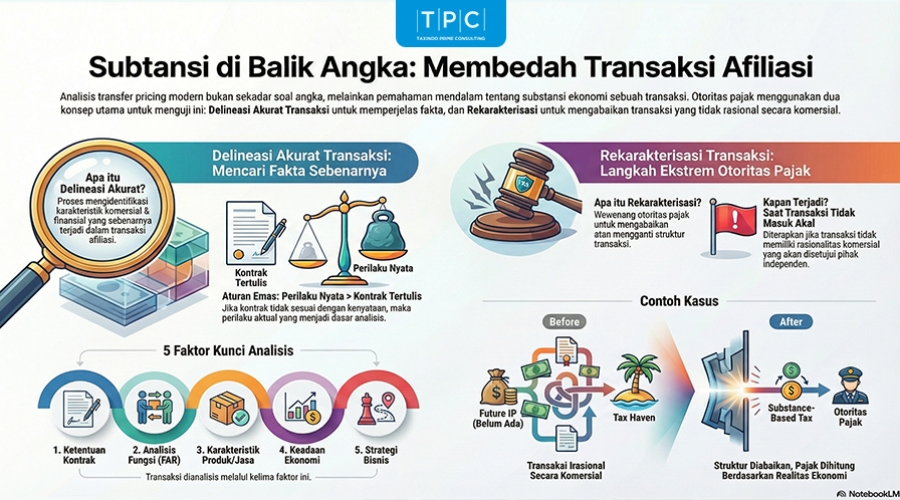
Before a transaction can be priced, it must be defined precisely. Accurate delineation is the process of identifying the actual commercial and financial characteristics between affiliated parties. The main goal is to ensure that transfer pricing analysis is based on factual substance, not just on labels given by the taxpayer.
To accurately delineate a transaction, both OECD guidelines and MoF Regulation (PMK) 172/2023 in Indonesia require an analysis of five relevant economic characteristics (often referred to as comparability factors):
The most critical aspect in delineation is testing the consistency between the written contract and the actual behavior (conduct) of the parties. If the provisions in the written contract differ from the actual behavior of the parties, then the actual behavior must be used to delineate the transaction.
In Indonesia, PMK 172/2023 Article 7 affirms that contractual terms include what is written as well as what is not written, which is carried out according to the actual situation.
If delineation is about "clarifying" the transaction, then recharacterization (or non-recognition) is about "ignoring" or "replacing" the transaction structure. This is an extraordinary step taken when a transaction lacks commercial rationality (commercial rationality).
Recharacterization generally is only permitted in two main conditions:
Independent parties will only enter into a transaction if the transaction does not leave them worse off compared to other best options.
Indonesia has strictly adopted these principles through PMK 172 of 2023, granting strong authority to the DGT to test compliance with the Principle of Fairness and Business Prevalence (PKKU).
Article 13 of PMK 172 introduces a "Preliminary Stage" for service and IP transactions. Taxpayers must prove existence, economic benefit, and business motive. If they fail, the transaction is considered not to meet PKKU and the cost is considered zero (non-deductible).
Article 36 of PMK 172 grants authority to the Director General of Taxes to re-determine the amount of income or deductions if the taxpayer does not apply PKKU, based on the actual situation.
Delineation and recharacterization are two sides of the same coin in modern transfer pricing analysis. Delineation ensures prices are based on actual behavioral facts, while recharacterization is a safety mechanism to reject transaction structures that do not make business sense.
TP Doc documentation must not only focus on numbers. You must be able to prove WHY the transaction occurred and that its economic substance makes business SENSE.
Is My Company Required to Create a Transfer Pricing Document?


 tpc.consulting
  tpc.consulting
  info@taxindo.co.id