



The economic spotlight today is on the strategies of the government and Bank Indonesia (BI) in strengthening the State Budget (APBN) and the real sector, amidst the threat of natural disaster impacts. The National Single Window Agency (LNSW) is developing strategies to prevent revenue leakage and improve logistics efficiency. For oversight purposes, vital commodities such as copper, gold, and palm oil will be integrated into the SIMBARA system. Meanwhile, BI has obtained a new mandate to strengthen the real sector, but Finance Minister Purbaya mentioned that the disaster in Sumatra will impact economic targets at the end of 2025. This summary will cover the revenue security strategy, BI's expanded role, and disaster risk.
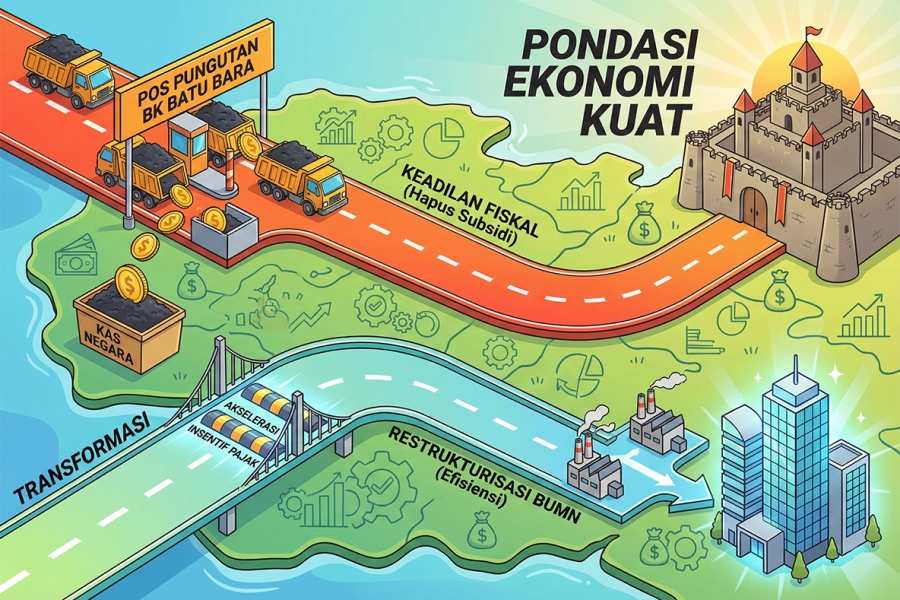
The National Single Window Agency (LNSW) is developing a strategy to support the State Budget (APBN). This strategy includes preventing state revenue leakage and increasing national logistics efficiency. To tighten revenue leakage from the natural resources sector, commodities such as copper, gold, and palm oil will be integrated into the SIMBARA system. This integration step aims to ensure data accuracy and maintain the integrity of state revenue.
On the other hand, Bank Indonesia (BI) has secured a new mandate from the regulator. This mandate aims to strengthen the national economic real sector, signaling an expansion of BI's role beyond its traditional monetary focus to support growth.
However, these economic strengthening efforts are facing external challenges. Finance Minister Purbaya mentioned that the natural disaster that occurred in Sumatra will impact the achievement of economic targets at the end of 2025. This statement highlights a serious challenge to fiscal projections and the need for effective disaster risk mitigation.
Today's news has broad implications, ranging from fiscal management and monetary roles to disaster risk mitigation. The LNSW strategy and commodity integration into SIMBARA imply increased traceability and revenue accuracy, yet demand higher compliance from commodity business actors. BI's new mandate to strengthen the real sector opens opportunities for closer coordination between fiscal and monetary authorities to drive growth. However, Purbaya's acknowledgement of the impact of the Sumatra disaster reminds the government of the environmental risks that can disrupt economic targets, highlighting the need for flexible APBN allocation for disaster mitigation and recovery.
Overall, the economic authorities are moving quickly to strengthen the fiscal defense line through the LNSW strategy and the SIMBARA system to safeguard the APBN from revenue leakage. Simultaneously, BI is taking a larger role in supporting the real sector. Despite the strengthening efforts, the external challenge posed by the impact of natural disasters remains a variable that must be watched, urging the government to prioritize risk mitigation to maintain economic stability and the 2025 targets.













 tpc.consulting
  tpc.consulting
  info@taxindo.co.id