



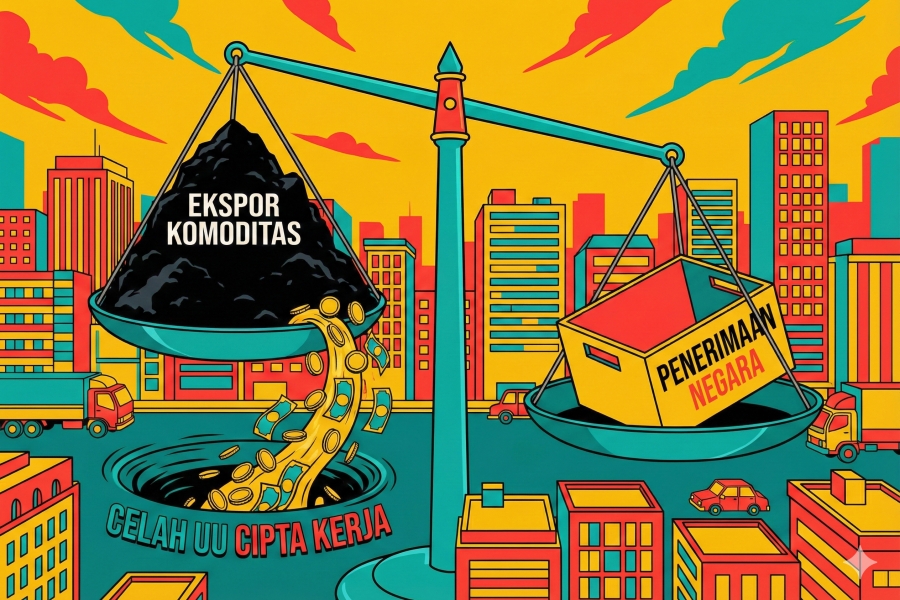
The government has decided to impose coal export duties starting in 2026 to stop the "bleeding" of state coffers caused by tax restitution (refund) claims, which have reached IDR 42.9 trillion. This strategic move targets IDR 25 trillion in revenue while simultaneously eliminating "hidden subsidies" for exporters created by loopholes in the Job Creation Law. The mining industry is now forced to adapt to new cost burdens amidst a sharp correction in export performance.
The Indonesian government is officially drafting the implementation of export duties on coal starting in 2026 to secure an annual state revenue target of IDR 25 trillion. This aggressive fiscal policy serves as a response to recent trade data showing a 4.10 percent decline in export volume to 320.47 million tons from January to October 2025, which also dragged down foreign exchange earnings by a sharp 20.25 percent. This move marks a turning point in natural resource management, as the consistent growth trend in export volumes seen from 2020 to its peak in 2024 has begun to lose momentum.
The Ministry of Finance is pursuing these export levies because the current taxation mechanism is burdening state finances through a surge in Value Added Tax (VAT) refunds, which reached a staggering IDR 42.9 trillion as of November 2025. The root of the issue lies in the Job Creation Law, which categorized coal as a Taxable Good (BKP). This status allows businesses to claim back their input taxes since the VAT rate for exports is set at 0 percent. This has created a cash flow imbalance where the state must routinely pay trillions of rupiah to mining corporations—a figure that has skyrocketed from just IDR 5.7 trillion in 2021 to tens of trillions today.
Minister of Finance Purbaya Yudhi Sadewa views this situation as nothing less than the state providing a "veiled subsidy" to the coal industry, despite the majority of its products being sold abroad. The government is determined to restore the industry to its original position, ensuring that natural wealth provides maximum benefit for public prosperity as mandated by the constitution, rather than eroding net tax revenue. This export duty policy is designed to work in tandem with similar levies on gold commodities as part of a comprehensive strategy to close fiscal gaps created by the Omnibus Law.
For industry players and investors, the policy signal is clear: the era of the "liquidity party"—fueled by easy tax refund claims which the government deems a unilateral subsidy without balancing levies—is coming to an end. Mining companies must now immediately recalibrate their corporate financial strategies to absorb the burden of new export duties, which have the potential to significantly erode net profit margins starting next year.
The dynamics of this policy tug-of-war demonstrate that the government will not allow regulatory loopholes to continue undermining the resilience of the National Budget (APBN). Achieving a new balance between investment incentives and the optimization of state revenue has now become an absolute priority amidst global economic challenges.

















 tpc.consulting
  tpc.consulting
  info@taxindo.co.id