



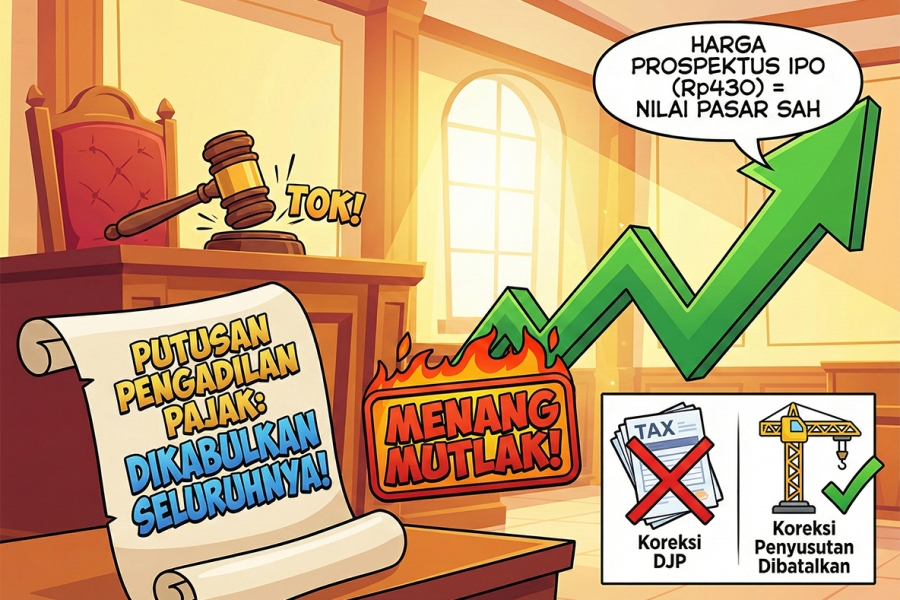
The application of Final Income Tax (PPh) Article 4(2) regulations, which mandate withholding at the time of payment or accrual, often leads to timing disputes between Taxpayers and the Directorate General of Taxes (DJP). The case of PT AAC highlights this complexity, where the correction of the Final PPh Article 4(2) Tax Base (DPP) amounting to Rp. 1,409,054,800.00 for the October 2020 Tax Period was successfully annulled. This decision underscores the significance of the material truth principle in tax litigation, even when PT AAC was late in fulfilling its withholding obligation. The DJP argued that the transaction originating from a PT TIG invoice constituted income subject to Final PPh in October 2020, but PT AAC had failed to withhold and report the tax during that period, leading the DJP to issue an Underpayment Tax Assessment Letter (SKPKB).
The core conflict in this dispute revolves around the difference in the timing of the tax withholding obligation fulfillment. The DJP stood firm on the examination findings showing no withholding in the October 2020 Tax Period. Conversely, PT AAC presented a solid rebuttal with authentic evidence. PT AAC successfully proved that the Final PPh on the disputed transaction, although originating from an October 2020 invoice, had been validly withheld, deposited, and reported in the February 2021 Tax Period. Withholding Slip Number 000005/PPH4(2)/II/2021 dated February 28, 2021, became the key piece of evidence, confirming that the tax had entered the state treasury, albeit in a different tax period.
In resolving the dispute, the Tax Court Panel meticulously evaluated the evidence submitted. The Panel acknowledged and accepted the validity of the withholding slip, concluding that the primary goal of tax administration, which is state revenue, had been achieved. Adhering to the principle of material truth and to prevent double taxation, the Panel was convinced that the correction imposed by the DJP for the October 2020 Tax Period must be annulled. This annulment was carried out because the imposition of a new tax liability would result in unfairness to PT AAC, who had already fulfilled its obligation in a subsequent tax period.
Analysis of this ruling has significant implications. For Taxpayers, the PT AAC case serves as a precedent that administrative meticulousness and swift cut-off practices are crucial. However, in the event of a timing error, strong documentation (withholding slips, tax deposit slips, and tax returns) demonstrating the actual deposit of tax serves as the main line of defense in the litigation process. The decision reinforces the Tax Court's role as a guardian of justice, prioritizing substance (tax has been paid) over formality (delay in tax period), provided the tax has been fully paid. The annulment of this SKPKB conveys a message that the DJP needs to consider evidence of tax fulfillment in other tax periods before enforcing a potentially dual correction.
The conclusion is that it is vital for Taxpayers to ensure that the Final PPh withholding obligation is carried out according to the regulations, but PT AAC’s success demonstrates that the principle of material truth provides a way out of timing disputes. The certainty of being able to present authentic evidence of tax fulfillment is a key strategy for annulling tax authority corrections.
A Comprehensive Analysis and the Tax Court Decision on This Dispute Are Available Here














 tpc.consulting
  tpc.consulting
  info@taxindo.co.id