


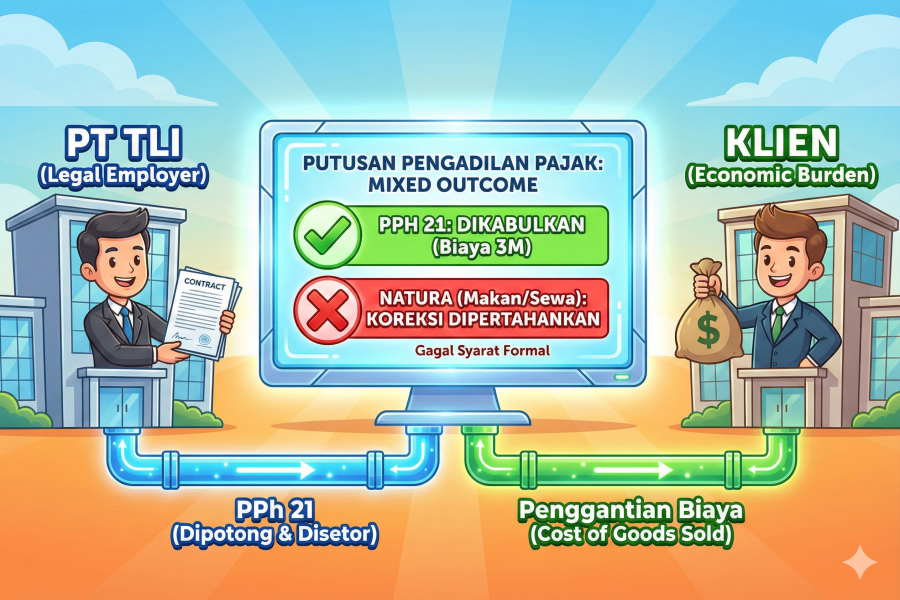
This Tax Court decision resulted in a mixed outcome for PT TLI in its Corporate Income Tax dispute for Fiscal Year 2016. Out of total positive tax corrections amounting to IDR 5,388,987,062, the Panel of Judges partially granted the Taxpayer’s appeal. The dispute focused on the deductibility of personnel-related expenses, particularly costs that were classified by the Directorate General of Taxes (DGT) as benefits in kind and/or fringe benefits.
PT TLI operates as a manpower service provider. Under this business model, labor constitutes the core service sold to clients. All costs directly attributable to manpower—including salaries, social security contributions, and Income Tax Article 21—are recharged to clients as part of the service price, with an additional management fee. From a labor law perspective, the workers are employees of PT TLI, as evidenced by the fact that PT TLI performs the withholding, payment, and reporting of Income Tax Article 21 on the employees’ income. Economically, however, the burden of labor costs is borne by the clients as users of the manpower services. This distinction between the legal employer and the economic bearer of costs forms the core context of the dispute.
The DGT argued that Income Tax Article 21 constitutes tax on employees’ income and therefore may not be deducted as an expense pursuant to Article 9 paragraph 1 letter h of the Income Tax Law. PT TLI countered by asserting that the Article 21 tax in dispute was not income tax payable by PT TLI, but rather tax on employees’ income that was initially paid by PT TLI and subsequently recharged to clients as part of the cost of manpower services. Accordingly, the Article 21 tax was recorded as part of the Cost of Goods Sold (COGS), rather than as a corporate tax expense.
The Panel of Judges agreed with the Taxpayer’s argument and concluded that the prohibition on expense deductibility under Article 9 paragraph 1 letter h of the Income Tax Law applies only to income tax payable by the Taxpayer itself. Since the disputed Article 21 tax did not constitute tax payable by PT TLI, but rather formed part of the direct costs of manpower services that generated income, the DGT’s correction on this item was annulled. In addition to the Article 21 issue, the dispute also covered corrections related to expenses classified as benefits in kind, namely Refreshment (Food and Beverages) costs of IDR 2.47 billion and Housing Rental Costs for Workers of IDR 832 million. For these items, the Panel upheld the DGT’s corrections on the grounds that PT TLI failed to prove compliance with the formal requirements for benefits-in-kind exemptions as stipulated in the implementing regulations.
Although PT TLI put forward business necessity arguments—claiming that food provision was intended for all employees at the workplace and that housing was provided due to the remote nature of the work location—the Panel found that the Taxpayer failed to demonstrate that the business location qualified as an officially designated special area, and that other formal requirements were not satisfied.
This partial victory for PT TLI offers two important lessons. First, in the context of manpower service providers, Income Tax Article 21 paid by the company may be classified as part of the cost of manpower services and treated as an expense incurred to generate income (3M), provided that it can be demonstrated that such costs are recharged to clients. Second, for expenses categorized as benefits in kind, strict compliance with the formal requirements under the relevant Minister of Finance Regulations is a decisive factor in determining whether such expenses are deductible.
This decision underscores the importance of distinguishing between legal employer status and the economic bearer of costs when assessing the deductibility of personnel expenses in Corporate Income Tax disputes.
Comprehensive and Complete Analysis of This Dispute is Available Here


















 tpc.consulting
  tpc.consulting
  info@taxindo.co.id