


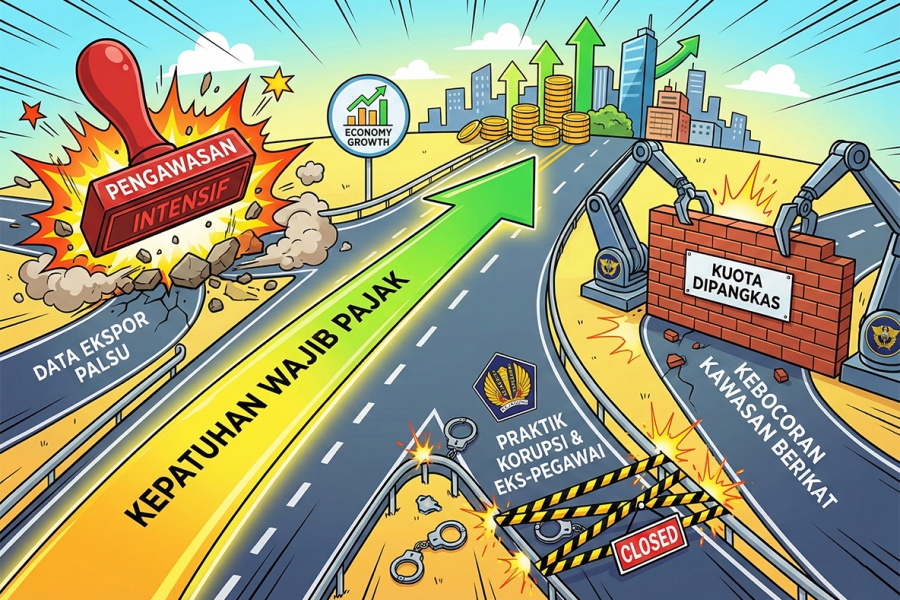
Recent developments in Indonesia's taxation and customs sector reflect the government's seriousness in tightening supervision and implementing administrative reform. This series of policies and law enforcement actions clearly illustrates the fiscal authorities' efforts to enhance taxpayer compliance and secure optimal state revenue.
The Directorate General of Taxes (DGT) now faces a major task concerning the Coretax System. Although this new tax administration system is crucial for modernization, data indicates that only about 5.73 million Taxpayers (WP) have successfully activated it. The slow activation rate could hinder the DGT's overall digital transition, demanding acceleration from business actors to ensure a smooth tax reporting process.
In line with efforts to maintain integrity, the DGT has established a significant new rule for its former employees. The regulation prohibits individuals who previously worked at the tax authority from practicing as tax consultants for five years after they quit or retire. This important policy aims to effectively prevent conflicts of interest and the potential misuse of internal information, thus requiring business actors to be careful in selecting independent and highly-integrity consultants.
On the customs front, the Directorate General of Customs and Excise (DGCE) is drafting a new regulation that will directly cut the sales quota of products from Bonded Zones (Kawasan Berikat/KB) into the domestic market. This tightening measure is a strategic step to control the flow of imported goods and encourage KB companies to be more export-oriented, ultimately forcing KB companies to adjust their distribution and operational strategies.
At the same time, the DGT demonstrates firmness in law enforcement. The tax authority will conduct intensive examinations of 463 Taxpayers strongly suspected of manipulating export data. This alleged manipulation was carried out to evade tax obligations or illegally obtain refunds (restitution). This news serves as a strong warning to all exporters to ensure the accuracy and transparency of their financial reporting data to avoid legal sanctions.
The firmness of law enforcement is also shown through the action of the Attorney General's Office (AGO) (Kejaksaan Agung). The AGO recently conducted raids at eight locations in the Jabodetabek area. This action is related to a case of alleged criminal corruption involving the unauthorized reduction of tax value. This case once again highlights the significant legal risks in unethical tax practices, emphasizing the need for absolute adherence to applicable regulations.
This series of policies and enforcement actions underscores the government's commitment to orderly administration and anti-corruption. Business actors and investors must understand that the current market dynamics not only demand operational efficiency but also high compliance with tax and customs regulations to ensure business certainty.















 tpc.consulting
  tpc.consulting
  info@taxindo.co.id