



The principle of Consideration Value as the Value Added Tax (VAT) Tax Base (DPP) has once again been tested in a VAT Output Tax correction dispute involving PT TTSM concerning Fresh Fruit Bunches (FFB) transactions from Plasma partners. This case highlights a crucial discrepancy between the formal tax obligations stipulated in the VAT Law and the complex revenue-sharing mechanism inherent in the plantation sector partnership scheme. In this Tax Court Decision, the Panel of Judges was required to dissect the unique layers of this transaction, which ultimately carries significant implications for the practice of determining the VAT DPP for plantation companies.
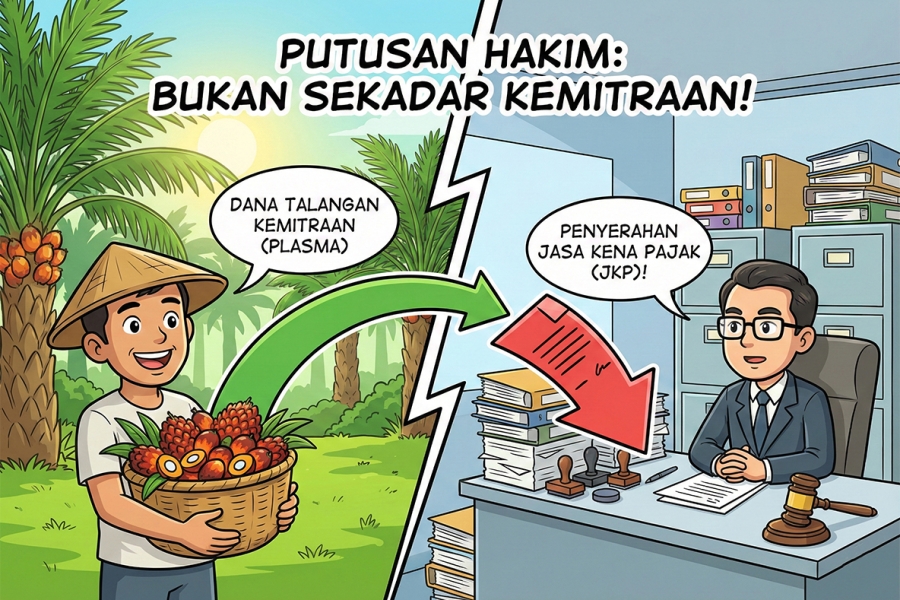
PT TTSM, as the Appellant, contested a VAT DPP correction of Rp. 1,180,035,158.00 set by Directorate General of Taxation (DJP). The core of the conflict lies in the differing perspectives on what constitutes the legitimate Tax Base. The DJP, through its audit findings, argued that the entire sales value of FFB from Plasma to PT TTSM must be recognized as the VAT DPP, irrespective of the internal profit-sharing or debt-deduction mechanism within the partnership scheme. This correction was based on a cash flow test and reconciliation that indicated an omission of turnover value that should have been subjected to VAT Output Tax. Conversely, PT TTSM argued that the legal obligation to operate a Plasma partnership dictates that this transaction cannot be treated as an ordinary supply of Taxable Goods (BKP). They contended that the corrected value should be excluded from the VAT DPP as it was part of the profit-sharing arrangement or a deduction for Plasma obligations, thus not meeting the definition of Full Consideration Value for the company.
Faced with this conflict of interpretation between sectoral plantation law and VAT law, the Panel of Judges adopted a stance that rigidly adhered to the principle of burden of proof and VAT formality. The Panel stated that, while the argument regarding the uniqueness of the Plasma partnership scheme is understandable, it cannot automatically override the prevailing VAT provisions. According to the Tax Court Law, the Appellant bears the obligation to prove that the Tax Base correction made by DJP is incorrect. The evidence must conclusively demonstrate that the IDR 1,180,035,158 value did not meet the element of VAT Consideration Value. Since PT TTSM was deemed to have failed to provide adequate supporting evidence, particularly documentation that clearly separated the VAT DPP component from other transactional elements within the partnership scheme, the Panel of Judges concluded that the correction carried out by DJP was valid and legally founded.
This decision, which rejected PT TTSM's appeal, sends a clear signal to Taxpayers in the plantation sector. A key lesson to be learned is that operational complexity, even when mandated by sectoral regulations, will not automatically provide protection from tax correction if the underlying documentation is weak. Best practice dictates that Taxpayers implement a meticulous recording system, including accounting journals and the issuance of tax invoices, that explicitly separates the VAT Consideration Value from the gross transaction value in the Plasma partnership scheme. Consistency between VAT reports and Corporate Income Tax (CIT) is also a major focus of the audit test. This decision serves as a stark warning for Taxable Entrepreneurs (PKP) to ensure formal VAT compliance aligns rigorously with unique transactional substance.
In conclusion, this VAT dispute stems from a divergent interpretation of Consideration Value within the context of the Plasma partnership. The DJP's victory at the Tax Court is not a rejection of the partnership scheme itself, but a rejection of PT TTSM's failure to provide sufficient proof for a different VAT DPP treatment than the full consideration value. Taxpayers must make documentation and reconciliation their primary line of defense in the face of similar disputes.
A Comprehensive Analysis and the Tax Court Decision on This Dispute Are Available Here.












 tpc.consulting
  tpc.consulting
  info@taxindo.co.id