



The Indonesian economic situation on December 5, 2025, shows a focus by the government and Bank Indonesia (BI) on accelerating growth, cracking down on illegal practices, and strengthening economic resilience. Finance Minister Purbaya is forming a Debottlenecking Task Force (Satgas) to streamline investment, while the National Single Window Agency (LNSW) is preparing firm action against illegal imports through cross-country data integration. On the monetary side, BI is starting to outline strategies or a "super formula" to maintain long-term economic stability. However, public attention is also drawn to the slow realization of the Village Fund due to obstacles amid disaster situations.
The Finance Minister is set to form a Debottlenecking Task Force which aims to accelerate the investment process and overcome bureaucratic hurdles in various strategic projects, demonstrating the government's commitment to boosting economic growth. In line with this, state spending is deemed necessary to be accelerated at the start of 2026 to effectively boost economic growth and tax revenue, where this spending acceleration is crucial for supplying liquidity and stimulating domestic demand.
In efforts to strengthen economic resilience, BI leaked a 5-point super formula that is designed to make the Indonesian economy immune to crisis in 2026. Additionally, the LNSW will take firm action against illegal imports through cross-country data exchange, which aims to enhance trade integrity, prevent smuggling, and secure state revenue from the customs sector.
However, the implementation of fiscal policy faces constraints on the ground. The Association of All Indonesian Village Governments (APDESI) criticized Finance Minister Purbaya because the Village Fund (Dana Desa) has not been optimally disbursed amid disaster situations. Although Purbaya provided a commitment to the Village Cooperative (Kopdes) program, the delay in Village Fund disbursement causes obstacles at the grassroots level and indicates bureaucratic issues that need urgent resolution.
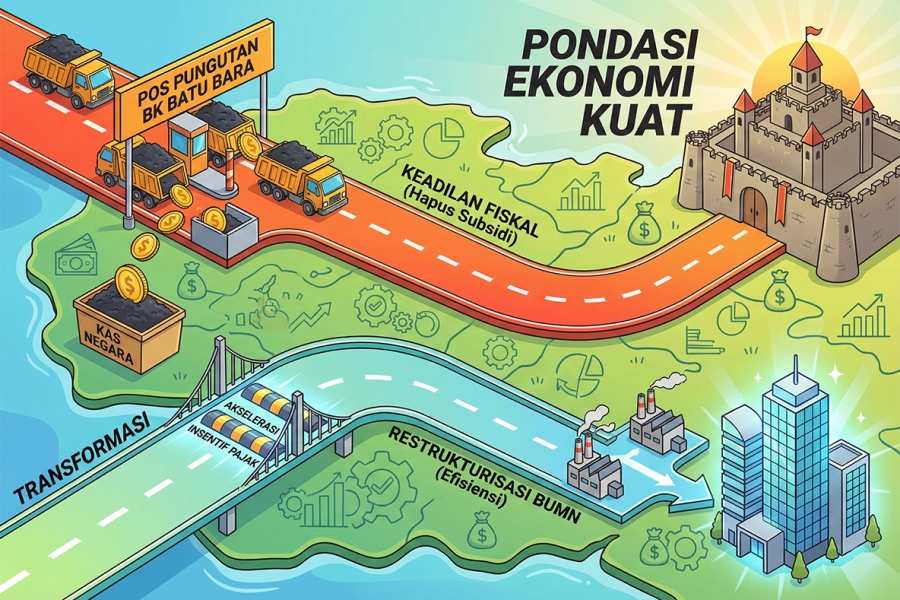
Today's events have crucial implications for three policy pillars: investment, stability, and fiscal affairs. The formation of the Debottlenecking Task Force by Purbaya promises efficiency in investment permits and realization, which is a key engine of growth. The LNSW's move to counter illegal imports strengthens trade integrity and protects domestic industry from unfair competition. On the other hand, the need to accelerate state spending at the beginning of 2026 shows an urgency to maintain economic momentum and achieve revenue targets. However, the APDESI criticism highlights the need for improvement in the Village Fund disbursement mechanism so that fiscal policy can be quickly accessed by disaster-affected communities. Finally, BI's crisis immunity formula confirms the monetary authority's commitment to maintaining stability amid global uncertainty.
Overall, Indonesia's economic authorities are designing both offensive and defensive measures ahead of 2026. The Government is focusing on accelerating investment through the Debottlenecking Task Force and securing trade via LNSW, as well as expediting state spending early in the year. Meanwhile, BI is introducing a stability formula to make the economy crisis-proof. Nevertheless, bureaucratic challenges, such as the slow disbursement of the Village Fund, remain a bottleneck that must be resolved immediately so that the benefits of fiscal policy can be felt evenly and quickly.














 tpc.consulting
  tpc.consulting
  info@taxindo.co.id