


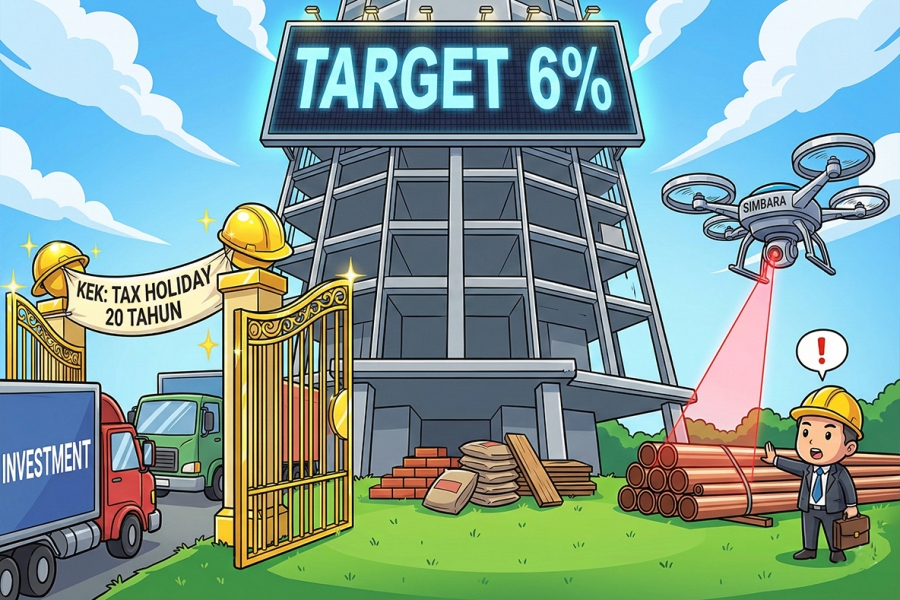
As the national economic debate intensifies, the discussion focuses on the realism of growth targets, investment policies, and commodity oversight under the new administration. The Finance Minister is facing criticism that the ambition for 6% growth is difficult to achieve because fiscal space is narrowing and the private sector is not aggressively expanding. Meanwhile, the Indonesian economy is projected to grow only 4.9%–5.1% in 2026 amidst five economic pitfalls. To attract investment, the government is offering tax incentives (tax holidays) of up to 20 years in Special Economic Zones (SEZs). On the other hand, the business community is requesting a transition period after copper oversight is tightened through the SIMBARA system.
The Indonesian economy is projected to grow only 4.9% to 5.1%; this is based on the existence of five "economic pitfalls" that pose serious challenges for the new administration. Analysis suggests that the Finance Minister's dream of achieving 6% economic growth is deemed unrealistic, due to narrow fiscal space and the private sector tending to hold back investment expansion.
In response, the government revealed that investments in Special Economic Zones (SEZs) can obtain a tax holiday of up to 20 years. This facility aims to attract large capital and encourage regional growth. Furthermore, Minister AHY expressed support for achieving the 8% economic growth target, where the focus of his strategy is to build targeted infrastructure to increase connectivity and productivity.
On the oversight side, copper supervision is being tightened through its integration into the SIMBARA system. Business owners responded to this measure by requesting a transition period so they can adapt to the new reporting and governance system, underscoring the need for planned and gradual policy implementation.
The latest update has crucial implications for economic projections and sectoral policy. The critical analysis that 6% growth is unrealistic implies the necessity of revising ambitious targets and focusing on fundamentals amid narrow fiscal space. The existence of five economic pitfalls and the 4.9%–5.1% growth projection signals structural challenges that must be overcome. Conversely, the tax incentives of up to 20 years in SEZs imply a potential increase in direct investment, while the request for a transition period from copper business owners highlights the need for communication and phased implementation in tightening commodity oversight.
In short, the new administration is facing the reality of projected growth that is tending to be moderate (4.9%–5.1% in 2026), where this challenge is exacerbated by fiscal limitations and private sector caution. The government is responding with a pro-investment strategy, such as the 20-year tax incentive in SEZs, and AHY's focus on infrastructure. However, the tightening of copper commodity oversight demands that authorities provide adaptation room to businesses to ensure the smooth flow of investment in the upstream sector.


















 tpc.consulting
  tpc.consulting
  info@taxindo.co.id