


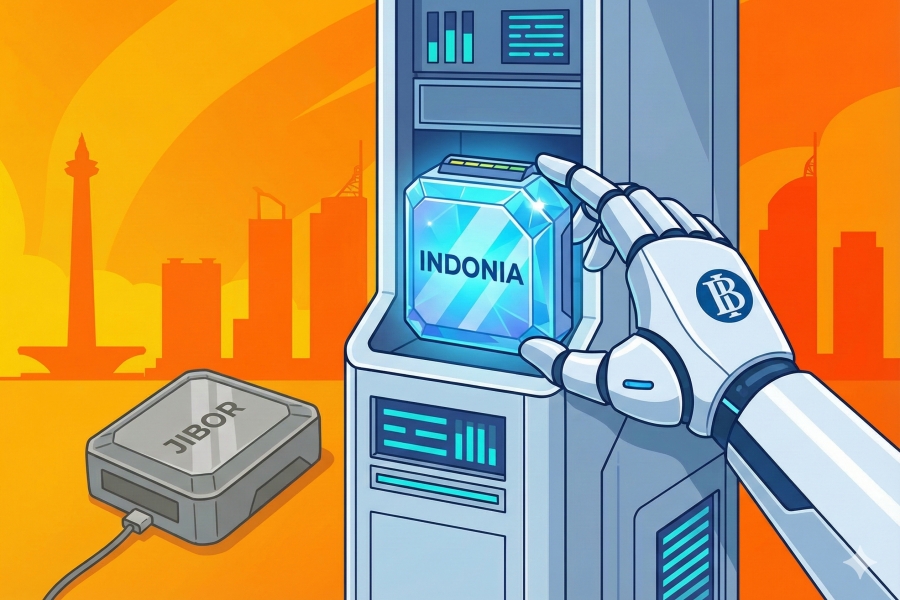
Bank Indonesia officially replaces JIBOR with INDONIA starting January 1, 2026, to create a more transparent and credible money market. This strategic move aligns the national financial system with global standards to prevent interest rate manipulation risks like the LIBOR case. Market participants are now fully shifting to a real transaction-based benchmark that ensures more effective monetary policy transmission.
A new era for the domestic money market is imminent following Bank Indonesia's decisive decision to abolish the Jakarta Interbank Offered Rate (JIBOR). The monetary regulator has established the Indonesia Overnight Index Average (INDONIA) as the sole rupiah interest rate benchmark starting January 1, 2026, for all tenors. This fundamental change aims to create a funding ecosystem that is far more transparent, efficient, and modern, in accordance with international best practices.
The use of INDONIA is considered more objective because it is calculated based on actual transactions (deal done) in the interbank money market, unlike JIBOR which was based solely on offer quotes from a handful of banks. Bank Indonesia ensures that this reform will deepen the domestic financial market while strengthening the credibility of the rupiah interest rate in the eyes of global investors. This new system promises a reflection of true market liquidity conditions without speculative distortions.
This major transformation is not merely a change in instrument names, but Indonesia's strategic response to global dynamics demanding higher financial data integrity.
The transition to INDONIA is a vital part of the global interest rate benchmark reform following the LIBOR manipulation scandal that shook the world in 2012. The old system relying on offer quotes proved to have high vulnerabilities to figure engineering for the benefit of certain banks' balance sheets. As a G20 member, Indonesia is fully committed to adopting the Financial Stability Board's recommendations to abandon such obsolete methods.
INDONIA offers more robust legal certainty as its figures are derived from a volume-weighted average of actual transactions that have occurred, making it impossible to be manipulated by any party. This move aligns Indonesia with developed nations like the United States which has shifted to SOFR and Japan to TONA. Data security and accuracy are the central bank's top priorities to protect the interests of all national economic actors.
The reliability of this new system is supported by mature infrastructure readiness and increasingly solid market participant adaptation approaching the implementation deadline.
Financial industry players have shown a very positive response with a drastic 67.7% drop in JIBOR-based contract values approaching the transition deadline at the end of 2025. Interbank Money Market (PUAB) activity has also recorded brilliant performance with average daily transactions breaching Rp15.4 trillion, reflecting high market confidence in this new mechanism. Bank Indonesia has also prepared Compounded INDONIA to replace long-term tenor functions from 2026 to 2027.
This reform roadmap is designed gradually and carefully, where the full implementation of the Overnight Index Swap (OIS) is scheduled to operate in 2028. The Financial Services Authority (OJK) noted a significant increase in contracts that already have replacement clauses (fallback rates), signaling prime banking legality readiness. Close collaboration between regulators and market participants is the key to the success of this decade's largest financial system migration.
The application of a real transaction-based benchmark brings fresh air to business certainty because the transmission of monetary policy to credit and deposit interest rates becomes faster and more accurate. Foreign and domestic investors will enjoy a fairer investment climate (fair play) thanks to the elimination of price manipulation risks that have long haunted global markets. This stability has the potential to lower the cost of funds, which in turn can lighten the interest burden for the real sector, corporations, and the wider public in accessing financing.
This total reform proves Indonesia's strong commitment to building a financial ecosystem with high integrity, modernity, and parity with developed nation standards. Business and banking players must immediately complete the adjustment of old contract clauses (fallback clauses) and update internal systems before the deadline ends to ensure smooth business operations in the coming year.
















 tpc.consulting
  tpc.consulting
  info@taxindo.co.id