This period highlights the government's focus on improving institutional governance and fiscal supervision, mainly to maintain public trust and state revenue. Concurrently, concerns arise regarding the potential increase in regional taxes due to cuts in regional transfer funds, as well as the sensitive issue of tax imposition on severance pay for layoffs. This summary reviews the government's efforts to build a stronger economic foundation amid the weakening of public purchasing power.
Economists emphasize that the government needs to build trust and improve institutional governance before undertaking greater economic expansion. This fundamental improvement is considered a key prerequisite for ensuring the effectiveness of fiscal policies and fostering sustainable growth, especially alongside pressure on the domestic sector. The Consumer Confidence Index (CCI) is predicted to continue its decline, reflecting the public's cautious stance in spending. This drop in the CCI indicates a weakening of purchasing power and consumption, which directly impacts the pace of national economic growth.
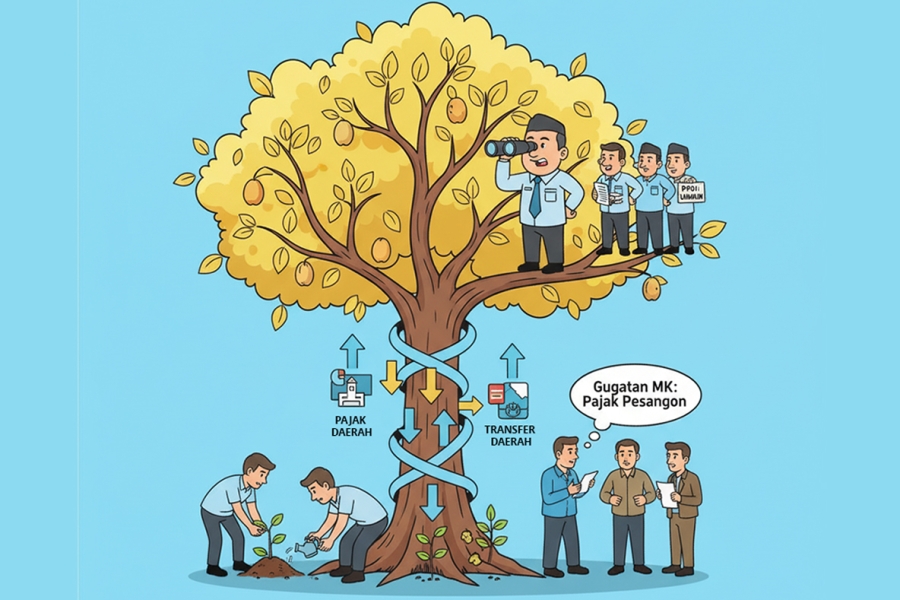
On the other hand, fiscal policies present potential risks and demands for strict supervision. The central government's cut in regional transfer funds is assessed to potentially trigger a tax increase by local governments (Pemda). Pemda will likely take this step to close budget deficits and seek alternative funding sources. In line with supervision, Coordinating Minister for Economic Affairs Airlangga Hartarto warns businesses against practicing "facture arisan" (tax invoice fraud) or other schemes to manipulate the 0.5% Final Income Tax (PPh) for MSMEs, asserting the government's commitment to maintaining the integrity of fiscal incentives.
Meanwhile, the issue of social justice in taxation has become a matter of public and legal concern. Two workers sue the tax imposition on severance pay for Layoffs (PHK) at the Constitutional Court (MK). The lawsuit reflects public objection to the policy, arguing that taxing severance pay may reduce the rights of workers facing economic hardship after being laid off. This issue reiterates the call for the government to improve institutional governance so that tax policies can be implemented fairly and transparently.
There is a dual pressure on fiscal and economic authorities. On one hand, cuts to regional transfer funds potentially trigger regional tax hikes, which could burden local communities and businesses, especially when combined with a falling CCI. On the other hand, the central government, through Minister Airlangga, tightens supervision of the Final PPh for MSMEs to prevent revenue leakage. Concurrently, the severance tax lawsuit at the Constitutional Court becomes a focal point of social justice within the taxation system, demanding that the government review policies affecting workers. All these challenges reinforce the economists' urgency that the government prioritize institutional governance reform as the foundation for sustainable economic expansion.
The dynamics of October 08, 2025, indicate that economic challenges are not only macro (weakening CCI) but also micro and regulatory (regional tax and Final PPh for MSMEs). The current priority of the government is to build public trust and improve governance as a soft landing effort for the economy. Businesses and local governments need to heed the warning about MSME PPh fraud and the potential for regional tax hikes, while the Constitutional Court's decision regarding the severance tax will be a crucial determinant of social justice in taxation.



















 tpc.consulting
  tpc.consulting
  info@taxindo.co.id