


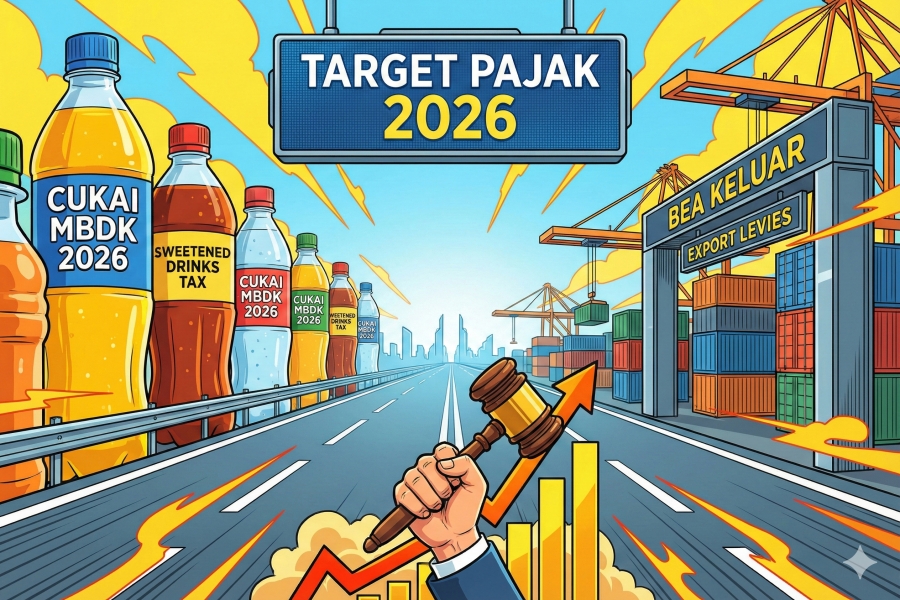
President Prabowo Subianto officially enacted the 2026 State Budget with a tax revenue target of Rp2,693.7 trillion covering new excise extensification. The government detailed revenue posts ranging from Income Tax, VAT, to export and import duties to support expansive state spending. This fiscal strategy is executed by Finance Minister Purbaya Yudhi Sadewa amidst the challenge of closing the budget deficit.
President Prabowo Subianto officially signed Law Number 17 of 2025 concerning the 2026 State Revenue and Expenditure Budget (APBN) which sets a state revenue target of Rp3,153.6 trillion. The government allocated a jumbo state expenditure worth Rp3,842.7 trillion, forcing Finance Minister Purbaya Yudhi Sadewa to work hard to close the deficit gap of Rp689.1 trillion or 2.68 percent of the Gross Domestic Product (GDP).
A prudent debt financing strategy worth Rp832.2 trillion and the use of the Accumulated Budget Balance (SAL) are prepared by the government as a fiscal cushion if targets are missed along the way to maintain economic stability.
The backbone of state revenue this year relies on domestic taxes pegged at Rp2,601.2 trillion with very specific and extensive post details.
Income Tax (PPh) becomes the largest contributor with a deposit target worth Rp1,209.3 trillion, followed by Value Added Tax (VAT/PPN) and Sales Tax on Luxury Goods (PPnBM) reaching the figure of Rp995.2 trillion, as well as Land and Building Tax (PBB) worth Rp26.1 trillion.
The government aggressively targets excise revenue of Rp243.5 trillion which not only targets tobacco products, alcohol, and ethanol, but also officially covers levies on sweetened packaged beverages. In addition, other tax revenue posts are projected to contribute Rp126.93 trillion to the state treasury to strengthen the APBN structure.
The government is also optimizing international trade tax revenue posts targeted to reach Rp92.4 trillion as mandated in article 4 paragraph (8) of the law. This figure consists of an import duty target of Rp49.9 trillion and export duties worth Rp42.5 trillion which will be collected from leading commodity export activities.
These highly detailed and comprehensive target details were compiled by the government as a strategic response to the evaluation of the previous year's performance to ensure every potential revenue gap, both domestic and cross-border, can be exploited optimally.
The setting of these detailed tax targets provides a real warning signal for industry players, especially food and beverage producers as well as exporters-importers who now face a new cost structure. Corporate and individual taxpayers need to immediately improve administrative compliance and asset reporting, considering the government will pursue every revenue potential from upstream to downstream aggressively and structurally.
The government shows great ambition in the 2026 State Budget to finance development, but its success depends heavily on the realization of challenging tax deposits amidst global economic dynamics.

















 tpc.consulting
  tpc.consulting
  info@taxindo.co.id