


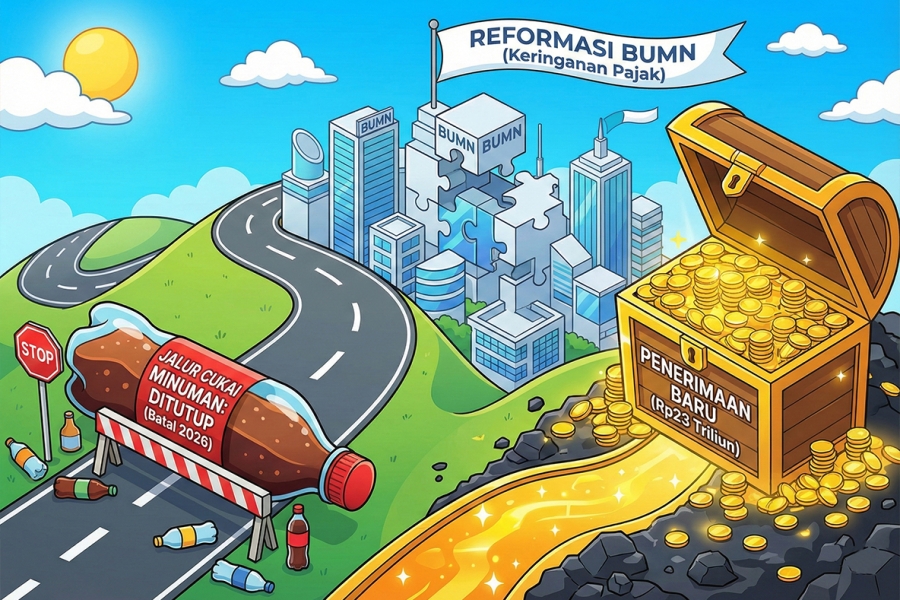
The latest fiscal policy highlights the Finance Minister's steps to strengthen revenue through commodity taxes while simultaneously providing restructuring incentives for State-Owned Enterprises (BUMN). The Minister cancelled the planned implementation of the excise duty on sweetened beverages (MBDK), which was set to take effect in 2026, but assured the imposition of Export Duty on coal and gold with a target potential revenue reaching Rp23 trillion. As part of the reform strategy, the Minister is also preparing tax relief facilities for BUMN corporate actions for up to three years, reflecting a balance between protecting purchasing power and optimizing state revenue.
The Finance Minister decided to cancel the implementation of the excise duty on packaged sweetened beverages (MBDK), which was originally scheduled to take effect starting 2026. This cancellation was made considering public purchasing power and the economic situation. Although the potential revenue from this excise is lost, the Minister is targeting a potential revenue of Rp23 trillion from the imposition of Export Duty (BK) on gold and coal.
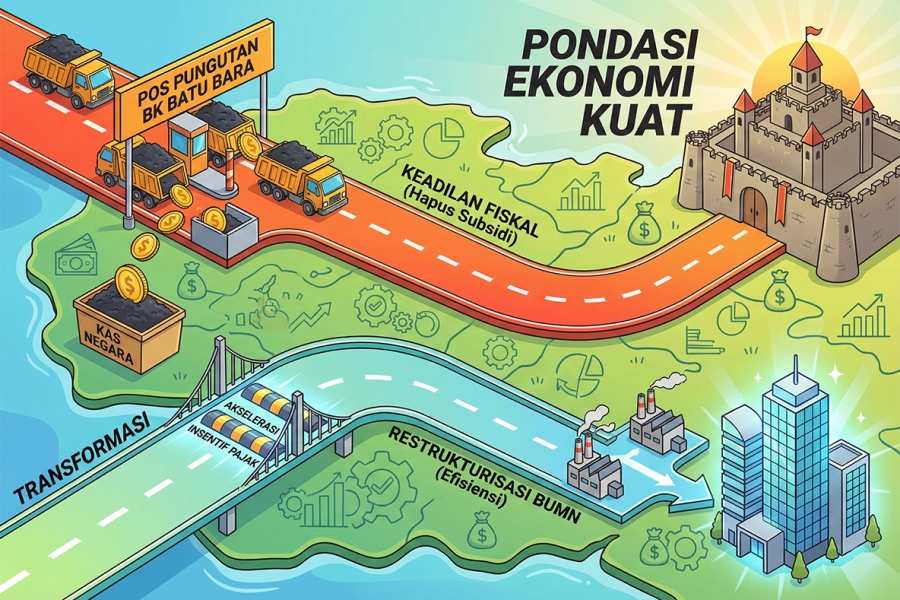
Regarding commodity revenue, coal is confirmed to be subject to an Export Duty (BK) with a maximum tariff of 5% that will be effective starting 2026. This decision aims to create fiscal justice and reduce subsidies for coal entrepreneurs. Not only Export Duty, the Minister will also tighten inspection of commodity exports. This tightening measure aims to prevent under-invoicing practices and state revenue leakage.
On the other hand, to encourage the consolidation and efficiency of State-Owned Enterprises (BUMN), the Finance Minister granted tax relief for BUMN corporate actions (such as mergers and acquisitions) that will be valid for the next 3 years. This incentive is expected to drive BUMN consolidation and efficiency as part of national corporate reform.
Today's decision has significant implications for state revenue and the business climate. The cancellation of the sweetened beverage excise implies protection for public purchasing power, but eliminates previously planned potential revenue. Conversely, the imposition of BK on gold and coal with a Rp23 trillion target indicates a large potential for extra-revenue starting 2026, supported by tighter export inspections to minimize leakage. Furthermore, the 3-year tax relief for BUMN corporate actions provides a strong catalyst for BUMN transformation, demonstrating the government's focus on corporate efficiency as part of a long-term economic strategy.
Overall, the Finance Minister is executing a pragmatic and strategic fiscal policy: sacrificing the potential MBDK excise revenue to safeguard purchasing power, while aggressively seeking new revenue from the Export Duty on gold and coal commodities with a Rp23 trillion target. At the same time, the provision of tax relief for BUMN corporate actions affirms the government's commitment to BUMN reform. This dual focus aims to maintain fiscal stability while encouraging national corporate efficiency heading into 2026.













 tpc.consulting
  tpc.consulting
  info@taxindo.co.id