



The Indonesian economy is once again highlighting institutional reform agendas, monetary liquidity, and long-term growth prospects. The push for Customs reform is intensifying following the discovery of underinvoicing practices that erode state revenue. Concurrently, the government is pressuring the central bank (Bank Indonesia - BI) to loosen liquidity to spur growth, despite credit demand remaining subdued. The current focus includes the urgency of Customs overhaul, the direction of monetary-fiscal policy, and the government's strategy to pursue ambitious growth targets through stronger international cooperation.
The Indonesian Government is currently striving to accelerate economic recovery by pushing for fiscal-monetary policy synergy. Finance Minister Purbaya openly requested Bank Indonesia (BI) to reduce market liquidity absorption. This request aims for funds to flow into the real sector and stimulate credit growth which has been sluggish. However, Economists assess that BI's liquidity loosening will not significantly move the economy if credit demand in banking remains low and aggregate demand from the real sector does not increase.
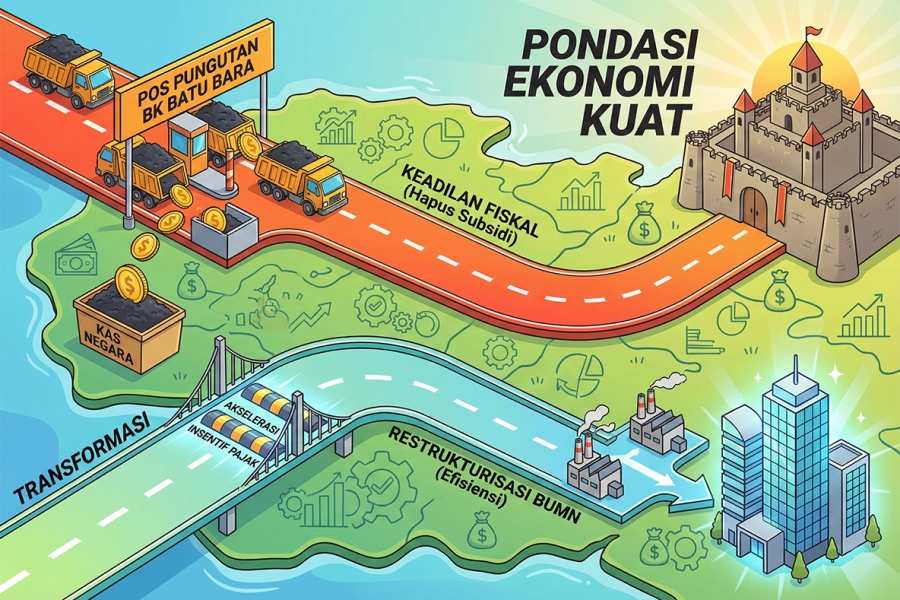
Amidst stimulus efforts, the House of Representatives (DPR) highlighted that Indonesia's economic foundation is not yet evenly distributed despite being deemed strong macroeconomically, where non-inclusive growth hampers welfare improvement. To achieve the ambitious 8% economic growth target and strengthen the foundation, Indonesia is collaborating with China to strengthen cooperation in the industrial and investment sectors, which aims to attract foreign capital and develop the national manufacturing sector.
In parallel, Economists asserted that the reform of the Directorate General of Customs and Excise (DJBC) cannot be postponed following the uncovering of underinvoicing practices that harm state revenue. This illegal practice hinders healthy business competition and threatens fiscal health, thus reinforcing the call for a total overhaul of customs governance.
The direction of current policies and findings has crucial implications for monetary stability and the business climate. The Finance Minister's request to BI to reduce liquidity absorption indicates a need for closer fiscal-monetary policy synergy. However, this liquidity loosening is potentially minimal in impact if credit demand from the business world does not recover. Meanwhile, underinvoicing practices and the urgency of Customs reform pose risks to state revenue and trade integrity, which, if not addressed immediately, will reduce the competitiveness of domestic products. At the macro level, economic unevenness emphasizes the government's challenge in creating inclusive growth, though cooperation with China is expected to provide a significant investment boost to meet the ambitious 8% target.
Overall, today's news shows that Indonesia's fiscal and economic authorities are at a crossroads, where institutional reform (Customs) is a prerequisite for equitable growth, and monetary-fiscal policy synergy is key to mobilizing the economy with weak credit demand. The government must respond to the urgency of Customs reform to secure revenue and create business fairness, while ensuring that cooperation with China can bridge the investment gap without exacerbating the economic unevenness highlighted by the DPR.
















 tpc.consulting
  tpc.consulting
  info@taxindo.co.id