


In the global taxation ecosystem, the issue of Transfer Pricing becomes a crucial point for Multinational Enterprises (MNEs) and tax authorities. For Indonesia, as a G20 member country, balancing the interests of securing the domestic tax base with international standards is a top priority.
The implementation of transfer pricing in Indonesia does not stand in a vacuum but is strictly regulated through a hierarchy of legislation that grants authority to the Directorate General of Taxes (DGT) to test Taxpayer compliance.
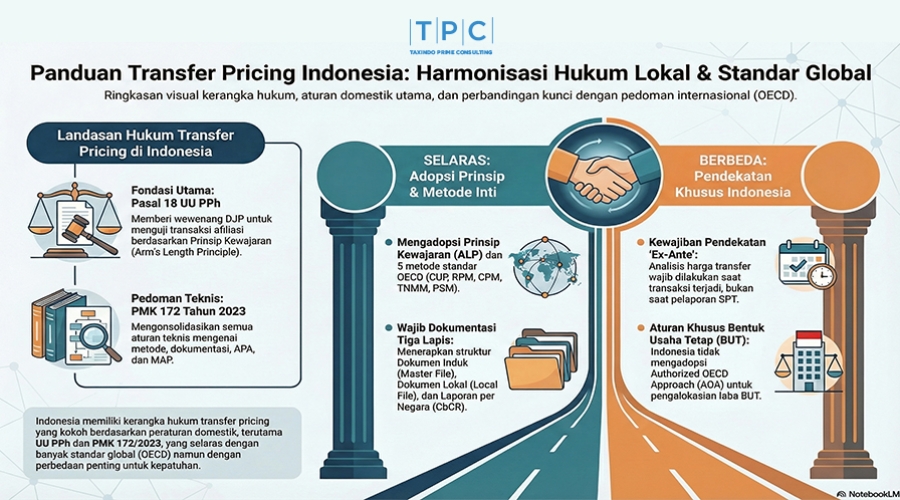
The main foundation of transfer pricing rules in Indonesia is contained in Article 18 paragraph (3) of the Income Tax Law. This article grants authority to the Director General of Taxes to re-determine the amount of income and deductions and to determine debt as equity to calculate the amount of Taxable Income for Taxpayers who have a special relationship. This re-determination must be in accordance with the Principle of Fairness and Business Prevalence (PKKU) or the Arm’s Length Principle (ALP).
Additionally, Article 18 paragraph (4) of the Income Tax Law defines what is meant by "special relationship". This relationship is considered to exist if there is capital participation of at least 25%, the existence of control (management or technology), or a family relationship by blood/marriage. This definition is very broad and covers substantial control beyond formal share ownership.
At the end of 2023, the government issued PMK 172/2023 which consolidated various previous transfer pricing rules (such as PMK 213/2016, PMK 49/2019, and PMK 22/2020). This regulation serves as the current main technical guideline governing:
Although Indonesia has domestic rules, transfer pricing practices are cross-border, thus requiring a "common language" with tax authorities of other countries.
OECD TP Guidelines are an international consensus that serves as the main reference for OECD and G20 member countries. These guidelines provide technical guidance regarding the application of the fairness principle, transfer pricing methods, comparability analysis, to documentation. Although Indonesia is not an OECD member, as a member of the Inclusive Framework on BEPS, Indonesia adopts many principles in these guidelines.
For developing countries like Indonesia, the UN Manual often becomes an important complementary reference. This manual provides more practical guidance and considers the realities and limitations of tax administration capacity in developing countries, which may differ from developed countries.
The relationship between Indonesian domestic regulations and OECD Guidelines is dynamic. The following is an analysis of Indonesia's position based on the OECD Transfer Pricing Country Profile - Indonesia (2025) and domestic regulations:
Legally, the OECD Transfer Pricing Guidelines do not have binding legal force in Indonesia. Domestic regulations (such as PMK 172/2023) hold the highest supremacy. However, OECD Guidelines are used as an additional interpretation tool or supplementary guide, especially in situations where domestic rules do not regulate specifically. If a conflict occurs, domestic rules prevail.
Indonesia fully adopts the Arm's Length Principle (ALP) as defined in Article 9 of the OECD Model Tax Convention. Article 3 of PMK 172/2023 requires Taxpayers to apply this principle by comparing the conditions and price indicators of affiliated transactions with comparable independent transactions.
Indonesia recognizes five standard OECD methods plus other methods such as asset valuation (valuation). Indonesia applies the principle of "Most Appropriate Method". Specific preferences:
Indonesia adopts a three-tiered approach (three-tiered approach):
This is an area where Indonesia does not follow the OECD approach fully. Indonesia does not adopt the AOA (Authorized OECD Approach) in most of its tax treaties. Indonesia uses an asset attribution approach and the force of attraction principle.
Indonesia has aligned most of its transfer pricing legal framework with global standards (OECD), particularly regarding pricing methods and documentation structure (BEPS Action 13). However, Taxpayers must be aware of stricter domestic nuances, especially the obligation to apply the fairness principle on an ex-ante basis (before the transaction) and the rejection of the AOA approach for Permanent Establishments. Compliance with PMK 172/2023 is absolute, while OECD Guidelines serve as vital supporting references in an international context.
Is My Company Required to Create a Transfer Pricing Document?


 tpc.consulting
  tpc.consulting
  info@taxindo.co.id