



PTAB has achieved an important victory in its pursuit of substantive justice in the field of taxation, as reflected in the Tax Court’s Decision Number PUT-000664.99/2025/PP/M.IXA of 2025. The case centered on the issuance of a VAT Tax Collection Letter (STP) for the December 2022 tax period, which imposed administrative sanctions amounting to Rp 44,171,107 due to alleged late issuance of Tax Invoices. The Director General of Taxes (DJP) adopted a firm and formalistic stance in defending the rejection of PTAB’s request for administrative sanction relief. DJP’s main arguments relied on strict adherence to the formal legal provisions of the General Tax Provisions and Procedures Law (UU KUP).
First, DJP asserted that the basis for issuing the STP was valid, as it had been established that the taxpayer did not issue tax invoices for taxable service transactions. Pursuant to Article 14(4) of the UU KUP, the absence of tax invoices objectively and automatically triggers the imposition of administrative sanctions in the form of a 1% penalty on the Tax Base (DPP). Second, in relation to the request for sanction relief under Article 36 of the UU KUP, DJP argued that the reasons submitted by PTAB—such as technical obstacles and non-PKP (non–VAT-registered) status—did not fall within the narrow definition of “taxpayer’s inadvertence or circumstances beyond the taxpayer’s control.” DJP regarded the sanctions as objective administrative consequences rather than punitive measures requiring intent or fault.
In its lawsuit, PTAB argued that the 1% sanction on the Tax Base should not have been imposed, as the company had not yet been registered as a VATable Entrepreneur (PKP) during the disputed period. Issuing tax invoices while still a Non-PKP would have violated Article 39A of the UU KUP, exposing the company to criminal penalties.
The core of PTAB’s defense emphasized that the delay in issuing invoices did not result from the taxpayer’s negligence, but rather from a series of administrative barriers during the PKP registration process. PTAB also highlighted that no loss to the state occurred, as the services provided (clinical and laboratory services) fall under the category of services exempted from VAT (0% rate) under the Tax Regulation Harmonization Law (UU HPP). PTAB maintained that these circumstances fully satisfied the criteria for sanction relief under Article 36(1)(a) of the UU KUP, as the situation was entirely beyond the taxpayer’s control.
Taking a different approach from DJP’s formalistic insistence, the Tax Court Panel of Judges thoroughly examined issues of fairness and factual realities. The Panel concluded that PTAB’s decision not to issue tax invoices while still holding Non-PKP status was reasonable, factually supported, and demonstrated prudence in avoiding potential criminal liability. The Court firmly held that DJP’s rejection of the sanction relief request was inappropriate and constituted a misapplication of the law, as it failed to properly consider principles of fairness and propriety.
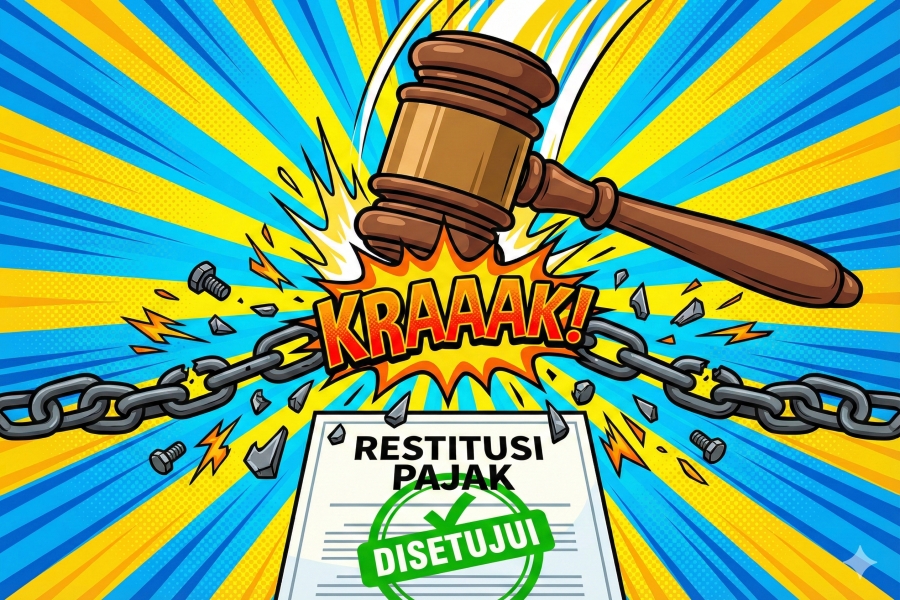
Based on these considerations, the Tax Court granted PTAB’s lawsuit in full, annulled the STP’s administrative sanction component, and removed the Rp 44,171,107 penalty entirely. This victory serves as a significant reminder that the Tax Court functions as a corrective institution, ensuring that the tax authority’s discretionary powers are exercised proportionally and that tax law remains grounded in substantive justice. It also reinforces our commitment to operating in full compliance with the law while safeguarding taxpayer rights.
A Comprehensive Analysis and the Tax Court Decision on This Dispute Are Available Here

















 tpc.consulting
  tpc.consulting
  info@taxindo.co.id