



A substantial failure to demonstrate the reconciliation between cost accounts in the General Ledger and the Income Tax Article 23 (PPh Article 23) withholding obligation directly implies the reinforcement of tax corrections by the authority. The dispute experienced by PT KMHI (formerly known as PT MHEDI) is a classic case study on equalization risk. The tax authority (DJP) found a significant discrepancy in several cost accounts, especially Material Consumption Expenses and Purchased Services, indicating that rewards for services had been paid or were payable but the corresponding PPh Article 23 had not been withheld. This led to the PPh Article 23 tax base correction being maintained at Rp. 3,089,390,325.00.
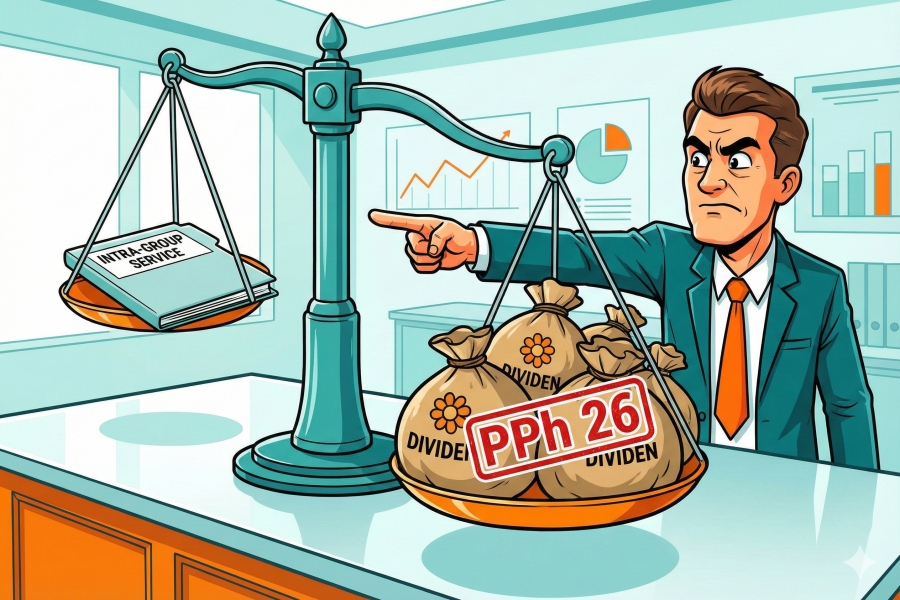
The core conflict in this dispute is the difference in the interpretation of transaction substance and the fulfillment of the withholding obligation. DJP argued that the difference arising from the equalization was an unreported PPh Article 23 object, and that cost accounts such as Material Consumption Expenses specifically contained elements of supporting services (installation, repair, delivery) which fall under the category of other services in PMK-141/PMK.03/2015. Conversely, PT KMHI insisted that most of the corrected accounts were not PPh Article 23 objects, but rather pure purchases of goods or materials, or even Final PPh payments, claiming they had reported PPh Article 23 on the services transactions that were due.
In resolving this dispute, the Tax Court Panel of Judges explicitly applied the principle of Burden of Proof (Onus of Proof). The Panel stated that once the DJP presented data showing potential PPh Article 23 under-withholding from the equalization results, the burden to prove otherwise shifted entirely to PT KMHI. PT KMHI failed to meet this mandate. The withholding slips, invoices, and payment receipts presented were deemed by the Panel to only prove the amount already reported in the PPh Article 23 Periodical Tax Return, not proving the withholding on the difference that was the subject of the correction. The failure to separate the components of goods and services prices, and the absence of a detailed transaction-by-transaction reconciliation, strengthened the DJP's argument.
The Tax Court Decision to reject PT KMHI's Appeal has significant implications for tax compliance practices. The implication of this ruling confirms that PPh Article 23 compliance must be supported by detailed documentation, not just aggregate reporting. Multinational Taxpayers, particularly those with mixed transactions (goods and services) or those performing PPh Body cost equalization with PPh Withholding/Collection, must ensure that every cost item claimed not to be a PPh Article 23 object is supported by strong, defensible evidence at the litigation level. This case serves as a critical reminder of the importance of synchronized accounting and tax documentation.
The conclusion to be drawn is that in PPh Article 23 disputes resulting from equalization, the victory lies in the details of the documentation. Taxpayers are advised to conduct internal reconciliation regularly and ensure that contracts and invoices explicitly separate the Service Tax Base (PPh 23 object) from the material/goods price (non-PPh 23 object) to minimize the risk of future disputes.
A Comprehensive Analysis and the Tax Court Decision on This Dispute Are Available Here


















 tpc.consulting
  tpc.consulting
  info@taxindo.co.id