


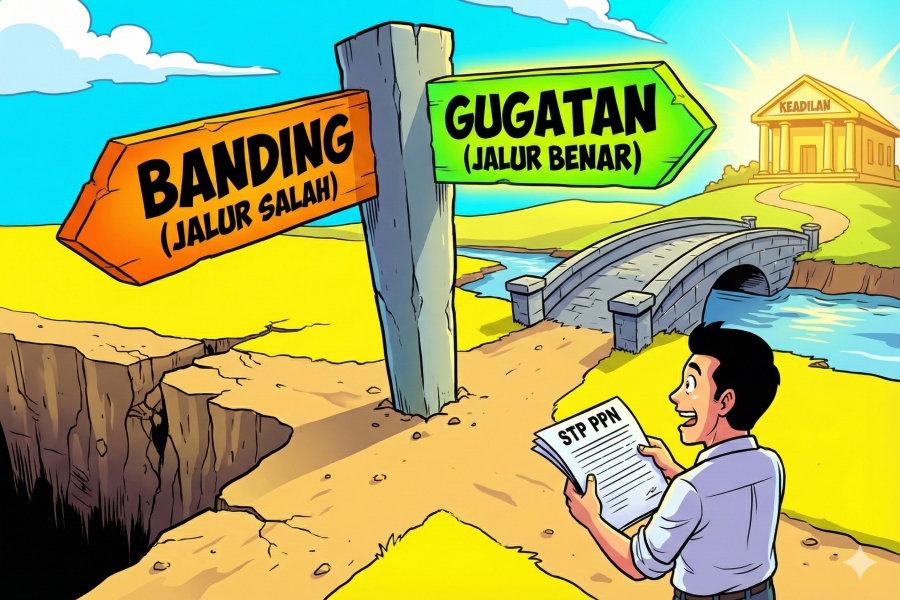
The Directorate General of Taxes' decision rejecting the application for administrative penalty abatement for CV MCA is strictly classified as an object of Lawsuit (Gugatan), not an Appeal (Banding),in accordance with Article 23 paragraph (2) letter c of the General Provisions and Tax Procedures Law (UU KUP). This fundamental point was central to this Tax Court Decision, which led the panel of judges to declare CV MCA's appeal inadmissible (Niet Ontvankelijke Verklaard).
This case originated from CV MCA's legal challenge against the Tax Authority's Decision Number KEP-02475/NKEB/PJ/WPJ.14/2023, which denied their request to waive the administrative penalties stipulated in the Value Added Tax (VAT) Tax Collection Letter (STP) for the December 2022 tax period. In exercising its rights, CV MCA chose the Appeal mechanism to bring the dispute before the Tax Court. This choice was based on the mistaken assumption that every final decision from the Directorate General of Taxes (DJP) is subject to an Appeal.
The core conflict in this case does not lie in the material reasons why CV MCA requested the penalty abatement (negligence or not their fault), but rather in the incorrect selection of the legal gateway. The panel of judges did not need to examine the substance because, procedurally, the case was formally flawed. The Panel referred to the provisions that specifically regulate the object of disputes at the Tax Court. Article 27 paragraph (1) of the Tax Procedures Law restrictively states that an Appeal can only be lodged against a Decision on Objection concerning a Tax Assessment Letter or third-party Withholding/Collection.
The legal resolution provided by the Panel of Judges is clear and definitive. A DJP Decision regarding the reduction, abatement, or cancellation of administrative penalties is a type of administrative decision related to the implementation of non-Tax Assessment Letters. This type of decision, according to Article 23 paragraph (2) letter c of the UU KUP, must explicitly be resolved through the Lawsuit (Gugatan) mechanism. Since CV MCA lodged an Appeal against an object that should have been challenged as a Lawsuit, the Panel lacked jurisdiction to proceed with the material examination and declared the Appeal inadmissible.
The implications of this decision for tax practice are highly significant. This ruling serves as a strong precedent, reminding Taxpayers and tax legal practitioners of the crucial need for precise understanding regarding the classification of the dispute's object. The consequence of a formal error like this is a loss of time and resources expended during the Appeal process, as well as the risk of missing the deadline to file the correct legal action (Lawsuit). Taxpayers are strictly mandated to ensure that the chosen legal remedy aligns perfectly with the type of DGT Decision issued. The failure to distinguish between an Appeal and a Lawsuit is equivalent to voluntarily closing the door to justice.
A Comprehensive Analysis and the Tax Court Decision on This Dispute Are Available Here.


















 tpc.consulting
  tpc.consulting
  info@taxindo.co.id