



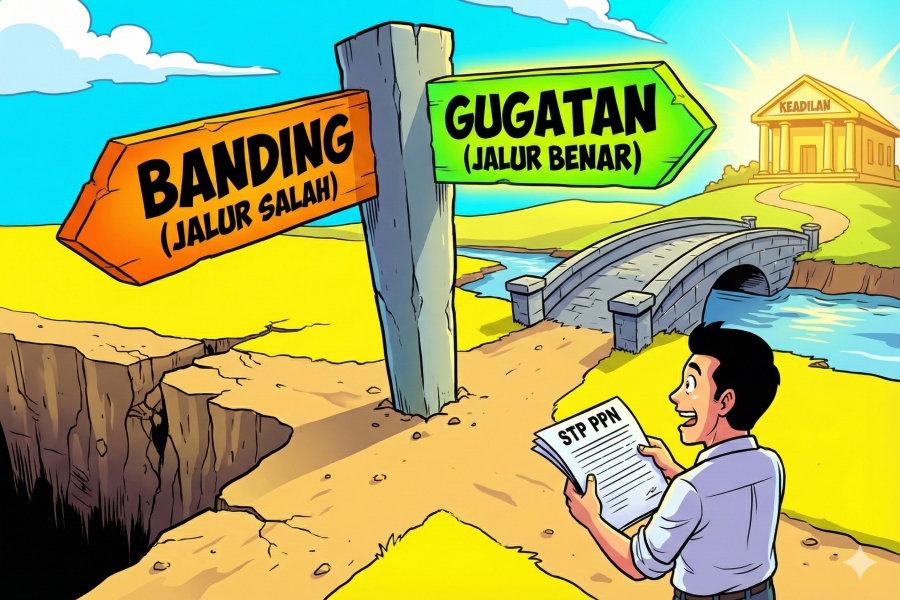
The Tax Court reaffirmed a fundamental principle in tax procedural law through Decision Number PUT-001567.99/2022/PP/M.IVB of 2025, which brought PT UMP as the Plaintiff against the Director General of Taxes as the Defendant. This dispute centers on the Plaintiff's attempt to revoke the Seizure Order (SPMP) Number SIT.PBB.MAN-001/WPJ.32/KP.0604/2022 dated February 2, 2022, issued by the Surakarta Tax Office as a follow-up to the collection of arrears in Land and Building Tax (PBB) for the 2014 Tax Year. This case sets an important precedent highlighting that compliance with formal administrative aspects is as crucial as material arguments in tax disputes, where procedural negligence can invalidate a taxpayer's rights even if there are seemingly strong legal arguments.
During the trial, the Plaintiff built its legal argument based on the chronology of objections that had been filed since July 23, 2014. The Plaintiff argued that because the Director General of Taxes did not issue any decision letter for more than 86 months after the request was submitted, in accordance with the provisions of Article 16 paragraph (5) of the PBB Law and Article 26 paragraph (1) in conjunction with paragraph (5) of the KUP Law, the objection must be considered granted by law. Assuming that the objection is accepted, the Plaintiff believes that the tax calculation should revert to the Taxpayer's independent calculation, which has been paid in full in the amount of IDR 71,334,000, so that the tax debt that is the basis for the seizure is considered nil or non-existent. Based on this logic, the Plaintiff considers the Defendant's seizure of assets worth IDR 1.9 billion to be unfounded and unlawful.
However, the Director General of Taxes, as the Defendant, successfully refuted the argument of “granted by law” by revealing facts regarding formal defects in the initial objection submission process. The Defendant proved that the objection letter submitted by the Plaintiff in 2014 did not meet the formal requirements as stipulated in Article 4 paragraph (1) letter d of the Director General of Taxes Regulation Number PER-25/PJ/2009, namely the absence of the original SPPT or SKP PBB documents. The Defendant emphasized that it had sent a letter of rejection (Letter Number S-672/WPJ.29/KP.0907/2014) one day after the request was received, stating that the request could not be considered. Because the objection was deemed invalid from the outset, the 12-month time limit rule did not apply, and the tax debt in the original decision remained legally binding.
Considering these legal facts, the Tax Court Panel of Judges decided to reject all of the Plaintiff's claims. The Panel was of the opinion that the active collection actions taken by the Defendant, starting from the issuance of the Tax Collection Letter, Warning Letter, Enforcement Letter, to the Seizure Order Letter, were in accordance with the procedures mandated in Law Number 19 of 2000 concerning Tax Collection by Enforcement Letter. This ruling provides a vital lesson for taxpayers that the fulfillment of formal requirements, such as the completeness of document attachments when filing legal actions, is absolute. Failure to fulfill these administrative aspects can result in the loss of taxpayers' rights to obtain material justice, while also providing full legitimacy for the tax authorities to carry out active (executory) collection actions on tax debts whose formal disputes are considered to have been resolved.
A Comprehensive Analysis and the Tax Court Decision on This Dispute Are Available Here


















 tpc.consulting
  tpc.consulting
  info@taxindo.co.id