



The Ministry of Finance issued new regulations targeting banking data and crypto assets to secure the ambitious 2026 tax target. This move was taken after the government faced the challenge of a significant tax revenue shortfall in the 2025 fiscal year. Concurrently, the 2026 State Budget Law officially came into effect with a tax revenue target exceeding Rp2,693 trillion.
Minister of Finance Purbaya Yudhi Sadewa launched a series of new Minister of Finance Regulations (PMK) at the end of 2025 to massively boost tax compliance. These new regulations grant broader authority for tax officials to access taxpayer financial information, ranging from bank accounts to the automatic reporting of crypto assets. The government also strengthened the authority of tax officers to conduct compliance spot checks through physical visits to business locations and established a new work unit specifically handling the Coretax system. These aggressive supervision steps serve as a strategic response to the shadow of revenue shortages that occurred in the previous fiscal year.
Tax revenue realization throughout 2025 is estimated to only reach Rp1,917 trillion or about 87.7 percent of the set APBN target. The Minister of Finance acknowledged this widening shortfall but ensured that the state budget deficit remained safely controlled below the 3 percent threshold of the Gross Domestic Product (GDP). This financial situation forces the fiscal authority to monitor tax collection performance directly and more strictly in the upcoming period to maintain fiscal health. With the evaluation of the 2025 performance, the government officially inaugurated a much higher ambition in the newly published State Budget Law for the 2026 fiscal year.
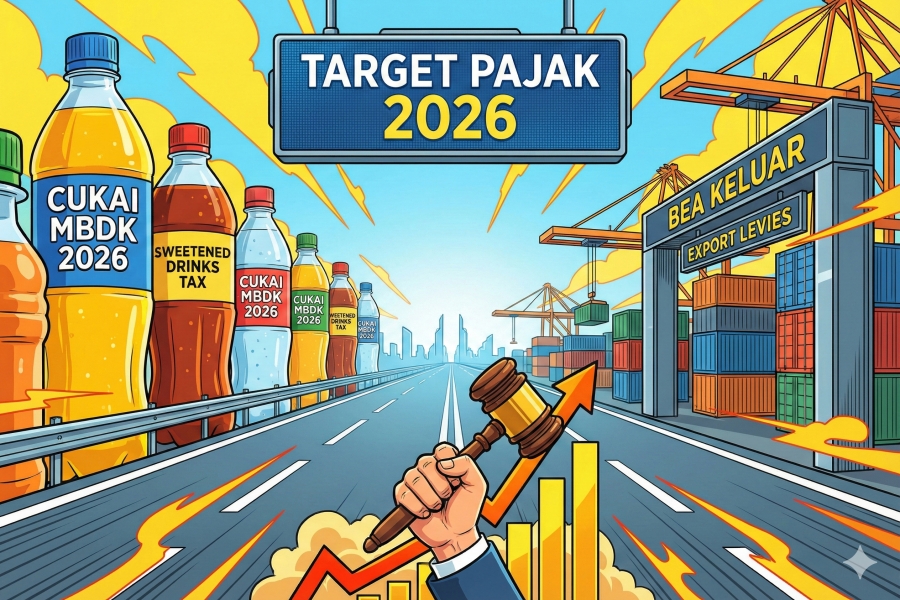
Law Number 17 of 2025 concerning the 2026 State Budget officially sets a tax revenue target at a fantastic value of Rp2,693.7 trillion. President Prabowo Subianto signed this regulation which details state revenue sources, ranging from Income Tax (PPh), VAT (PPN), to the extensification of excise on sweetened packaged beverages. The government also pegged the state spending allocation at Rp3,842.7 trillion with a deficit projection that is disciplined at 2.68 percent.
This regulatory tightening and target increase carry serious implications for business actors and investors to immediately improve asset reporting transparency, especially for digital-based assets like crypto. The general public and entrepreneurs need to anticipate this more intensive supervision by improving tax administration to avoid burdensome audit sanctions. On the other hand, the fiscal discipline shown by the government provides a positive signal for macroeconomic stability which is direly needed for the sustainability of the investment climate in Indonesia.
The government shows high optimism in securing state coffers through regulatory modernization and measurable supervision intensification. Taxpayers should immediately utilize this early year momentum to review their tax compliance and utilize digital Coretax services for business convenience.

















 tpc.consulting
  tpc.consulting
  info@taxindo.co.id