The transformation of Indonesia's tax administration system through the Core Tax Administration System (Coretax) brings fundamental changes to how taxpayers manage their rights and obligations. One aspect undergoing significant modernization is the administration of family taxation or the Family Tax Unit. For married women (wives), understanding their position and options within this new system is crucial to ensure efficient tax compliance and avoid administrative disputes.
This article explores the spectrum of a wife's tax obligations, ranging from the legal philosophical foundations and the choice between joining or separating Taxpayer Identification Numbers (NPWP) to technical fulfillment procedures within the Coretax application.
Philosophical Foundation: The Family as a Single Economic Unit
Before diving into the technicalities of Coretax, we must revisit the basic principle of Indonesian taxation. The income tax system in Indonesia views a family—husband, wife, and minor children—as a single economic entity.
This is explicitly regulated in Article 8 of Law Number 7 of 1983 regarding Income Tax, as amended several times, most recently by Law Number 6 of 2023 (Income Tax Law):
Article 8 paragraph (1) of the Income Tax Law:
"All income or losses for a woman who is married at the beginning of the tax year... shall be considered as the income or losses of her husband, except for income purely received or obtained from one employer that has been taxed under the provisions of Article 21 and such work has no connection with the business or independent profession of the husband or other family members."
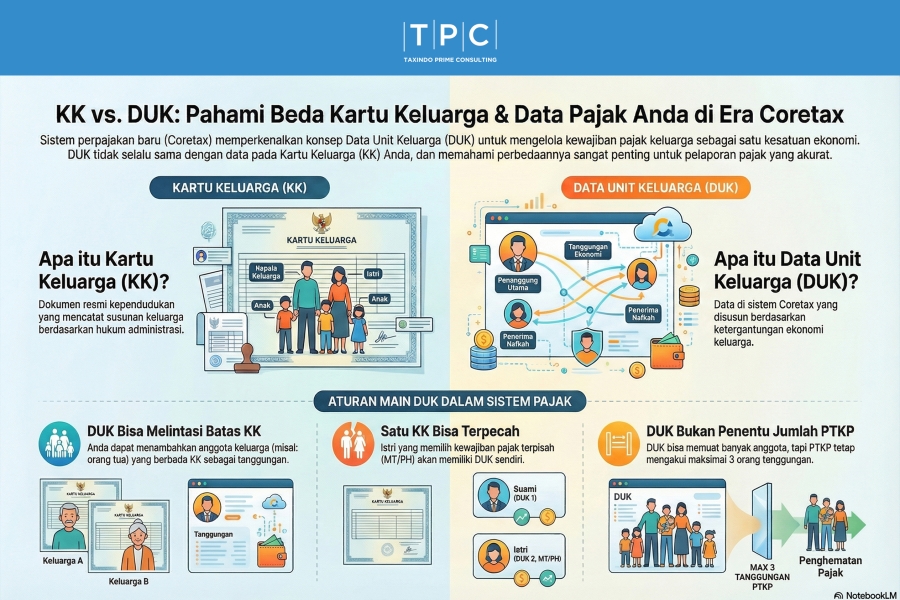
In the Coretax ecosystem, this principle is translated into the Family Data Unit (Data Unit Keluarga or DUK) feature. The DUK is a data repository that links all family members into a single tax profile managed by the Head of the Household (Husband).
Scenario 1: Joined Status (KK) – The Simplest Choice
The default scenario and the one most recommended by the Directorate General of Taxes (DGT) for administrative efficiency is the integration of the wife’s tax rights and obligations with the husband’s (Status KK).
Implications in Coretax:
- Single Identity: The wife does not need an active Coretax account for filing. Her National Identification Number (NIK) is simply registered under the husband’s Coretax account in the DUK menu with the status "Dependent."
- Reporting Obligation: The wife does not need to file a separate Annual Tax Return (SPT). All reporting is handled by the husband.
- Income Treatment:
- Employees: If the wife works for a single employer and has no other business, her income is treated as final. The husband simply reports the wife's net income and the withheld Article 21 Tax in the "Income Subject to Final Tax" section of his SPT. This prevents the husband's tax calculation from resulting in an "Underpayment" due to the merger of salaries.
- Business/Profession: If the wife owns a business or practices a profession (e.g., doctor, notary), her income is combined with the husband’s and recalculated using progressive rates under Article 17 of the Income Tax Law in the husband's SPT.
Scenario 2: Separate Status (PH and MT) – Proportional Consequences
Although the primary principle is unity, Article 8 paragraph (2) and Coretax regulations accommodate conditions where a wife’s taxes are calculated separately:
- Separate Wealth (PH): The husband and wife have a written agreement to separate their wealth and income.
- Choosing Separate (MT): The wife chooses to exercise her own tax rights and obligations even without a prenuptial wealth separation agreement.
Implications in Coretax:
In PH or MT conditions, the wife is treated as a standalone Individual Taxpayer.
- Independent Account: The wife must have her own Coretax account, and her NIK must be activated as an NPWP.
- DUK Administration: In the husband’s account, the wife’s data must still exist in the DUK, but her status is changed to "Head of Other Tax Unit - MT/PH." This signals to the system that the wife will file her own SPT.
- Proportional Tax Calculation: This is the most complex part. Although they file separately, their taxes are not calculated in isolation. The net incomes of both husband and wife are first aggregated to determine the Total Combined Tax Due. This tax burden is then split proportionally based on the ratio of their respective net incomes.
- Risk of Underpayment: Often, PH/MT status leads to significant Underpayment (PPh Kurang Bayar) at year-end because the combined income often pushes the tax into a higher progressive bracket compared to being calculated individually.
Scenario 3: Living Apart (HB)
This status applies if the couple is legally separated or divorced by a court ruling. In this condition, the economic unity is dissolved.
- Both parties fulfill their tax obligations entirely independently.
- Taxes are no longer calculated proportionally; they are fully individual.
- In Coretax, the marital status is updated, and the Non-Taxable Income (PTKP) for each returns to "Single" (TK) plus any dependents (children) under their care.
Technical Fulfillment in the Coretax Application
- Family Data Validation: The Husband (Head of Household) must log in to Coretax and navigate to My Profile > Family Data Unit (DUK). He must ensure the wife’s NIK is listed. The system validates this data in real-time with the civil registry (Dukcapil).
- Determining Tax Status: When adding/editing the wife’s data in the DUK, the husband must select the "Tax Unit Status":
- Select "Dependent" if the wife joins the husband’s NPWP (Scenario KK).
- Select "Head of Other Tax Unit (MT/PH)" if the wife intends to file her own SPT.
- Withholding Slips (For Employee Wives):
- Joined Status (KK): The employer uses the wife's NIK. Coretax detects the link to the husband's NPWP, and the slip pre-populates automatically in the husband’s draft SPT.
- PH/MT Status: The employer uses the wife's NIK/NPWP, and the slip appears in the wife’s independent Coretax account.
- Annual SPT Filing:
- Joined (KK): The husband fills out the SPT and includes the wife's income in the "Final Tax" attachment (for single-employer income).
- PH/MT: The wife logs into her own account, fills out the Individual SPT, and must complete the "Attachment for Tax Calculation of Married Taxpayers (PH/MT)." The system will require the husband's net income data to calculate the proportional tax.
Conclusion
The Coretax system reinforces the Family Tax Unit concept through tighter data integration via NIK and DUK. For most families, joining NPWPs (Status KK) remains the most efficient option regarding both administration and tax burden.
However, for wives desiring tax independence (MT) or those with Separate Wealth (PH) agreements, Coretax facilitates this through more complex administrative requirements—specifically the obligation to update DUK status and perform proportional calculations in their respective annual returns.














 tpc.consulting
  tpc.consulting
  info@taxindo.co.id