


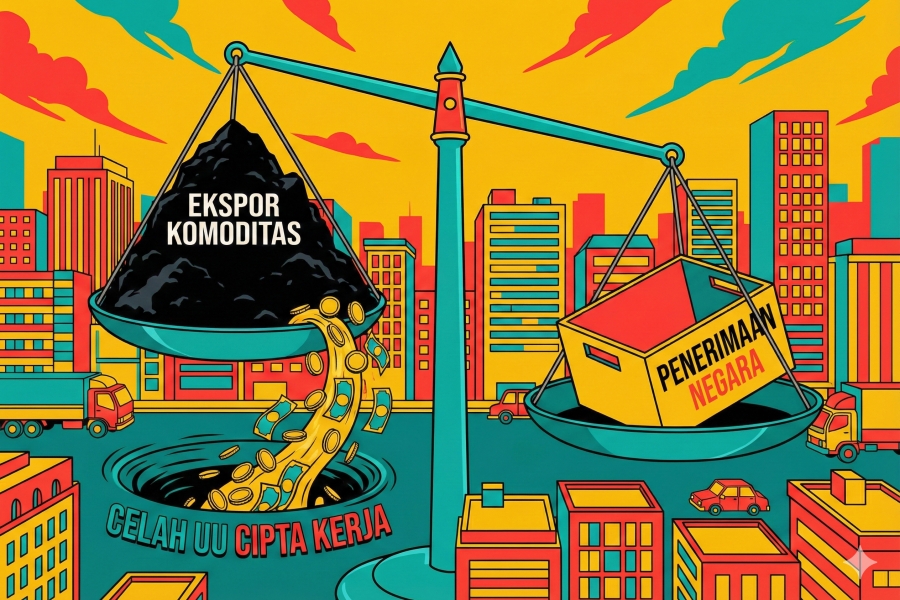
The Ministry of Finance has reported a significant strain on the state budget after tax restitution claims soared to IDR 351 trillion by November 2025. This fiscal pressure is driving the government to reassess the Job Creation Law, which opened loopholes for excessive tax refunds in the coal sector. In a move to stabilize revenue, officials are now finalizing a new coal export duty to counterbalance these losses next year.
The Indonesian government is currently grappling with a substantial fiscal gap after tax refund claims skyrocketed to IDR 351 trillion as of late November 2025. Data from the Ministry of Finance reveals that while gross tax revenue successfully reached IDR 1,985.4 trillion, the net revenue retained by the state was severely eroded to IDR 1,634.4 trillion due to these massive payouts. This trend dealt a severe blow to Value Added Tax (PPN) and Luxury Goods Sales Tax (PPnBM) receipts, which contracted by 6.6 percent year-on-year after restitutions were paid, despite gross transaction volumes actually showing positive growth.
This liquidity pressure also battered Corporate Income Tax (PPh Badan) performance, which should have grown by 4.7 percent based on gross figures but instead plummeted to a contraction of 9 percent after claims were settled. Vice Minister of Finance Suahasil Nazara highlighted that while PPN usually serves as the pulse of the economy reflecting real transactions, the widening gap between gross and net receipts signals a critical need to evaluate the current tax mechanisms.
The deepening erosion of state revenue has forced fiscal authorities to trace the root of the problem, which points directly to regulatory gaps within the mining sector.
The Ministry of Finance has identified the implementation of the Job Creation Law (UU Cipta Kerja) as the primary catalyst behind the swelling restitution claims, particularly from coal exporters. This regulation reclassified coal as a Taxable Good (BKP), allowing companies to claim input tax credits even though their export tariffs are set at zero percent, effectively forcing the state to pay out the difference. Head of the Fiscal Policy Agency (BKF) Febrio Nathan Kacaribu stated that the government is now recalculating the impact of this rule to ensure the principle of fairness under Article 33 of the 1945 Constitution is upheld in natural resource management.
Finance Minister Purbaya Yudhi Sadewa has responded decisively by drafting a new coal export duty strategy targeted for January 2026 to halt what he describes as a "subsidi" to the industry. This policy is projected to generate an additional IDR 25 trillion in annual state revenue, helping to reverse the current deficit caused by the previous regulatory framework. This measure will run parallel to the imposition of gold export duties, which have already been regulated through the latest Minister of Finance Regulation to strengthen domestic reserves.
This drastic shift in fiscal policy creates a new wave of uncertainty that will directly impact the cash flows of mining giants in the upcoming fiscal year.
Players in the extractive industries, particularly coal and gold exporters, must immediately prepare for significant margin compression due to the implementation of these new levies. Investors holding energy sector stocks need to be wary of potential earnings corrections in 2026, as the era of "tax ease" facilitated by the Job Creation Law is set to be dismantled by fiscal authorities.
The dynamics of state revenue in 2025 demonstrate that incentives without strict oversight can backfire on fiscal resilience. The government's move to revise regulations signals that maximizing revenue from natural resources will be the top priority to salvage the posture of the State Budget (APBN) in the future.


















 tpc.consulting
  tpc.consulting
  info@taxindo.co.id