



The lawsuit filed by PT IRS raises an important issue regarding the ambiguity of the phrase “paid by the Taxpayer” in Article 12 paragraph (2) letter a of Minister of Finance Regulation (PMK) 8/PMK.03/2013. The dispute questions whether the settlement of administrative sanctions that occurred not by the taxpayer’s volition, but due to actions taken ex officio by the tax authority, can be deemed as payment by the taxpayer and thereby extinguish the taxpayer’s right to file an application for the cancellation of sanctions under Article 36 of the General Tax Provisions and Procedures Law (UU KUP). This issue became the focal point of controversy when the Directorate General of Taxes (DJP) rejected PT IRS’s second application to cancel VAT penalties amounting to approximately three billion rupiah, on the sole basis that the Tax Collection Letter (STP) in question had already been marked as “paid.” According to DJP, this status violated the procedural requirement in PMK 8/2013, which stipulates that sanctions requested for cancellation must not yet be paid or settled by the taxpayer.
PT IRS rejected this formalistic reasoning. While they did not dispute that the STP had indeed been marked as paid, they emphasized that such payment occurred without their intention. The payment resulted from a unilateral action by the Tax Office (KPP), which offset the taxpayer’s VAT refund (arising from an SKPKPP) against the disputed STP through an ex officio bookkeeping transfer (pemindahbukuan). PT IRS argued that the phrase “paid by the Taxpayer” must be interpreted as a legal act involving intention or volition. Since the taxpayer took no action that reflected a willingness to make payment, the involuntary settlement could not be equated with payment by the taxpayer as required by the PMK.
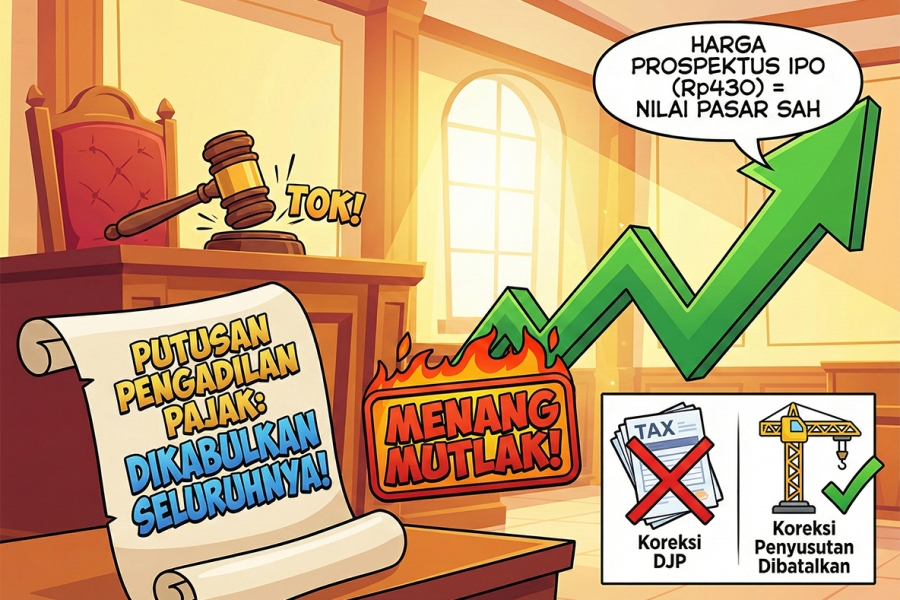
The Tax Court Judges, in Decision PUT-000218.99/2018/PP/M.VIIIB of 2019, granted the entirety of PT IRS’s claim. Notably, the Judges did not examine the substantive basis of the Article 36 application such as whether the sanction arose from an error or negligence by DJP. Instead, their focus was directed toward the procedural defect in DJP’s rejection decision. The Judges confirmed that the settlement of the STP was conducted entirely ex officio and that the taxpayer remained passive throughout the process. Accordingly, the paid status could not be interpreted as payment by the taxpayer in a manner that would extinguish the taxpayer’s right to request cancellation of the sanction. The Judges held that the wording of PMK 8/2013 is ambiguous and does not account for involuntary settlements caused through administrative offsets by the tax authority. In this context, DJP may not rely on regulatory ambiguity and its own unilateral actions as grounds to undermine the taxpayer’s procedural rights.
The Judges further emphasized that since the PMK requires the sanction to be unpaid by the taxpayer, any form of settlement not carried out through the taxpayer’s actions, including involuntary settlement resulting from the tax authority’s actions, cannot be used as a basis to reject an Article 36 application. The Judges also criticized DJP’s conduct, noting that using an ex officio offset to then justify rejection of the taxpayer’s application is inconsistent with principles of fairness and constitutes a practice that cannot be accommodated within administrative tax law.
Ultimately, the Tax Court annulled DJP’s Rejection Letter and ordered DJP to reprocess PT IRS’s application for cancellation of administrative sanctions. This decision affirms that involuntary settlements cannot be deemed as payment by the taxpayer for the purposes of enforcing Article 12 of PMK 8/2013. The decision stands as an important precedent that strengthens taxpayer rights, upholds substantive justice, and ensures clearer regulatory application so that administrative actions by the tax authority are not used in ways that disadvantage taxpayers.
A Comprehensive Analysis and the Tax Court Decision on This Dispute Are Available Here














 tpc.consulting
  tpc.consulting
  info@taxindo.co.id