


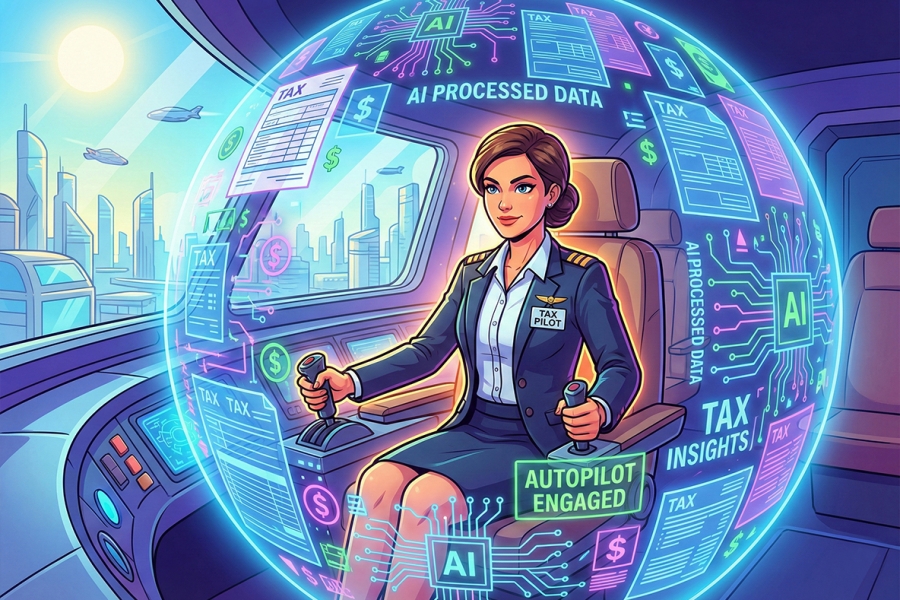
Executive Summary
The following compelling piece is a summary of the article "Will AI Replace Tax Practitioners?" by Benjamin Alarie, Rory McCreight, and Cristina Tucciarone, published in Tax Notes Federal in October 2023.
Transforming the Tax Law Landscape
The article begins with a fundamental question haunting many professionals in the digital age: Will tax practitioners eventually be ousted by the artificial intelligence (AI) revolution?
The authors acknowledge that AI's ability to accelerate core tax professional tasks is undeniable, potentially pushing traditional roles toward obsolescence. However, the central thesis of this article is not about total replacement, but rather evolution. The authors argue that intrinsic human values—such as negotiation, empathy, ethics, and the ability to draw complex inferences—are arts that machines cannot yet replicate. The ultimate conclusion is that practitioners who embrace AI tools will supersede those who resist them.
The Vulnerability of the Tax Profession to AI
Unlike previous technological advancements that primarily impacted manufacturing or blue-collar jobs, the current generative AI revolution disproportionately affects white-collar knowledge workers who were historically considered safe. A report from Goldman Sachs estimates that generative AI has the potential to replace roles equivalent to 300 million full-time jobs, with 44% of legal tasks at risk of automation.
In practice, generative AI tools like ChatGPT and Gemini are becoming increasingly proficient in tasks such as:
This creates a new dynamic where AI can drastically increase efficiency, allowing less experienced (junior) practitioners to perform complex tasks faster. This effectively "levels the playing field" between novices and experts. Research indicates that entry-level workers gain the largest productivity boost from using AI, enabling them to perform at a level approaching their more senior colleagues.
Consequently, traditional roles for junior staff—such as initial research and basic drafting—will be accelerated or taken over by machines. This forces a role shift where future tax practitioners will function more as "hyper-augmented" project managers overseeing AI tools rather than performing manual administrative tasks. The profession's focus will shift from rote memorization to a blend of technical expertise and human-centric understanding.
Access to Justice and Changing Business Models
AI holds immense potential to transform the business structure of professional service firms. Small firms can leverage AI to provide service levels equivalent to large firms but with higher efficiency and lower overhead costs. This challenges the traditional billable hours structure, as the efficiency model of AI contradicts a system that rewards the length of time worked. Agile firms may shift to alternative pricing strategies, such as fixed fees, to gain a competitive advantage.
Furthermore, AI has the potential to address barriers to access to justice. Currently, most civil legal issues faced by low-income individuals in the United States are not adequately addressed because legal experts tend to serve wealthier demographics. The ability of advanced language models to pass law school exams suggests that, in the future, clients may prefer the speed and cost-effectiveness of AI over traditional human advice for specific issues.
The AI Arms Race with Tax Authorities
Another crucial aspect is the utilization of AI by tax authorities. The IRS (Internal Revenue Service) in the United States has leveraged advanced data analytics to detect tax evasion. This technological evolution on the regulator's side will trigger an "arms race," where professional service firms must adopt similarly advanced tools to align themselves with regulators.
By using tools equivalent to those used by the IRS, firms can understand the operational methods of tax authorities and provide more precise advice to clients. Large firms will likely race to innovate and outperform tax authorities in AI adoption, ultimately redefining the role of the tax profession.
Limitations of AI and Human Superiority
Although AI excels in efficiency, the article asserts that the total replacement of humans remains speculative due to fundamental limitations in current technology.
Human tax practitioners possess the unique ability to connect disparate tax provisions and interpret the implications of seemingly unrelated factors. Humans can predict regulatory shifts by placing data within a broader business, economic, and geopolitical context—something difficult for AI that relies on past data. Tax planning demands a balance between minimizing tax liability, adhering to ethics, and ensuring compliance—an art requiring human judgment.
The Human Touch: Empathy and Trust
The greatest comparative advantage of tax practitioners lies in client interaction. Tax issues often intersect with deeply personal and emotional aspects of a client's life, such as divorce, inheritance, or business challenges. In these scenarios, the tax practitioner acts not only as a technical advisor but also as an empathetic listener. The ability to simplify complicated tax concepts and tailor explanations to a client's verbal and non-verbal cues is a communication skill that machines cannot emulate.
Moreover, the practitioner-client relationship is built on trust and accountability. Clients need the assurance of human oversight, especially since AI tools can sometimes experience "hallucinations"—generating information that sounds plausible but is inaccurate, or even citing fake legal cases. Ultimately, it is the tax professional who must take responsibility for discrepancies or misinformation, not the machine.
Ethical Concerns and the Digital Divide
Despite optimism regarding access to justice, the authors highlight the risk that AI could exacerbate inequality. The digital divide means that individuals without access to technology or adequate digital skills will remain disadvantaged. Many sophisticated AI-based tax tools are expensive, meaning legal aid organizations serving marginalized groups may not be able to afford them.
Furthermore, AI tools often operate as "black boxes" that are not transparent, making it difficult for taxpayers to understand or challenge decisions generated by algorithms. There is also the danger of bias embedded in training data. For example, marginalized communities might face unfair audit patterns or incorrect advice due to historical bias in tax data—such as the Earned Income Tax Credit (EITC) claims, which are frequently targeted for audits despite lower fraud rates compared to wealthier groups. If AI development is driven solely by profit motives, the needs of marginalized groups may be sidelined.
The Future of Tax Law: Learning from History
To provide a future perspective, the article uses a historical analogy regarding the introduction of VisiCalc (the first digital spreadsheet) in the late 1970s. At that time, accountants worried that the automation of manual calculations would make their jobs obsolete. However, the opposite happened; the accounting profession flourished. Automation allowed accountants to shift from tedious calculation tasks to dynamic scenario analysis and forecasting, making them more valuable business advisors.
Similarly, AI promises a transformation for today's tax practitioners. AI will not replace practitioners directly but will enhance and diversify their roles. By letting AI handle heavy transactional research, practitioners can deliver faster and more effective insights. The future of the tax profession will see practitioners playing a dual role: as informed users and as knowledgeable "architects" who help develop and refine AI tools and guide legislative frameworks to ensure these tools adhere to ethical standards.
Conclusion
In closing, the article affirms that the trajectory of the tax profession is being reshaped by AI advancements, but the narrative is one of synergy, not replacement. AI enhances accuracy, efficiency, and foresight, while the need for nuanced legal interpretation, personalized client relationships, and ethical considerations ensures continued human relevance. This transformation is inevitable, and the tax practitioners of the future are those who embrace this new frontier, leveraging AI to provide more holistic and profound solutions for their clients.
Key Takeaway: The Autopilot Analogy
To simplify this dynamic, the relationship between AI and tax practitioners can be likened to the relationship between an airplane's autopilot and a human pilot.
While the autopilot (AI) can handle most routine flight operations, manage complex navigation data, and keep the aircraft stable with efficiency far exceeding that of a human, the presence of the pilot (tax practitioner) remains absolutely indispensable.
The pilot is needed to make critical decisions when facing unexpected storms, to communicate with control towers (clients/regulators) with the proper nuance, and to take manual control when systems error, ensuring passenger safety and trust. AI makes the flight safer and more efficient, but it does not eliminate the need for a captain in the cockpit.













 tpc.consulting
  tpc.consulting
  info@taxindo.co.id