



The application of Withholding Tax (WHT) Article 26 rates under a Double Taxation Avoidance Agreement (DTAA) mandates strict adherence to formal requirements, where the Certificate of Domicile (SKD) or DGT Form of the Non-Resident Taxpayer (NRT) serves as the crucial document determining the eligibility for benefits. This context forms the core of the dispute in the appeal between PT HI against the Director General of Taxes (DJP), originating from the WHT Article 26 Underpayment Tax Assessment Letter (SKPKB) for the May 2017 Tax Period. DJP, as the tax authority, imposed a positive correction on the WHT Article 26 Tax Base (DPP), primarily based on the presumption that the NRT receiving the income failed to meet the administrative requirements for the SKD/DGT Form, thus necessitating the application of the normal WHT Article 26 rate of 20%.
The core conflict revolves around two issues: first, the legality of DJP reconciling the Value Added Tax (VAT) object on the Utilization of Intangible Taxable Goods from outside the Customs Area (VAT-JLN) as a basis for WHT Article 26 imposition; and second, the consequences of PT HI's failure to complete the formal SKD requirements. DJP argued that the existence of VAT-JLN strongly indicates payments to an NRT that constitute potential WHT Article 26 objects, and since the formal DTAA requirements were not met, the 20% normal rate must be enforced. Conversely, PT HI refuted this, asserting that the VAT-JLN object is legally distinct from the WHT Article 26 object. PT HI demanded that the Tax Court Panel examine the substance of the transaction and the NRT’s material right to claim DTAA benefits.
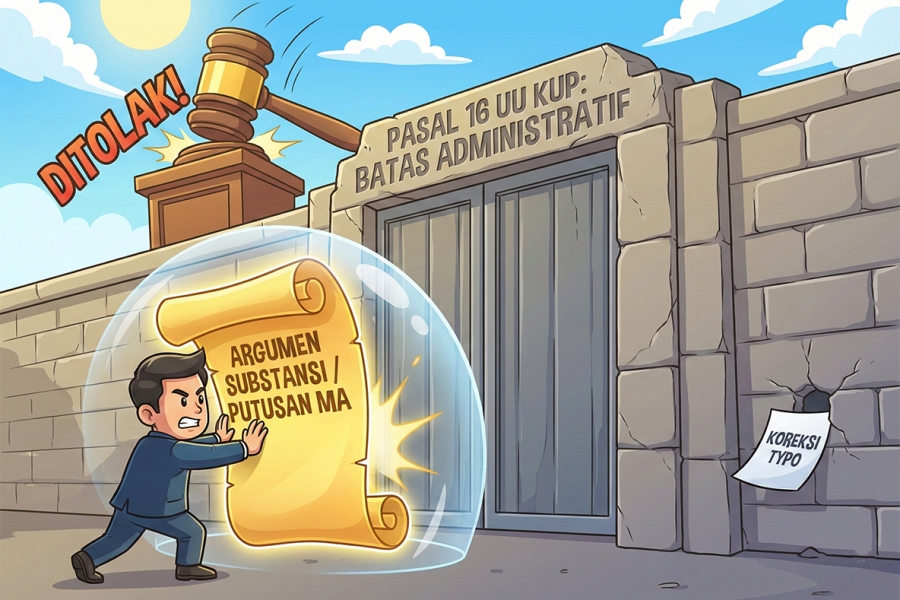
Regarding the resolution of this conflict, the Tax Court Panel issued a Partial Grant decision. In its legal consideration, the Panel indicated that the arguments and evidence presented by DJP were insufficient to sustain the entire correction value. The Panel only acknowledged and upheld a small portion of the WHT Article 26 DPP correction. This decision implicitly rejects DJP’s premise that the entirety of the VAT-JLN object can be automatically corrected into a WHT Article 26 object solely based on SKD formality.
An analysis of this decision carries significant implications. The Panel’s ruling affirms that although formal compliance with the SKD/DGT Form is mandatory to automatically benefit from DTAA rates, the tax authority must still prove the substance of the income being corrected. If the object of the correction (in this case, based on VAT-JLN reconciliation) cannot be conclusively proven as NRT income subject to WHT Article 26 (for instance, if it represents a pure reimbursement or a non-WHT object), the correction can be cancelled. This ruling serves as a reminder for Taxpayers not only to focus on SKD completeness but also on the documentation supporting the substance of every VAT-JLN transaction to preempt reconciliation disputes.
In conclusion, the PT HI case highlights the necessity of comprehensive evidence in WHT Article 26 disputes related to DTAA. The takeaway is the need for Taxpayers to always maintain formal SKD compliance. However, if a dispute arises, Taxpayers have a strategic opportunity to defeat the correction by proving the difference in the nature of the tax object, specifically by challenging the VAT-JLN reconciliation methodology that does not always align with WHT Article 26 object provisions.
A Comprehensive Analysis and the Tax Court Decision on This Dispute Are Available Here.
















 tpc.consulting
  tpc.consulting
  info@taxindo.co.id