



This Tax Court Decision revoked the taxpayer's PPh Article 26 correction related to the Taxable Base (DPP) reclassified as a deemed dividend (secondary adjustment), underscoring that the validity of transfer pricing documentation for intra-group services is critical in mitigating the risk of this derivative dispute. PT NSBLI, successfully proved that the service transactions with its affiliated parties complied with the Arm’s Length Principle (ALP) through comprehensive documentation.
Tax disputes involving PPh Article 26 often arise as a logical consequence or secondary adjustment of a Transfer Pricing correction under Corporate Income Tax (PPh Badan). In the NSBLI case, the dispute originated from the Directorate General of Taxes' (DJP) disallowance of Intra-group Service Fees, which consequently led to the reclassification of the disallowed amount as an imputed dividend to the foreign affiliated entity, thus triggering PPh Article 26 liability. The core issue revolves around proving the ALP compliance for the services received from foreign affiliates.
The DJP argued that the PPh Article 26 correction was proper, being based on the disallowance of the intra-group service fees in the previous PPh Badan dispute. This disallowance was due to PT NSBLI perceived failure to prove two main elements: the benefit test (actual economic benefit of the service) and the existence of service (the reality and arm's length pricing of the service). The correction was automatically presumed to be a profit allocation (excess profit) disguised as an imputed dividend, making it subject to PPh Article 26. Conversely, PT NSBLI refuted the correction by emphasizing the completeness of its Transfer Pricing documentation (Evidence P-1 to P-51), which they claimed proved the arm's length nature of the transaction and its compliance with ALP. NSBLI’s rebuttal contended that if the service transaction was proven to be at arm's length, there was no basis to reclassify it as a deemed dividend, and thus the PPh Article 26 correction must be canceled.
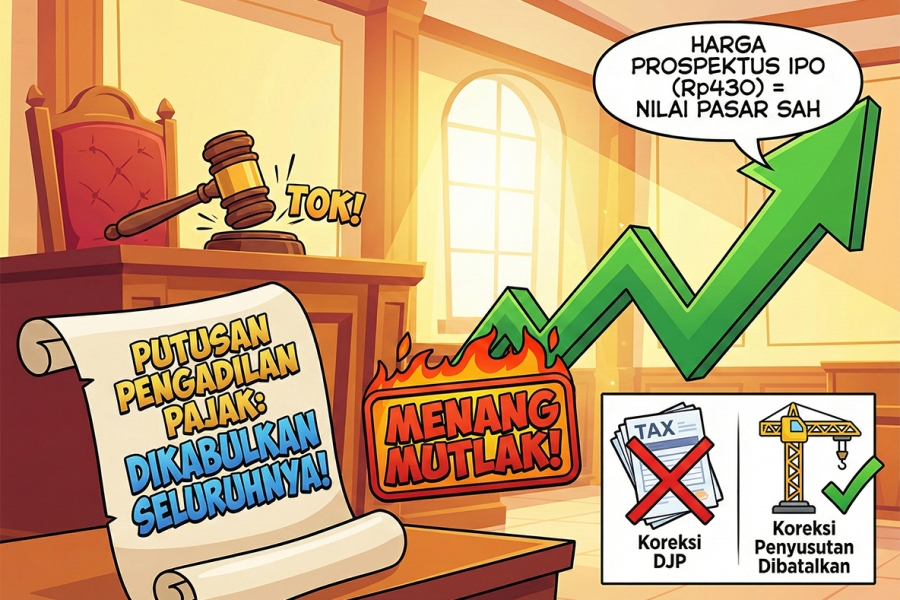
The Tax Court Panel of Judges determined that the PPh Article 26 dispute was a derivative dispute, whose resolution was absolutely dependent on the outcome of the primary PPh Badan dispute. After reviewing and assessing all the evidence submitted by PT NSBLI, including documentation proving the benefit test and pricing mechanism, the Panel concluded that PT NSBLI had successfully substantiated its claim regarding the arm's length nature of the Intra-group Service Fees. Consequently, since the primary PPh Badan correction on those fees was revoked, the secondary adjustment PPh Article 26 correction arising from the reclassification of the same fees must also be canceled. The Panel granted PT NSBLI's appeal in full.
This decision has significant implications, reinforcing the precedent that in a secondary adjustment dispute, the Tax Court’s focus will always revert to the validity of the primary adjustment. For multinational corporations, the NSBLI case is a vital lesson that the strength of ALP documentation is the main key. This strength lies not merely in the presence of a contract, but in real operational evidence (substance over form) such as timesheets, progress reports, and documentation showing the service provider's cost base. The decision provides legal clarity for taxpayers to eliminate the risk of secondary adjustment by proactively strengthening their Transfer Pricing compliance.
The NSBLI case highlights the complexity of PPh Article 26 disputes arising from intra-group service Transfer Pricing corrections. PT NSBLI's victory proves that with adequate documentation and a robust legal argument concerning compliance with the Arm’s Length Principle, derivative tax corrections like the secondary adjustment can be entirely nullified.
A Comprehensive Analysis and the Tax Court Decision on This Dispute Are Available Here














 tpc.consulting
  tpc.consulting
  info@taxindo.co.id