



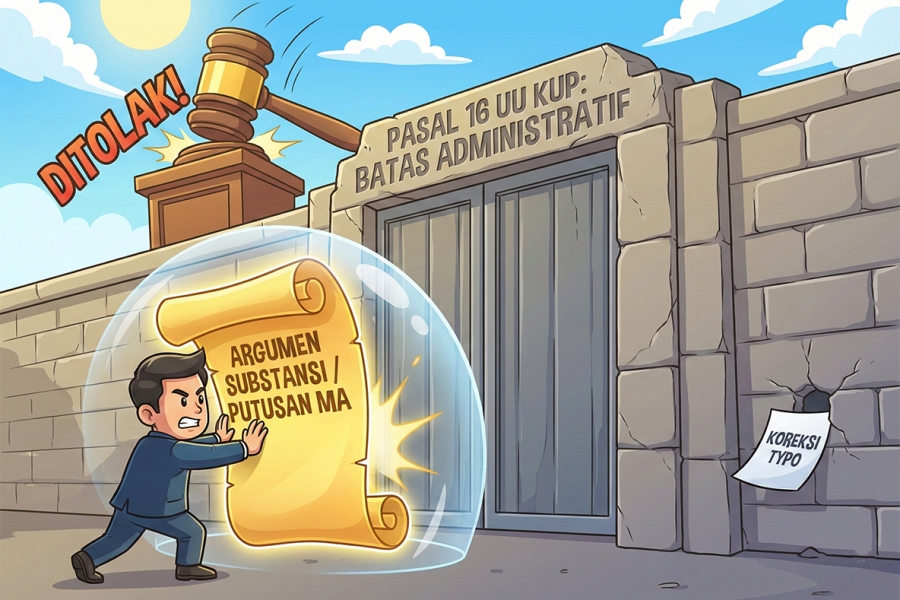
The Tax Court's decision in the PT ASD dispute serves as a crucial case study for FORM-C2 procedural disputes. The Panel of Judges rejected PT ASD's lawsuit challenging a letter from the Director General of Taxes (DJP) that returned their application for tax assessment cancellation. This decision underscores the fatality of violating formal requirements—specifically the "no double dipping" principle and the competence requirements for tax representatives —even when PT ASD possesses strong arguments regarding the legality of the underlying tax assessment.
The core conflict began when PT ASD filed a lawsuit against DJP Letter No. S-1080/WPJ.01/2024. This letter was not a substantive rejection but an administrative letter returning the application for cancellation (under Article 36 paragraph (1) letter b) of the Tax Procedures Law (UU KUP) of a Withholding Tax (PPh) Article 23 assessment that PT ASD had submitted. PT ASD argued that the tax assessment was void ab initio (nietig) because it was issued without a valid examination procedure (violating Article 29 of the UU KUP). Therefore, PT ASD demanded the DJP issue a substantive decision (accepting or rejecting the cancellation) and accused the act of returning the application as an abuse of power.
The DJP did not address the validity of the PPh Article 23 assessment at all. The DJP's argument was purely procedural. The action of returning the application was based on two fatal formal violations under Ministry of Finance Regulation (PMK) No. 8/PMK.03/2013. First, a violation of Article 14 paragraph (2) letter c. The DJP found that PT ASD had previously applied for (and received a decision on) a request for the reduction of administrative sanctions (Article 36 paragraph (1) letter a) of UU KUP) for the exact same tax assessment. According to the regulation, this choice is mutually exclusive and invokes the "no double dipping" principle, meaning PT ASD was no longer eligible to apply for cancellation of the tax principal. Second, a violation of Article 14 paragraph (4) letter e. The application was signed by a representative but failed to attach proof of "specific competence" (such as a license or certification) as mandated by Article 32 paragraph (3a) of the UU KUP.
The Panel of Judges, in its deliberation, made a clear distinction. First, the Panel accepted the formality of PT ASD's lawsuit. The Panel rejected the DJP's exceptions and affirmed that the return letter (S-1080) was an administrative decision (KTUN) that constituted a valid object of a lawsuit (FORM-C2). The Panel also validated the lawsuit filing signed by only one representative and confirmed the original power of attorney was attached.
However, on the merit of the dispute, the Panel of Judges rejected PT ASD's entire lawsuit and affirmed the DJP's actions. The Panel agreed that PT ASD's application to the DJP was formally flawed. The Panel upheld the "no double dipping" principle, stating that Article 14 paragraph (2) letter c of PMK 8/2013 was applicable, and rejected PT ASD's argument attempting to differentiate between SKP "not correct" (Article 13 paragraph (1)) and "should not have been issued" (Article 13 paragraph (3)). The Panel also validated the DJP's second reason, stating that the absence of proof of the representative's competence was a fatal formal defect under the mandate of Article 32 paragraph (3a) UU KUP. Because the application was proven to be formally defective, the DJP's action to return it, in accordance with Article 15 paragraph (3) of PMK 8/2013, was lawful and not an abuse of power.
This decision is a critical lesson for Taxpayers and tax practitioners. The choice of legal remedy (e.g., between Article 36 paragraph (1) letter a and b) must be made with extreme care as it is mutually exclusive. Furthermore, this decision establishes a new standard post-UU HPP and PP 50/2022, where proof of a representative's competence (certification, license, diploma) has now become an absolute formal requirement that must be attached to all correspondence and applications submitted to the DJP.
A Comprehensive Analysis and the Tax Court Decision on This Dispute Are Available Here














 tpc.consulting
  tpc.consulting
  info@taxindo.co.id