


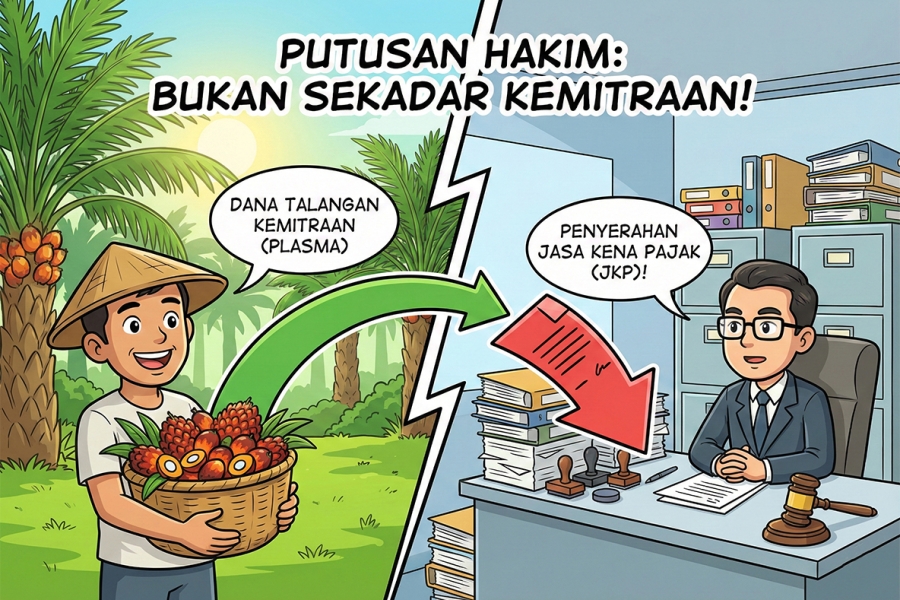
Subject to VAT! Why Did Judges Classify Plasma Plantation Cost Allocation as Taxable Services? Key Takeaways from the Palm Oil VAT Dispute
PUT-009382.16/2024/PP/M.XIVB Tahun 2025
The regulatory conflict between core-plasma partnership obligations in the palm oil industry and the Value Added Tax (VAT) provisions has resurfaced. This Tax Court Decision affirms the dominance of the transactional fatbestand principle in Indonesian VAT, rather than the economic substance of the financing scheme. This dispute centers on a VAT Base (DPP) correction of Rp. 1.466.003.802 arising from the allocation of operational costs and a 5% management fee charged to the plasma plantation.
The Directorate General of Taxes (DJP) insisted that the allocation of material and labor costs, along with the 5% management fee levied by PT TTSM on the plasma plantation, constituted a Taxable Service (Jasa Kena Pajak/JKP) as stipulated in Article 4 section (1) letter c of the Indonesian VAT Law. The DJP viewed the existence of a legal act (fatbestand) that created a right to collect payment, where PT TTSM performed plantation management classified as a service. Conversely, PT TTSM refuted this correction. The core company argued that these costs were a fulfillment of an integrated partnership obligation and merely a cost recovery mechanism for an advanced fund, not compensation for a separate service. PT TTSM emphasized that VAT should not be imposed if the transaction does not genuinely increase the company's economic capability, in line with the Income Tax approach.
The Tax Court Judges strictly adhered to the principle of VAT neutrality and its transactional nature (fatbestand or legal format bestand). The Panel held that the fact that PT TTSM's accounting records showed a receivable or a right to collect payment from the plasma plantation fulfilled the elements of service delivery. Even though PT TTSM argued using the Income Tax perspective (substance over form), the Panel affirmed that in the VAT context, the existence of the transaction and the right to collect is the more crucial criterion. Consequently, the Panel Rejected PT TTSM's appeal, confirming the Output VAT Base correction.
This decision carries significant implications for all core companies operating under the plasma partnership scheme. The Panel's ruling reinforces the precedent that in VAT disputes, the format or recording of the transaction will be prioritized over the substance of the partnership. The lesson for Taxpayers is the importance of clearly separating (both legally and accounting-wise) an advanced fund/working capital loan to the plasma, which must be repaid, from an intentional service delivery. If documentation shows a management fee and cost allocation absorbed by the plasma, the risk of being classified as a Taxable Service will be extremely high.
This case serves as a warning that Taxpayers in the plantation sector must formulate a bulletproof agreement and billing mechanism to ensure that the financing of plasma plantations is not interpreted as the submission of Taxable Services.
A Comprehensive Analysis and the Tax Court Decision on This Dispute Are Available Here










 tpc.consulting
  tpc.consulting
  info@taxindo.co.id