



Tax disputes often reflect the complexity of regulatory interpretation between Taxpayers and authorities. An interesting case highlighting the classic conflict between formal substantiation during an audit and the economic substance of a transaction occurred with PT AI. In this case, the Directorate General of Taxes (DJP) performed an operating revenue correction amounting to Rp271.5 billion by reclassifying a Settlement Discount and a Channel Rebate as taxable income. A deep analysis of this ruling provides valuable insights into the challenges of proving commercial transactions and the strength of an argument focused on substance when facing tax disputes.
The core conflict stemmed from a difference in perspective regarding two types of incentives given by PT AI, a computer product distributor, to its own distributors. The Settlement Discount was a price reduction for early payment, while the Channel Rebate was a rebate related to a promotional program. The DJP's argument centered on one pillar: failure of proof. According to the DJP, PT AI could not provide complete supporting documents during the audit process to prove the essence and existence of the discount scheme. Due to the lack of formal evidence at that stage, the DJP relied on the broad definition of income in Article 4 paragraph (1) of the Income Tax Law (UU PPh) and treated the amounts as an "addition to economic capability." Conversely, PT AI's argument focused on the economic substance of the transaction. PT AI asserted that both discounts were common and legitimate price reductions, supported by comprehensive evidence such as cooperation agreements, commercial invoice and Tax Invoice examples clearly listing the price reduction, as well as corresponding proof of fund flow.
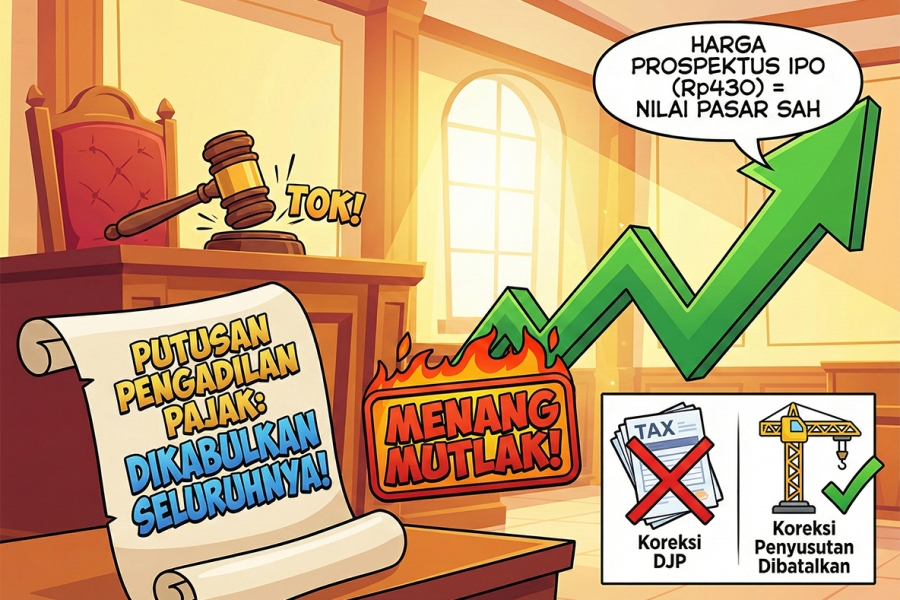
In its resolution, the Panel of Judges viewed this dispute as a dispute of evidence. After reviewing all the evidence submitted by PT AI during the trial, the Panel of Judges was convinced of the existence and mechanism of both discounts. The Panel was of the opinion that because the discounts genuinely reduced the billed value and the company's economic capability received, the correct treatment was as a reduction of operating revenue, not as income. Consequently, the Panel of Judges annulled the entire DJP correction on this disputed item.
This ruling is an important affirmation of the principle of substance over formality, demonstrating that material truth supported by strong evidence in court can override findings based on a deficiency of documents during the initial audit stage.
In conclusion, the PT AI case confirms that legitimate, real, and demonstrable sales discounts and rebates are not subject to Income Tax (PPh). This ruling provides a valuable lesson for the business world regarding the crucial nature of neat and comprehensive documentation. The main lesson is the importance of implementing a "dispute-ready documentation" policy—archiving all supporting evidence of transactions in real-time to anticipate potential disputes and to be able to always prove the commercial substance of every decision made.
Comprehensive and Complete Analysis of This Dispute is Available Here













 tpc.consulting
  tpc.consulting
  info@taxindo.co.id