


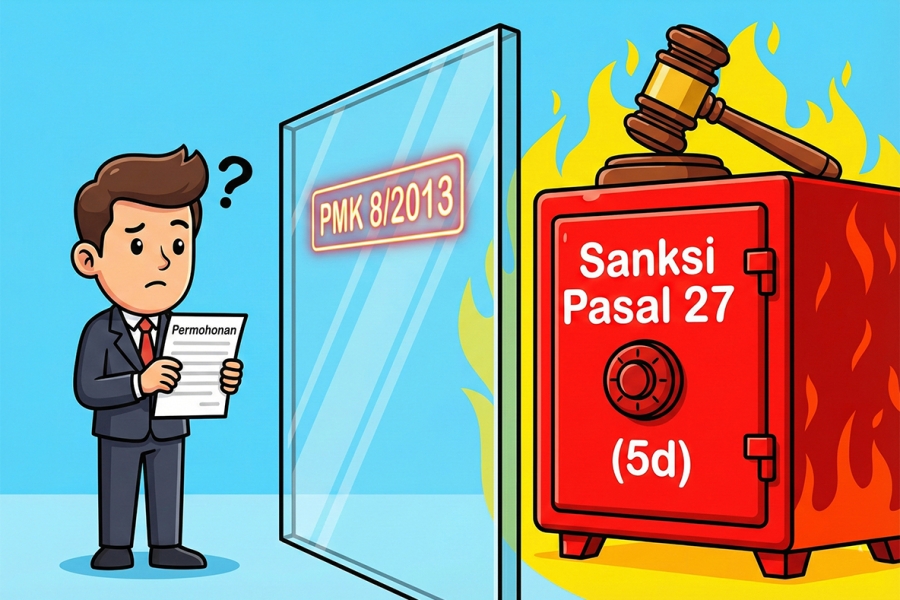
Tax Court Decision Number PUT-011706.99/2023/PP/M.XB of 2025 affirms the principle of prudence in tax litigation, particularly in relation to administrative sanctions in the form of Collection Fines under Article 27 paragraph (5d) of the General Provisions and Tax Procedures Law (KUP Law). This penalty, which is a financial consequence of rejecting an appeal, is explicitly excluded from the scope of sanctions that can be waived through a taxpayer's request under Article 4 letter b of Minister of Finance Regulation Number 8/PMK.03/2013. This legal implication closes the opportunity for taxpayers to use administrative channels to mitigate the risk of fines arising after the appeal process, making it a critical point in dispute management.
The core of the conflict in this case centers on the hierarchy of laws and regulations. The DGT rejected the taxpayer's (Plaintiff) request for the removal of collection penalty sanctions on strong grounds based on PMK 8/PMK.03/2013, which excludes collection penalties from the scope of administrative sanctions that can be removed. On the other hand, the taxpayer argued that the exclusion stipulated in the PMK (regulation under the law) contradicted the rights generally granted in Article 36 paragraph (1) letter a of the KUP Law (regulation above it). The plaintiff adhered to the principle of Lex superior derogate legi inferiori, whereby higher regulations must prevail. The collection penalty itself arose due to a delay in the payment of taxes owed as a result of an appeal process that was subsequently rejected.
In its view, the Panel rejected the taxpayer's argument and agreed with the DGT. The Panel of Judges interpreted the phrase “may reduce or waive administrative sanctions... in accordance with the provisions of tax laws and regulations” in Article 36 paragraph (1) letter a of the KUP Law not as an absolute right, but as a mandate to the Minister of Finance to further regulate its implementation. Therefore, PMK Number 8/PMK.03/2013 is considered a valid implementing regulation and does not violate the KUP Law. The DGT's decision to reject the request for the elimination of administrative sanctions is considered correct and in accordance with the applicable legal corridor.
The analysis and impact of this decision provide important legal certainty for taxpayers who are currently or will be pursuing litigation. This decision emphasizes that the collection penalty under Article 27 paragraph (5d) of the KUP Law is not an ordinary sanction, but rather compensation for the delay of the state's rights. With the rejection of this lawsuit, taxpayers are required to improve their financial risk analysis before deciding to file an appeal or lawsuit, especially since this penalty is exclusive and cannot be mitigated through a request for the removal of sanctions. Payment of the principal tax amount before filing an appeal is the only effective way to avoid this sanction if the final decision rejects the taxpayer.
A Comprehensive Analysis and the Tax Court Decision on This Dispute Are Available Here













 tpc.consulting
  tpc.consulting
  info@taxindo.co.id