



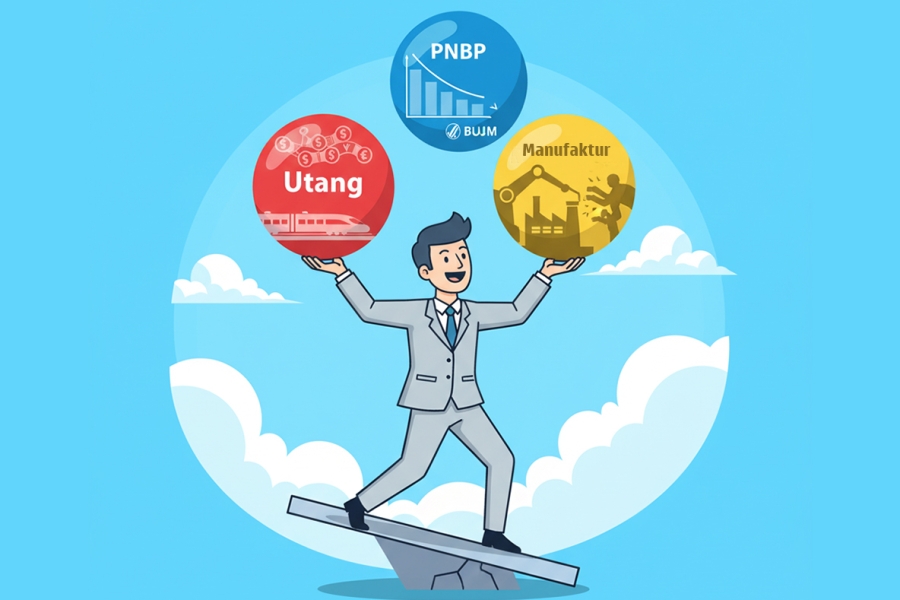
President Prabowo Subianto has issued a strong directive to his cabinet to conduct a comprehensive evaluation of two strategic economic policies. The primary focus of this evaluation is the effectiveness of implementing the Export Proceeds (DHE) regulation, as well as an analysis of the debt financing scheme for the Jakarta-Bandung High-Speed Rail project (Whoosh) to mitigate potential burdens on the State Revenue and Expenditure Budget (APBN).
The directive regarding DHE specifically targets a review of Government Regulation (PP) Number 36 of 2023. The government will thoroughly examine whether the regulation, which mandates exporters to place a portion of their DHE within the domestic financial system, has achieved its objectives or requires revision for optimization. Coordinating Minister for Economic Affairs, Airlangga Hartarto, confirmed that the results of this evaluation will form the basis for determining the subsequent policy.
Separately, the government has also been instructed to review the debt structure of the high-speed rail project to the China Development Bank (CDB). According to Airlangga, President Prabowo requested that the debt settlement scheme be formulated meticulously. "Furthermore, concerning the high-speed rail, how the debt settlement can be managed so as not to burden the APBN," he asserted. This instruction underscores the government's priority of ensuring fiscal sustainability in the management of national strategic projects.
PNBP Performance Strained by Commodity Volatility and Loss of SOE Dividends
Non-Tax State Revenue (PNBP) in 2025 is facing dual pressures stemming from external factors and internal policy changes. The weakening performance is caused by the normalization of global commodity prices, which were previously a major support, as well as the loss of dividend remittances from State-Owned Enterprises (BUMN), the management of which has now been restructured.
The main challenge arises from the price volatility of key commodities such as coal and crude palm oil (CPO), which historically have been significant contributors to PNBP from the natural resource (SDA) sector. The decline in these commodity prices directly corrects the potential state revenue, creating a fiscal risk that the government needs to mitigate. This condition necessitates an adjustment of revenue targets and a more realistic strategy.
Furthermore, structural pressure emerges from the implementation of a new policy that diverts SOE dividend remittances to the Nusantara Investment Management Agency (Badan Pengelola Investasi Daya Anagata Nusantara or Danantara). This change effectively eliminates a major source of PNBP from the Separated State Assets (KND) post. Consequently, the government is faced with the urgency to diversify non-SDA sources of PNBP and optimize other revenue posts to maintain APBN stability.
Manufacturing Sector Shifts to Capital-Intensive, Deindustrialization Concerns Intensify
Indonesia's manufacturing sector is facing a serious structural challenge leading to the phenomenon of deindustrialization, marked by a significant shift from labor-intensive industries towards capital-intensive ones. This transformation poses crucial implications for national employment absorption capacity, even though the sector's nominal contribution to the Gross Domestic Product (GDP) remains robust.
Data indicates that the elasticity of employment absorption in the manufacturing sector continues to decline. This means that every one percent growth in industrial output now creates a much smaller proportion of jobs compared to the previous decade. This phenomenon is exacerbated by the slowdown in growth in labor-intensive subsectors such as the textile and textile products (TPT) and footwear industries, which have historically been massive job creators.
The shift towards capital-intensive industries, such as natural resource downstreaming, is indeed capable of increasing value-added and economic contribution, but it is not matched by commensurate job creation. Economists argue that without strategic policy intervention to revitalize labor-intensive industries, Indonesia risks experiencing jobless growth, which could widen social inequality and hinder the long-term development agenda.
















 tpc.consulting
  tpc.consulting
  info@taxindo.co.id