




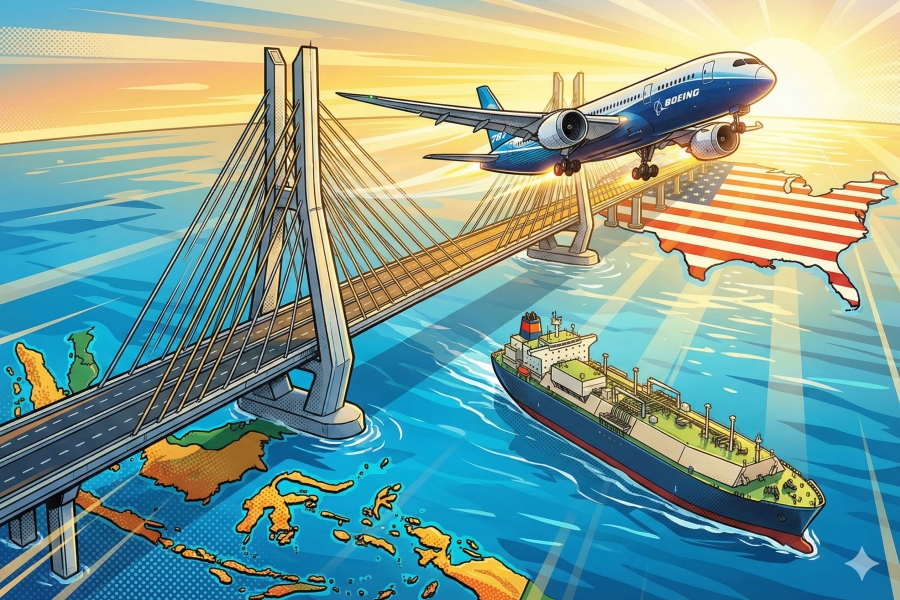
In the latest economic landscape, public attention is focused on the challenges of international trade and domestic inflationary pressure toward the end of the year. The RI-US tariff deal is under threat of failure, a risk that could affect Indonesia's trade balance and economic stability, although Indonesia affirmed it would continue to import oil and gas from the US. On the other hand, Russia-Indonesia trade relations have strengthened by 17% over the last nine months following the meeting between President Prabowo and President Putin. At the domestic level, the Central Statistics Agency (BPS) noted price increases for various food commodities such as shallots, chilies, and chicken eggs ahead of the Christmas and New Year (Nataru) period. The government has thus been asked to fix the food import system to mitigate the potential price surge. This overall development illustrates the dynamic between bilateral trade risks, the strengthening of non-traditional alliances, and the challenge of stabilizing food prices.
The RI-US tariff deal is judged to be at risk of failure, which potentially pressures Indonesia's trade balance and overall economic growth. Although RI-US trade deal negotiations are reportedly deadlocked, Indonesia affirmed it would continue to import oil and gas (Migas) from the US. This assurance demonstrates a crucial energy need for Indonesia.
As an effort to diversify markets and strengthen non-traditional alliances to offset trade uncertainty with the US, trade cooperation between Russia and RI is reported to have increased by 17% over a nine-month period following the meeting between President Prabowo and President Putin.
On the domestic side, the Central Statistics Agency (BPS) noted a rise in food prices ahead of the Nataru period, including shallots, chilies, and chicken eggs. This increase causes inflation concerns at the end of the year, leading the government to be asked to reform the food import system. This reform aims to ensure stable supply and control inflation toward the end of the year.
The latest information has significant implications for macroeconomic stability, trade policy, and inflation control. The risk of the RI-US tariff deal failing implies export uncertainty and pressure on the Rupiah, which must be balanced by strengthening non-traditional trade cooperation such as with Russia. The increase in food prices ahead of Nataru implies disruption to purchasing power and the potential for higher inflation at the end of the year. This implies the need for rapid government intervention and structural reform in the food import system to guarantee supply availability and dampen price volatility.
In summary, the government is faced with a dual threat: trade uncertainty with the US which threatens the trade balance, offset by strengthening trade relations with Russia. Domestically, the increase in food prices ahead of Nataru demands that the government immediately fix the food import system in order to control inflation and maintain the stability of public purchasing power at the end of the year.











 tpc.consulting
  tpc.consulting
  info@taxindo.co.id