


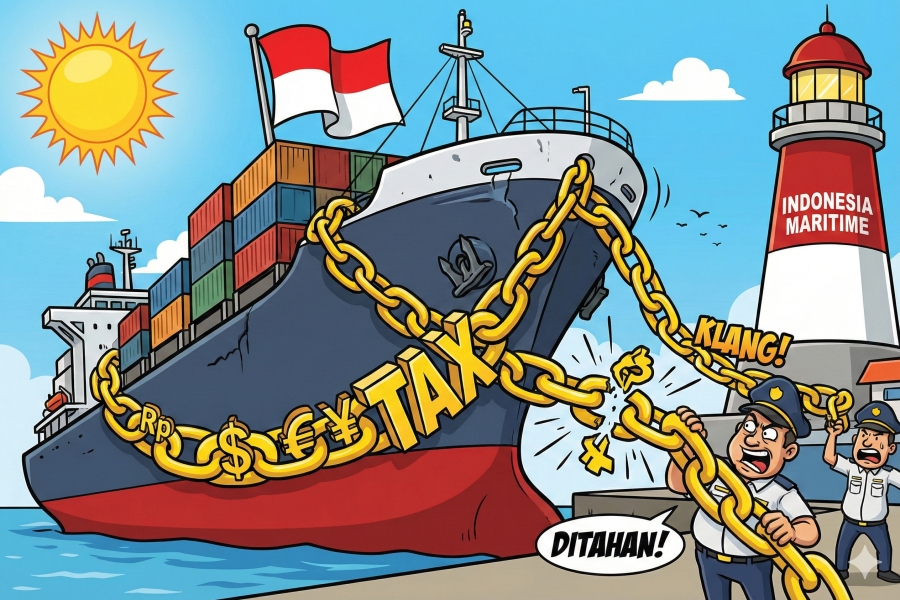
The Indonesian government is moving swiftly to plug a trillion-rupiah state revenue leak from foreign ship taxes that have historically evaded payment obligations. The Ministry of Finance and Ministry of Transportation are synergizing to draft new derivative regulations requiring tax clearance before sailing permits are issued. This momentum for governance improvement is further complemented by Indonesia's reelection to the IMO Council, reaffirming the nation's strategic maritime position globally.
Strong protests from the national shipping industry players, united under the Indonesian National Shipowners’ Association (INSA), have finally yielded a positive response from the government. Currently, an unequal treatment exists where national ships must clear their taxes, while foreign ships freely enter and exit Indonesian waters without depositing income tax by exploiting regulatory loopholes. Maritime experts highlight the modus operandi of using invalid Certificates of Domicile (CoD) to claim tax treaty facilities, causing a potential state revenue loss of up to Rp19 trillion, with only around Rp600 billion actually realized.
Responding to this urgency, the Directorate General of Taxes (DJP) at the Ministry of Finance emphasized that they are not merely revising old rules but are drafting specific derivative regulations from KMK 417/1996. This strategic move will be synchronized with the Ministry of Transportation's policies, where Minister of Transportation Dudy Purwagandhi has expressed readiness to make tax payment proof an absolute requirement for issuing Sailing Approval Letters (SPB). This cross-ministerial synergy is expected to establish the "No Tax, No Sail" principle, guaranteeing that every foreign ship must settle its obligations to the state before weighing anchor.
Amidst these intensive domestic regulatory improvements, proud news arrives from the international stage, further solidifying Indonesia's maritime authority. Indonesia has successfully been reelected as a member of the International Maritime Organization (IMO) Council Category C for the 2026–2027 period, securing support from 138 countries. This diplomatic achievement serves not only as global recognition of Indonesia's strategic role in global trade routes but also as powerful capital for the government to enforce fiscal sovereignty in its own waters without hesitation.
The government's decisive step in closing this tax loophole brings a breath of fresh air for a healthier and fairer business competition climate for national shipping entrepreneurs. The implementation of this rule potentially boosts state revenue significantly from the maritime sector while eliminating market distortions that have long disadvantaged local players. For investors and global business players, this signals that Indonesia is increasingly serious about improving customs and tax governance that is transparent and legally certain.
In conclusion, the combination of strict domestic law enforcement and strong international recognition places Indonesia in a golden momentum to reform its maritime economy. The government must immediately ratify these derivative regulations and integrate the tax payment system with Inaportnet to ensure real-time and automated monitoring.














 tpc.consulting
  tpc.consulting
  info@taxindo.co.id