



This Tax Court Decision provides crucial clarity on the limits of applying the Arm’s Length Principle (ALP/PKKU) and the definition of income from debt forgiveness in the case of Debt-to-Equity Swap (DES). PT SP successfully demonstrated that this corporate restructuring action did not create an object of Corporate Income Tax (CIT), resulting in the full cancellation of the Out-of-Business Income correction amounting to IDR 390,871,389,030.00 asserted by the Directorate General of Taxes (DJP). The core of this dispute lies in the fundamental interpretive difference of whether a DES should be valued based on fair market price or merely treated as a balance sheet reclassification using legally agreed-upon par value.
The conflict began when the DJP, utilizing its authority under Article 18 paragraph (3) of the Income Tax Law (UU PPh), claimed that the DES between PT SP and its affiliated party was not fair. The DJP argued that the value of the debt converted was higher than the fair market value of PT SP’s shares, which was determined through a Business Valuation method. This positive difference in value was interpreted by the DJP as income from debt forgiveness, pursuant to Article 4 paragraph (1) letter k of the UU PPh. Based on the valuation result, which yielded a significantly low share value, the DJP added hundreds of billions of Rupiah to PT SP’s taxable income.
On the other hand, PT SP consistently argued that DES was neither debt forgiveness nor an exchange of assets. PT SP asserted that the transaction was purely a balance sheet reclassification, where the debt was settled by issuing new shares at par value. Since there was no actual economic gain and no difference was considered a share premium/discount upon capital injection, there should be no CIT object. PT SP rejected the DJP’s Business Valuation results, emphasizing that the share’s par value, established in the notarial deed, should be the legally valid and relevant value for tax purposes.
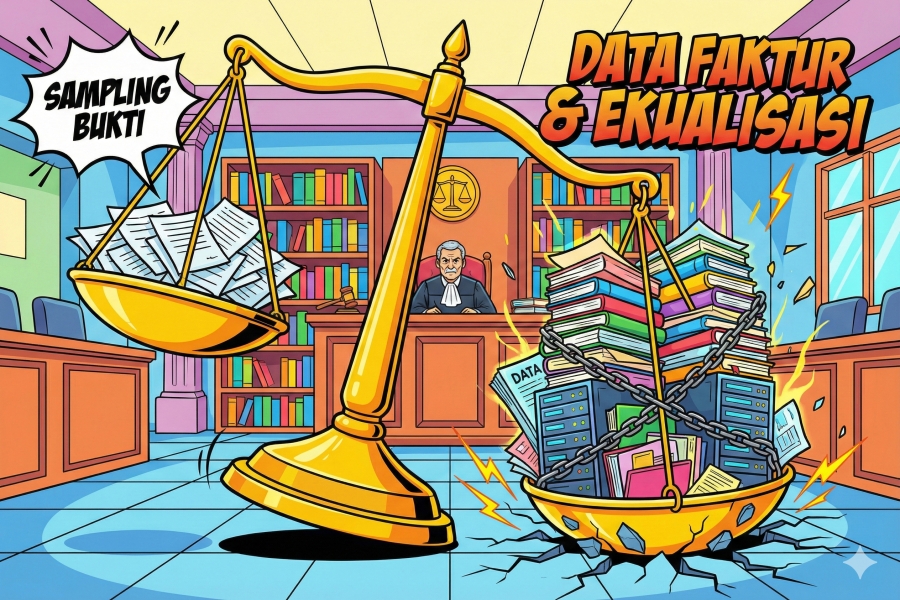
The Tax Court Panel of Judges firmly sided with PT SP in their decision. The Panel’s legal consideration focused heavily on the substance of the transaction and corporate legality. The Judge stated that DES is an internal restructuring that does not meet the criteria for income from debt forgiveness. Most critically, the Panel ruled that the DJP failed to provide a strong legal basis to enforce the fair value determined by the Business Valuation as a basis for the CIT correction, especially when the par value used was consistent with the legal agreements. The cancellation of this primary correction automatically nullified the consequential correction made to PT SP’s Prior Year Loss Compensation.
The implications of this decision are significant for Taxpayers undertaking debt restructuring with affiliates. The ruling affirms that not all affiliated transactions must be subject to the ALP test if the transaction does not involve the transfer of goods, services, or assets, but merely reclassifies the balance sheet. This provides legal certainty that the legally recognized par value in the deed of establishment can be upheld as the basis for a DES transaction, thereby limiting the DJP’s scope to unilaterally use business valuations as a basis for Corporate Income Tax corrections.
A Comprehensive Analysis and the Tax Court Decision on This Dispute Are Available Here.



















 tpc.consulting
  tpc.consulting
  info@taxindo.co.id