


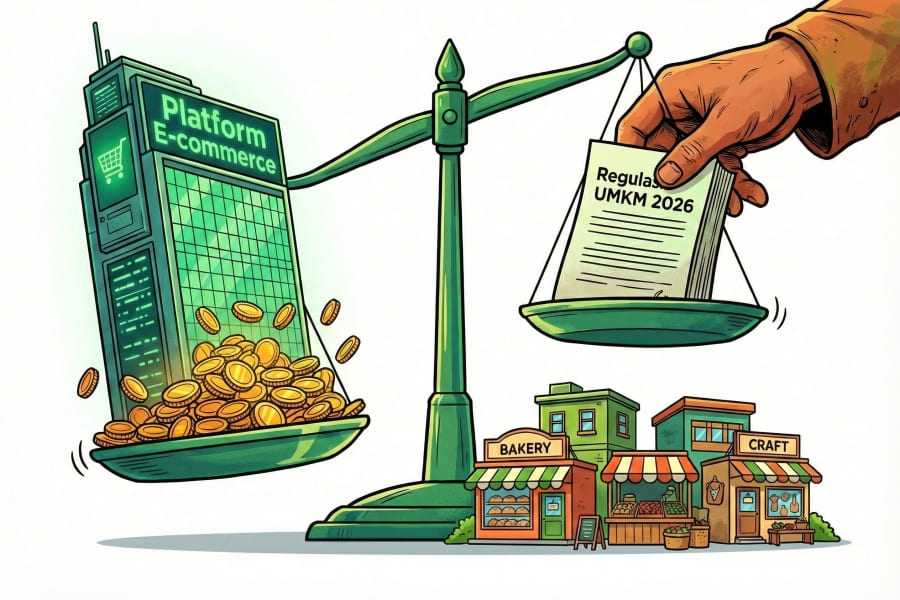
Shopee and Tokopedia officially raise seller administrative fees up to 10% in early 2026 to maintain platform business sustainability. The government, through the Ministry of MSMEs, is moving quickly to draft new regulations to protect small merchants from excessive cost burdens left to market mechanisms. This intervention aims to balance e-commerce profitability with the competitiveness of local products through the revision of digital trade rules.
Shopee has officially announced a restructuring of administrative fees for sellers effective January 2026. The e-commerce giant set the highest rate at 10% for fast-moving consumer goods (FMCG), daily necessities, and certain fashion products, while baby equipment and high-value goods like jewelry are charged lower rates ranging from 4.25% to 6.75%. This strategic move is claimed by the Indonesian E-Commerce Association (idEA) as a reasonable effort by platforms to achieve long-term business sustainability through mature internal calculations.
In addition to regular admin fees, Shopee also updated its service policy for the pre-order system by charging an additional fee of 3% per completed product quantity. A similar policy was previously implemented by Tokopedia, which raised service fees gradually since October 2025, although they provided special discount schemes for sellers with high service rates. idEA Chairman, Hilmi Adrianto, stated that each platform has autonomy in determining pricing strategies to maintain service quality.
The surge in cost burdens borne by merchant partners triggered a reactive response from the government to immediately take concrete regulatory intervention steps.
The Ministry of MSMEs expressed full commitment to drafting new regulations to protect small business players from platform fee pressures deemed increasingly suffocating. Minister Maman Abdurrahman emphasized that this rule will refer to Law Number 20 of 2008 and Government Regulation Number 7 of 2021 so that admin fee determination is no longer left entirely to market mechanisms. The government considers state presence crucial to ensuring business activities in the digital space continue to provide fair growth room for the people's economy players.
This protection strategy is executed through close collaboration with the Ministry of Trade, which is revising Trade Minister Regulation Number 31 of 2023. The revision covers three main points: setting minimum import prices, standardizing local products, and regulating platform fee transparency, including the obligation to notify the government before raising rates. Deputy for Small Business, Temmy Satya Permana, promised special incentives in the form of fee cuts for micro-enterprises and domestic products in the upcoming regulation.
This aggressive increase in operational costs potentially erodes MSME profit margins drastically or forces them to raise selling prices to end consumers. This dilemmatic situation could weaken the competitiveness of local products against the onslaught of imported goods if affirmative regulations are not immediately realized. The balance of the digital economic ecosystem is now at stake between the platforms' need to generate profit and the survival of millions of small merchants who are the backbone of the national economy.
Government intervention through transparent platform fee regulations is the absolute solution awaited to create inclusive and sustainable digital economic justice. MSME players are advised to immediately recalculate product price structures and utilize local algorithm priority features smartly while waiting for the official legal framework to be issued.















 tpc.consulting
  tpc.consulting
  info@taxindo.co.id