



Finance Minister Purbaya Yudhi Sadewa uncovered tax avoidance practices worth Rp4 trillion per year through a sudden inspection of steel factories using the cash basis transaction mode. This finding pushed the Directorate General of Taxes (DJP) to urge the realization of cash transaction limitation rules to close state revenue leakage gaps. This aggressive step is accompanied by a reshuffle of 40 tax officials and the government's commitment not to raise tax rates to maintain economic growth momentum.
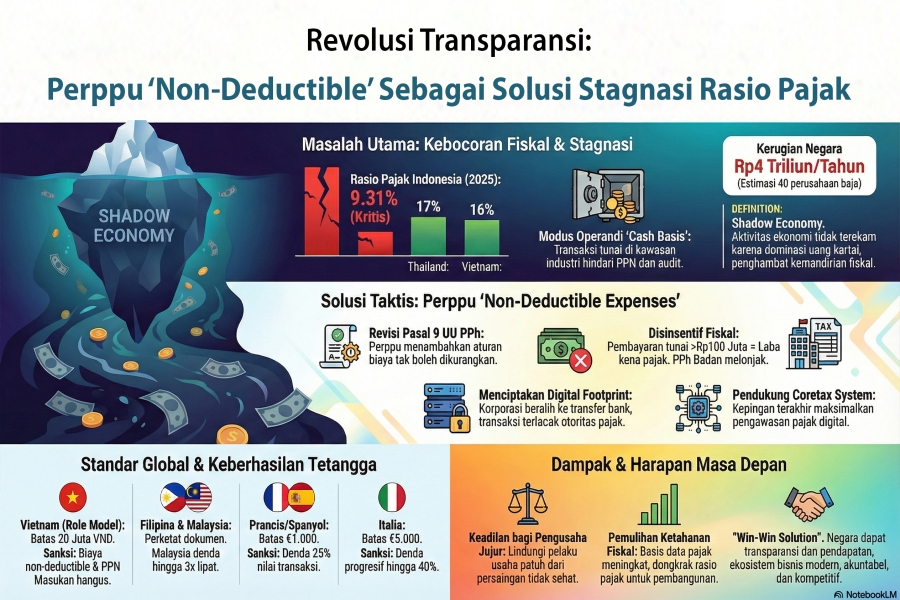
Minister of Finance Purbaya Yudhi Sadewa conducted a sudden inspection (sidak) of a steel factory, PT PSM, in Tangerang which was indicated to be conducting massive tax avoidance through cash basis transaction modes. The fiscal authority found that around 30 to 40 steel companies used a similar pattern, namely selling construction materials without tax invoices and hiding company turnover in the personal accounts of management, shareholders, or employees. This fraudulent practice, which has been going on for a long time, is estimated to cost the state up to Rp4 trillion annually due to the loss of potential Value Added Tax (VAT) and significant depreciation of Corporate Income Tax (PPh) obligations. This shocking field finding serves as strong empirical evidence for the government to immediately reform the payment system in large-scale business transactions.
Director General of Taxes Bimo Wijayanto emphasized that this case is a crucial momentum for the government to urge the realization of cash transaction limitation rules (uang kartal) whose discourse has been rolling for a long time. The DJP assesses that the use of cash in jumbo amounts makes it easy for rogue businessmen to eliminate audit trails, so the transition to digital payment gateways and QRIS must be immediately mandatory to narrow the movement space for illegal "players". In addition to the steel industry, the tax authority is now also targeting other manufacturing sectors based on construction materials, such as the furniture industry, which are strongly suspected of using similar modi operandi to deceive tax officers. This effort to close cash transaction loopholes runs in parallel with massive internal improvements within the tax authority body.
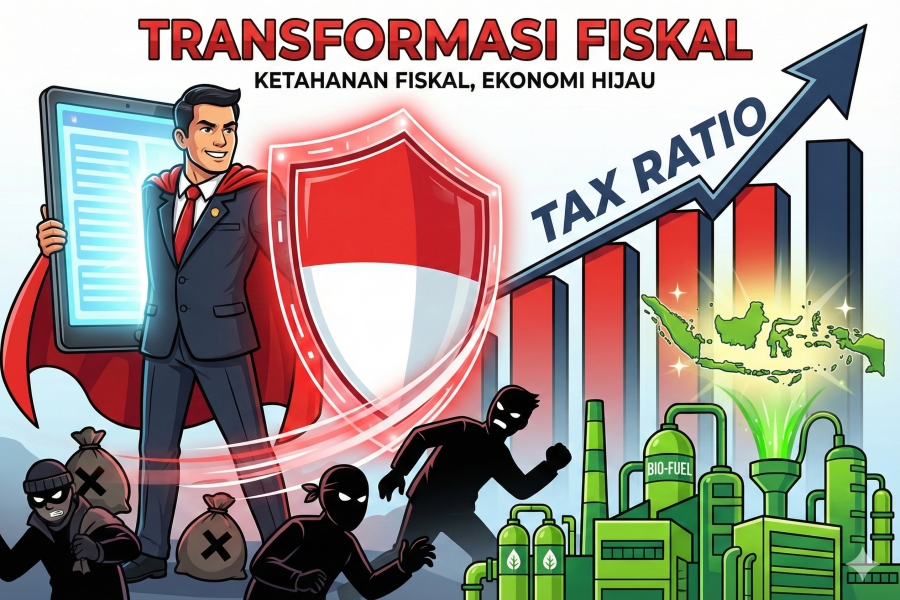
Responding to the drop in the 2025 tax ratio to the level of 9.31 percent, Purbaya immediately overhauled the organizational structure by inaugurating 40 Echelon II officials within the DJP. The State Treasurer admitted to having "trouble sleeping" seeing revenue performance that was not optimal amidst a growing economy, so he targeted this new team to be able to hoist the tax ratio to the figure of 11 to 12 percent in 2026 through a more aggressive but measured strategy. Purbaya emphasized that this performance-based rotation aims to place the best people in strategic positions to ensure revenue targets are achieved without compromise. Despite demanding high performance from his apparatus, the government continues to take a wise approach regarding the tax burden for the wider community.
The government ensures that it will not raise tax rates in the near future even though 2025 economic growth was recorded at 5.11 percent and Quarter IV reached 5.39 percent. Purbaya assesses that raising rates at this time risks hitting people's purchasing power which has just recovered, so the revenue optimization strategy will be focused on extensification and law enforcement against tax evaders, not burdening compliant taxpayers. The government's main focus is now shifting to efforts to spur quality ministry spending and attract investment through debottlenecking to keep the economic engine hot.
The government's firm step to limit cash transactions and crack down on tax evaders brings serious implications for the business world to immediately switch to a transparent and digital financial system. For industry players who have been compliant so far, this policy will create a fair competition climate because market prices are no longer distorted by cheating players who can sell cheap goods because they do not pay taxes.
The government has beaten the drums of war against the underground economy through a combination of data intelligence, cash limitations, and bold field actions. Business players must immediately fix their financial governance because the era of untraceable cash transactions will soon end for the sake of Indonesia's fiscal sovereignty.












 tpc.consulting
  tpc.consulting
  info@taxindo.co.id