


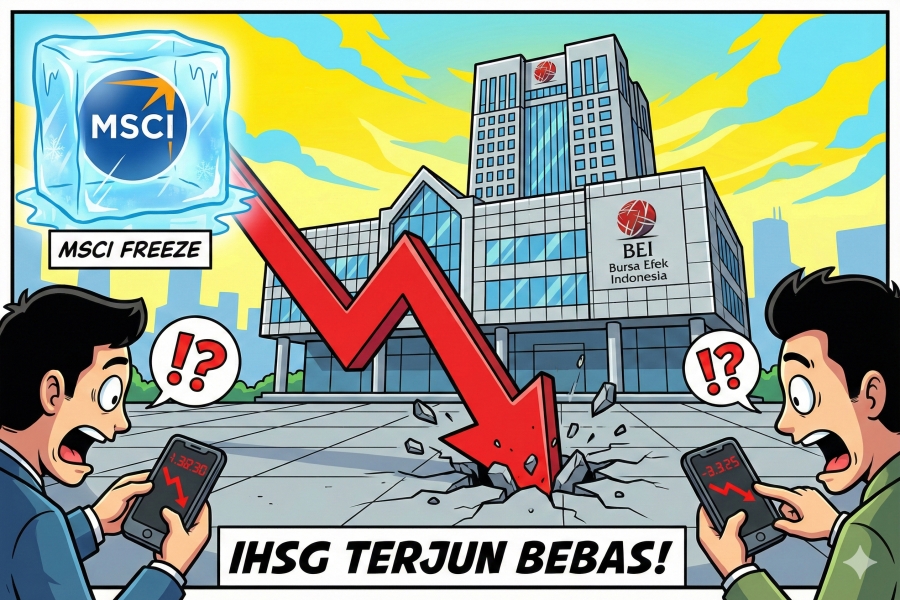
The Indonesian stock index suffered a drastic crash of up to 8% triggering a trading halt after MSCI froze index weight adjustments due to data transparency issues. As a global investment benchmark, MSCI's decision forced Goldman Sachs to downgrade Indonesian stocks and triggered potential massive foreign capital outflows. The government pledged to fix governance before the May 2026 deadline to prevent a market status downgrade to Frontier Market.
Mass panic struck the Jakarta exchange floor as the Composite Stock Price Index (IHSG) plummeted more than 7 percent, forcing authorities to activate the trading halt mechanism to cool down the market,. This massive sell-off exploded after MSCI froze Indonesia's stock weight adjustments for the February 2026 period due to serious concerns regarding public ownership transparency and stock manipulation practices,. Brutal selling pressure immediately hit giant banking stocks like BCA and BRI, and decimated major conglomerates like the Barito Group, which experienced very deep price corrections during the morning trading session,.
Amidst this market chaos, global financial giant Goldman Sachs immediately took drastic steps by downgrading Indonesian stocks to "underweight" due to investment eligibility risks. They calculated a terrifying potential capital outflow reaching Rp217 trillion (equivalent to US$13 billion) if Indonesia's status is indeed downgraded from an Emerging Market to a Frontier Market. This huge risk forces global investment managers to immediately rebalance their portfolios to avoid further losses due to the predicted decline in market liquidity.
This severe shock occurred because MSCI (Morgan Stanley Capital International) is not just an ordinary research institution, but the primary barometer determining the flow of hundreds of trillions of rupiah from global institutional investors,. The indices they formulate serve as the absolute compass for world investment managers in structuring portfolios, so the inclusion of a stock on MSCI's radar guarantees infusions of fresh liquidity and significant price increases,. Conversely, when MSCI freezes adjustments or expels issuers from its list, the market responds with brutal sell-offs due to the loss of confidence from foreign investors who adhere strictly to these index benchmarks,.
Given this vital role, the Indonesian government responded to this situation seriously, with Minister of Finance Purbaya Yudhi Sadewa together with the OJK guaranteeing that the investor data reporting system improvements would be completed before the May 2026 deadline,. The government views this turbulence as a temporary shock and is fully committed to fixing economic fundamentals and free float data governance to restore foreign investor confidence and maintain the emerging market status,.
This market shock brings direct impact to business players and investors who must face high volatility and significant asset value depreciation in a short time, especially in big-cap stocks. Issuers are now under immense pressure to disclose share ownership data transparently to avoid removal from global indices which could dry up their stock liquidity. For the general public, this instability serves as a harsh warning about capital market investment risks, but simultaneously opens opportunities for selective accumulation in fundamentally strong stocks that are now discounted.
This event is a hard slap that must become a momentum for total improvement for Indonesian capital market regulators to save the country's credibility in the eyes of the world. Investors are advised to refrain from excessive panic (wait and see) and start targeting defensive stocks once the storm subsides, while authorities must prove their transparency improvement promises tangibly before the final verdict is passed.
Keywords: MSCI, IHSG, Indonesia Stock Exchange, Trading Halt, Foreign Investors, Goldman Sachs, Blue Chip Stocks, OJK, Frontier Market, Market Transparency













 tpc.consulting
  tpc.consulting
  info@taxindo.co.id