



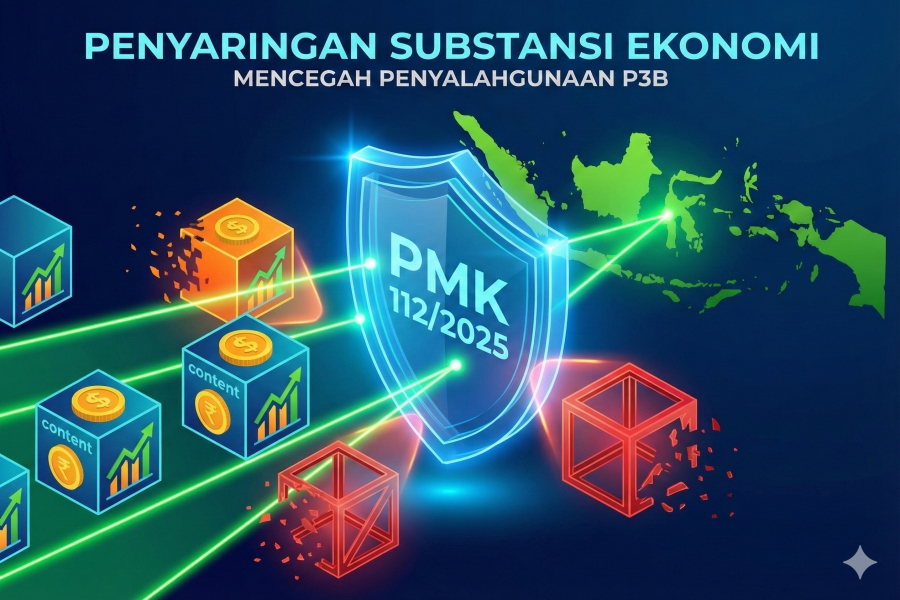
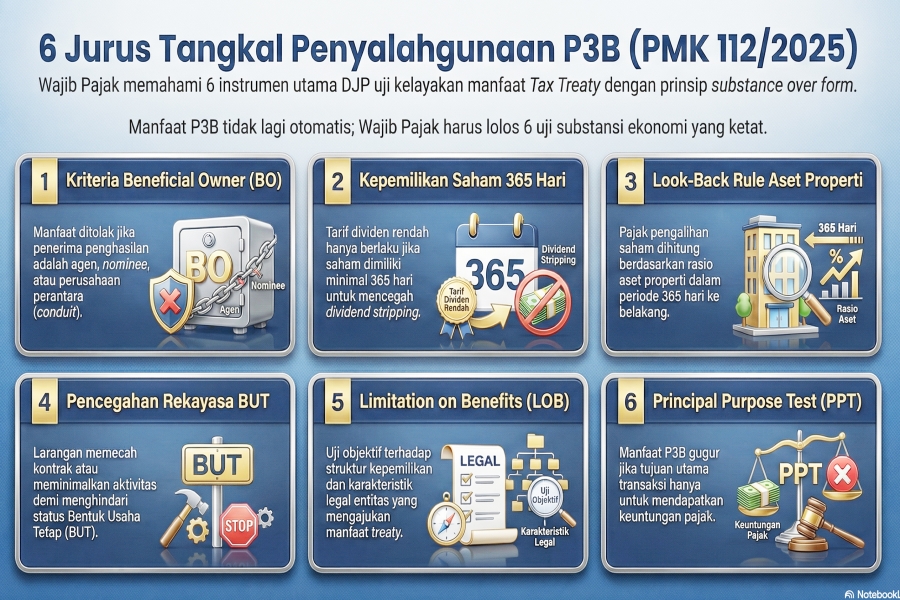
Indonesia's international tax landscape has undergone a significant transformation with the issuance of Minister of Finance Regulation Number 112 of 2025 (PMK 112 of 2025) concerning Procedures for the Implementation of Double Taxation Agreements (DTA). This regulation serves as the implementing rule for Article 50 paragraph (2) of Government Regulation Number 55 of 2022, marking a new era in the government's effort to prevent base erosion and profit shifting. One of the most crucial instruments detailed in this regulation is the application of the Principal Purpose Test (PPT). The PPT acts as a safeguard to prevent treaty abuse practices by Non-Resident Taxpayers (WPLN) seeking to obtain improper tax benefits.
PMK 112 of 2025 explicitly stipulates that the application of lower tax rates or tax exemptions based on a DTA is not an absolute right granted automatically. Article 2 paragraph (4) establishes three cumulative conditions for a Non-Resident Taxpayer to be entitled to DTA benefits: they must not be an Indonesian resident taxpayer, they must be a resident of the DTA partner country, and they must not engage in treaty abuse.
The definition of treaty abuse is clarified in Article 2 paragraph (7) as an attempt by a Non-Resident Taxpayer to reduce, avoid, or defer tax payments that would otherwise be due, contrary to the object and purpose of the DTA itself. The object and purpose of a DTA, as explained in Article 2 paragraph (8), is to eliminate double taxation without creating opportunities for non-taxation or reduced taxation through tax evasion or avoidance, including through treaty-shopping schemes.
In this context, the PPT emerges as a General Anti-Avoidance Rule. According to Article 18 paragraph (3) letter f, the PPT is categorized as a provision to prevent treaty abuse practices, implemented based on the provisions within the DTA itself. This means the PPT is applied to ensure that DTA facilities are enjoyed only by entities conducting substantial and legitimate economic activities, not merely for tax purposes.
The core regulation regarding the PPT is found in Article 28 of PMK 112 of 2025. Article 28 paragraph (1) defines the PPT as a provision stating that DTA benefits shall not be granted if "the principal purpose or one of the principal purposes" of a transaction or arrangement is to obtain said DTA benefit, either directly or indirectly.
The phrase "one of the principal purposes" is key. It lowers the burden of proof for tax authorities. The authority does not need to prove that tax was the sole reason for the transaction; proving that obtaining a tax benefit was one of the dominant purposes of the scheme is sufficient.
To determine whether a transaction fails the PPT, Article 28 paragraph (3) provides comprehensive guidance in the form of ten analysis factors that must be considered by the Director General of Taxes. This analysis is not partial but looks at the entirety of facts and circumstances ("reasonable to conclude having regard to all relevant facts and circumstances"). These ten factors include:
To provide clarity on implementation, the Annex of PMK 112 of 2025 provides "Example 6," which illustrates the application of PPT in a case of shareholding manipulation to obtain a lower dividend withholding tax rate.
In the example, an entity named G Ltd. from Country X holds 20% shares in PT I (an Indonesian Taxpayer). The Indonesia-Country X DTA provides a special dividend tax rate of 5% if shareholding is at least 25%. Below that, the rate is 15%. PT I announces a dividend distribution on March 31. Suspiciously, on March 25 (six days before distribution), G Ltd. increases its shares to 25%. Then, immediately after the dividend is received, on April 10, G Ltd. sells back the 5% shares, returning its ownership to 20%.
Based on these facts, it is "reasonable to conclude" that the principal purpose of the arrangement was to obtain the DTA benefit. Consequently, the 5% rate benefit is denied, and PT I is obliged to withhold tax at the 15% rate applicable for ordinary portfolio holdings, or even the normal 20% rate if deemed wholly ineligible.
The enactment of PMK 112 of 2025 empowers the Director General of Taxes to test the compliance of Non-Resident Taxpayers. As stipulated in Article 18 paragraph (1), the Director General of Taxes has the authority to examine whether the tax withholding performed by the tax withholder is appropriate or if abuse has occurred.
If a Non-Resident Taxpayer is proven to fail the PPT, then according to Article 18 paragraph (5) and Article 28 paragraph (3), DTA benefits will be denied. This means taxation will revert to domestic provisions (Income Tax Law with a 20% rate) or higher DTA provisions that should have applied absent the avoidance scheme.
Minister of Finance Regulation Number 112 of 2025 confirms that Indonesia is serious about combating cross-border tax avoidance practices. The Principal Purpose Test is no longer just a theoretical discourse in multilateral instruments (MLI) but is firmly embedded in Indonesia's domestic law with clear operational criteria. For cross-border business operators, this demands strong commercial justification (business purpose) in every transaction structure and corporate arrangement. The era where aggressive tax schemes could hide behind the formalities of DTA documents is over; now, economic substance and transaction purpose are the primary parameters in determining taxing rights.














 tpc.consulting
  tpc.consulting
  info@taxindo.co.id