


Executive Summary:
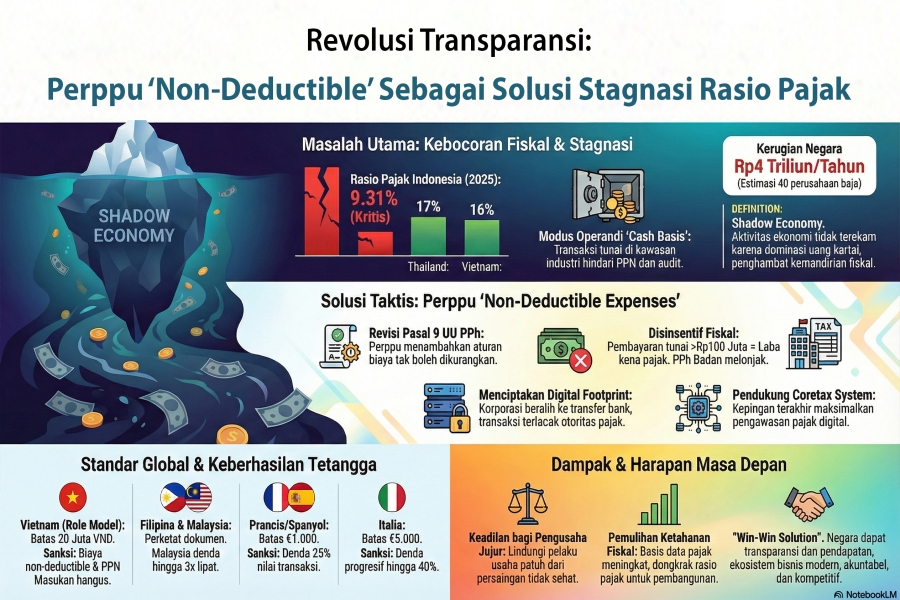
Amidst findings of trillions in cash-based tax evasion and FY’s 2025 tax ratio only 9.31%, Indonesia requires a smart and rapid legal solution. Issuing a Government Regulation in Lieu of Law (Perppu) to revise Article 9 of the Income Tax Law, designating cash payments above a certain limit as non-deductible expenses, is a precise strategy to overcome legislative deadlock of the Cash Transaction Restriction Bill that has been stalled since 2014. Backed by the success of similar models in Vietnam and strict European standards, this step is believed to force economic transparency, support the Coretax System, and restore the state's fiscal resilience.
A recent surprise inspection in the Tangerang industrial area has opened the public's eyes to the urgency of national tax system reform. Minister of Finance Purbaya Yudhi Sadewa, alongside Director General of Taxes Bimo Wijayanto, revealed business practices at a major steel factory conducting construction material sales entirely on a cash basis. This modus operandi is not merely a conventional payment preference but a cunning strategy to evade Value Added Tax (VAT) and eliminate audit trails. As a result of such practices indicated across 40 similar companies, the state bears an estimated revenue loss of up to IDR 4 trillion annually—funds that could have built thousands of schools or health centers.
This momentum must be viewed positively as an entry point for the government to reorganize Indonesia's financial oversight architecture. Tax authorities now possess strong empirical grounds to offer a progressive legal solution: restrictions on cash transactions (uang kartal). The narrative being built is no longer just about criminalization, but an effort to rescue the State Budget (APBN) structure through the modernization of a transparent and accountable payment system.
This micro-condition on the ground mirrors the macroeconomic challenges that must be immediately answered with a bold legislative breakthrough.
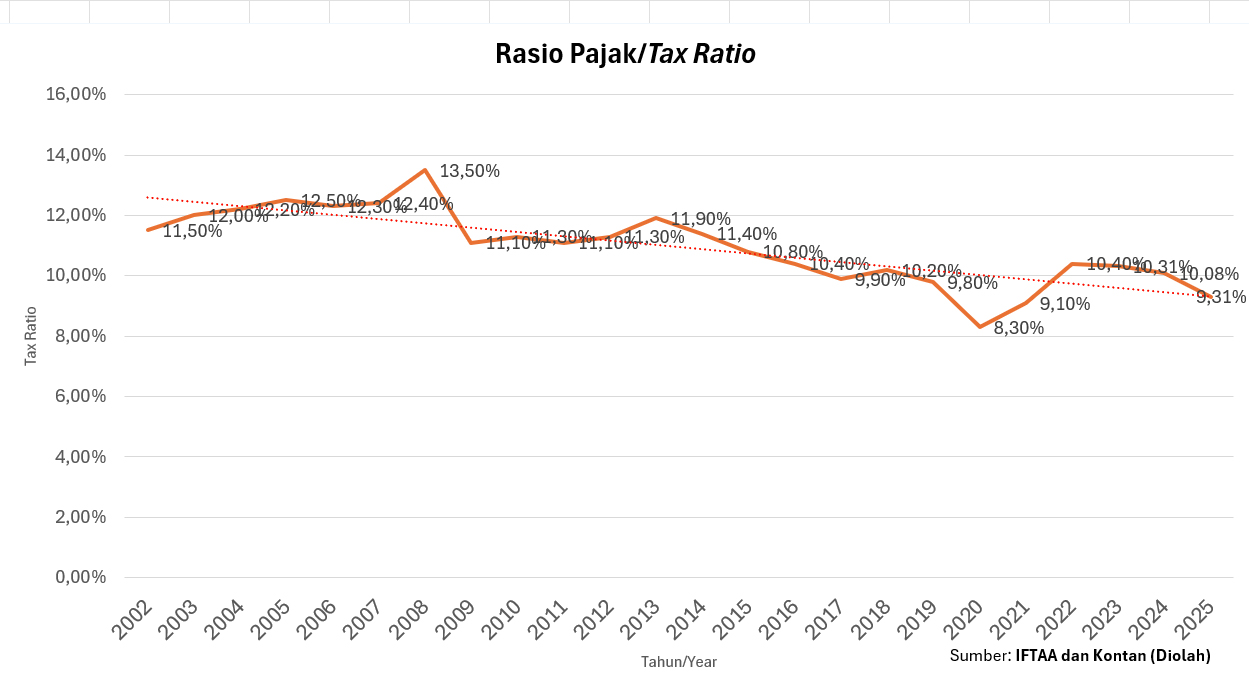
Historical data shows that Indonesia faces a tough challenge in increasing its tax ratio over the last 25 years. After touching 13% in 2008, this ratio has experienced a stagnant trend. In fact, Indonesia 2025’s tax ratio fell to a critical level of only 9.31%. This figure lags far behind neighbors like Thailand and Vietnam, and is below the ideal standard for maintaining national fiscal independence.
https://www.taxindo.co.id/assets/images/blog/img/addimg_revolusi_transparansi__perppu_‘non_deductible’_siap_menjadi_game_changer_dobrak_stagnasi_tax_ratio_dan_selamatkan_ekonomi_1e9f6.jpg
This low ratio indicates a massive amount of unrecorded economic activity (shadow economy) due to the dominance of cash transactions (uang kartal) escaping the tax safety net. In this situation, waiting for the ratification of the Cash Transaction Restriction Bill (RUU PTUK) through the normal legislative process, often hampered by political issues in parliament, is not a profitable option. The country needs acceleration.
Efforts to restrict cash transactions (uang kartal) in Indonesia actually have a long history full of dynamics, but unfortunately often end in legislative deadlocks. Since 2014, the National Law Development Agency (BPHN) of the Ministry of Law and Human Rights has prepared the Academic Paper for the Bill on Cash Transaction Restrictions. At that time, the urgency of this bill was driven by the need for economic efficiency and the prevention of money laundering (TPPU) and corruption, with an initial proposal of a maximum cash transaction limit of IDR 100 million. Although it was included in the priority National Legislation Program (Prolegnas) for the medium term 2015-2019, the discussion of this Bill experienced significant stagnation.
The main obstacles often came from political resistance. Some parties in parliament were concerned that this rule would complicate economic activities in areas not yet reached by banking access, as well as its potential impact on the flexibility of political campaign funds which still rely heavily on physical cash. Throughout the period 2019 to 2024, although the Financial Transaction Reports and Analysis Center (PPATK) continued to push for this Bill as a vital anti-money laundering instrument—especially after the exposure of various bribery cases worth billions of rupiah using cash—the Bill failed to be passed.
However, a positive narrative is now starting to rebuild in line with the improving digital payment infrastructure across the country. Bank Indonesia has successfully implemented QRIS and fast payment systems reaching micro-merchants, debunking the argument that non-cash transactions are difficult. The government continues to assure parliament that this Bill provides logical exceptions for frontier, outermost, and underdeveloped regions (3T) as well as emergency conditions, ensuring the interests of the common people remain protected.
Now, with strong encouragement from the Directorate General of Taxes (DJP) following the discovery of industrial tax evasion, this Bill is regaining a golden momentum for ratification in the coming legislative period by reflecting on the success of neighboring countries.
The government has a golden opportunity to issue a Government Regulation in Lieu of Law (Perppu) as a smart tactical step. This Perppu does not need to enter the criminal realm which is often a subject of heated debate, but directly targets business profit logic through fiscal instruments.
This breakthrough can be achieved by adding a provision to Article 9 of the Income Tax Law (UU PPh). The core idea is simple yet massively impactful: any business cost or expenditure above a certain amount (e.g., IDR 100 million) paid in cash (uang kartal) is designated as a non-deductible expense. This means such costs cannot be used to reduce gross income when calculating Taxable Income (PKP).
This is a brilliant "fiscal disincentive" strategy. Entrepreneurs are not banned from holding cash (uang kartal), but if they dare to transact in large amounts of cash, the consequence is a drastic spike in Corporate Income Tax burdens because their operational costs cannot be deducted in the calculation of taxable profit. Naturally, corporations will voluntarily switch to bank transfers for tax efficiency, ultimately creating a transparent digital footprint for state oversight systems.
Optimism for this policy is grounded in the success of neighboring ASEAN countries that have already implemented strict controls on cash (uang kartal) for economic stability.
Vietnam is the most relevant role model for this Perppu proposal. The Vietnamese government enforces a rule where business expenditures above a certain limit (such as 20 million VND for invoices, or approx. 5 million VND in newer rules) must be paid via non-cash channels. If violated, the expenditure is automatically not recognized as a tax-deductible expense and the Input VAT is forfeited (cannot be credited). This policy has proven successful in forcing economic formalization without needing repressive police approaches, as the tax system works automatically to discipline business actors.
The Philippines takes preventive steps through strict banking gatekeeping. The authorities tighten supervision on large cash withdrawals (uang kartal) to close the leak of money from the formal system to the underground economy that is often used for illegal activities.
Malaysia implements a very strict reporting threshold (RM 25,000) and is finalizing a Cash Transaction Limit rule with significant penalties. Malaysia's progressive step confirms that financial transparency is an absolute requirement to upgrade to a developed nation status.
Beyond ASEAN, European countries have proven that cash restrictions (uang kartal) are a global norm for creating a healthy and fair business ecosystem.
Bulgaria: Enforces heavy fines for corporations violating cash limits, reaching 50% of the transaction value, forcing companies to fully comply with banking channels.
India: Stands out with an aggressive fiscal approach, applying fines of up to 100% of the cash transaction value for violations, effectively forcing the formal sector away from cash.
The year 2025 is a crucial moment with the implementation of the Coretax System. The sophistication of this system will be in vain if the "rat paths" of cash transactions (uang kartal) are not closed. Issuing the non-deductible expenses Perppu is the final puzzle piece that will perfect Indonesia's tax reform.
This step offers a win-win solution: the state gains a significant tax base increase to boost the tax ratio from 9.31%, while honest entrepreneurs are protected from unfair business competition against tax evaders. With strong political support and a positive narrative about economic justice, this Perppu will be a valuable legacy laying the foundation for Indonesia as a country with a modern, transparent, and resilient financial system.
Naskah Akademik Rancangan Undang-Undang Tentang Pembatasan Transaksi Tunai can read here
Reference:













 tpc.consulting
  tpc.consulting
  info@taxindo.co.id