


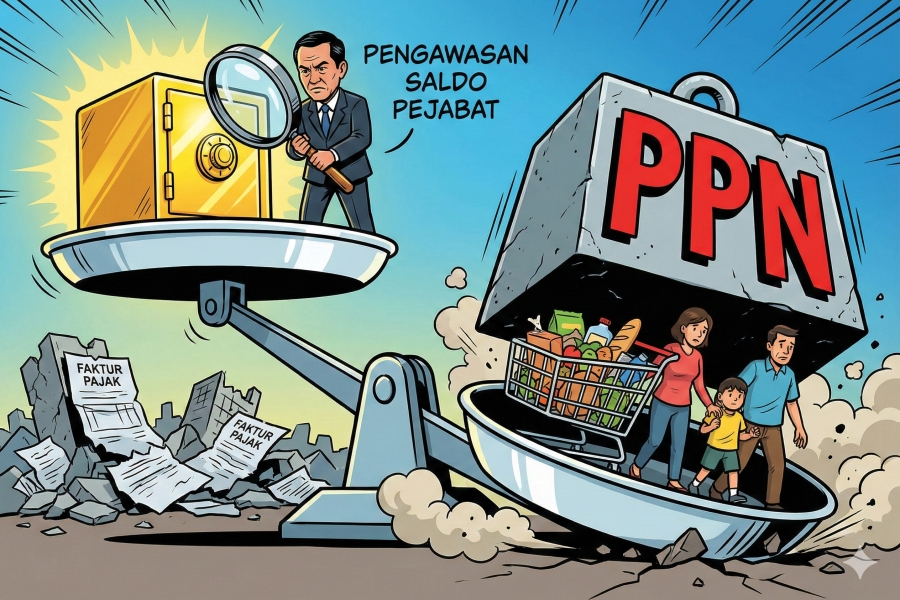
Finance Minister Purbaya Yudhi Sadewa is tightening internal oversight by directly monitoring tax officials' account balances to prevent corruption. On the other hand, fiscal authorities have successfully dismantled a syndicate in a single village producing fake tax invoices causing hundreds of billions in state losses. However, economic challenges in 2026 are becoming more real with a tax structure predicted to increasingly burden the middle class's purchasing power.
Finance Minister Purbaya Yudhi Sadewa now has full access to monitor the savings balances of tax officials ranging from echelon III to echelon I levels to maintain institutional integrity. This preventive step is carried out by comparing the State Officials Wealth Report (LHKPN) with annual banking data to detect unnatural wealth spikes. Purbaya emphasized that although inspection results so far show relatively normal balances, officials are urged not to underestimate the layered surveillance system now implemented by the government. This internal transparency serves as a crucial foundation before tax authorities move to crack down on organized crime harming state revenue out there.
The Directorate General of Taxes (DJP) has just revealed shocking facts regarding the existence of a single village operating massively as a factory for fake tax invoices. Director General of Taxes Bimo Wijayanto stated that this syndicate manipulated the advance tax refund scheme through sham transactions, causing state losses of up to Rp180 billion. Although its operational base was centered in one remote village, the perpetrator network was successfully apprehended in the Banten region, signaling that this illegal practice is a highly organized cross-regional crime. This firm crackdown on the tax mafia is being conducted amidst the government's efforts to balance the state financial sheets facing global economic slowdown challenges.
The government has decided to change the 2026 tax revenue target structure, which is assessed as potentially placing heavier pressure on the middle class. The target for Article 21 Income Tax (PPh 21) revenue for employees has been significantly lowered to Rp251.19 trillion due to the slowing pace of economic growth impacting worker income. Conversely, the state has actually raised the Value Added Tax (VAT) revenue target to Rp995.28 trillion, a move shifting the tax burden from income to consumption. This shift in focus to consumption tax is feared to be regressive as it will hit people's purchasing power regardless of their income level.
Aggressive fiscal policies in the consumption sector and tight internal oversight demand rapid adaptation from all elements of society and bureaucracy. The middle class must prepare to rearrange household financial strategies to face potential price increases, while public officials must maintain integrity amidst increasingly sharp transparency scrutiny.
The government needs to ensure that optimizing state revenue through VAT does not kill people's purchasing power, which is the main engine of national economic growth. Tax intensification strategies must be balanced with real economic stimulus so that 2026 development targets can be achieved without sacrificing people's welfare.














 tpc.consulting
  tpc.consulting
  info@taxindo.co.id