


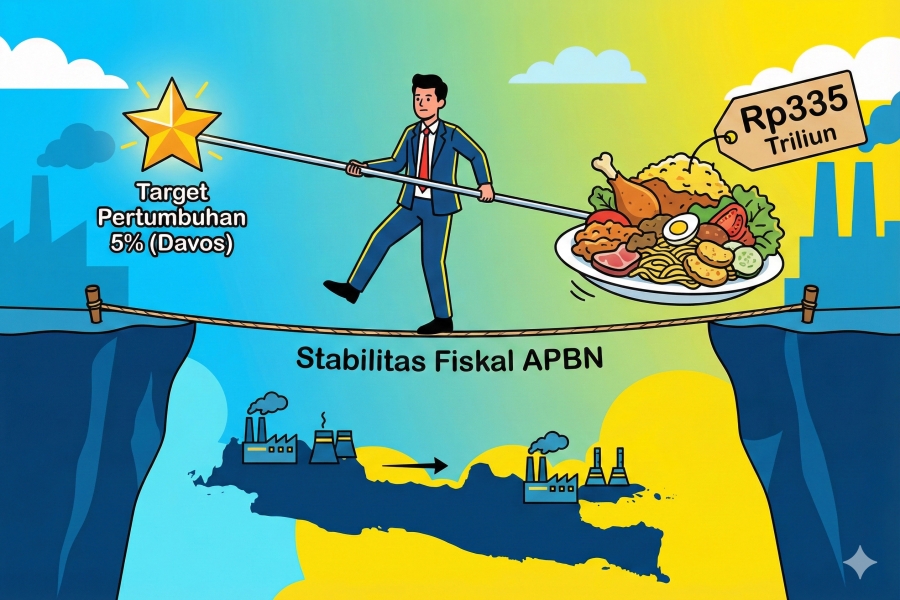
President Prabowo promises economic growth surprises in Davos amidst sharp scrutiny over the risk of inefficiency in the Rp335 trillion free nutritious meal budget. Labor-intensive industry players now face a major dilemma between relocating to Central Java for cheap wages or staying in West Java with high efficiency. The government's macroeconomic strategy is being tested by tight fiscal realities and rapidly changing employment dynamics.
President Prabowo Subianto appeared full of confidence before global CEOs at the World Economic Forum (WEF) 2026 in Davos, Switzerland. He emphasized that Indonesia's economy would provide a significant surprise to the world with growth exceeding 5 percent amidst global uncertainty. Prabowo cited an IMF report calling Indonesia a bright spot in the world economy thanks to fiscal discipline keeping the deficit under 3 percent and controlled inflation. This grand ambition to attract foreign investment must face domestic challenges regarding state budget management currently under sharp scrutiny by economists.
The Free Nutritious Meal (MBG) program, a government flagship, is drawing harsh criticism for consuming a fantastic budget of Rp335 trillion, equivalent to 47.5 percent of the central government's total education budget. Indef economist M. Rizal Taufikurrahman warned of massive inefficiency risks considering 2025 budget absorption only reached 72.5 percent with recipient targets missed by a wide margin.
Finance Minister Purbaya Yudhi Sadewa promised to recomb the fund allocation "line by line" to cut waste and unnecessary budget duplication. While the government struggles to manage this jumbo budget efficiency, the private sector is racking its brains to navigate operational cost burdens increasingly choking business continuity.
The wave of labor-intensive factory relocations from West Java and Banten to Central Java continues in pursuit of a more competitive wage structure. CORE Indonesia Executive Director Muhammad Faisal noted that this industrial migration phenomenon has been occurring for a decade due to striking wage disparities between Greater Jakarta (Jabodetabek) and the Central Java region. However, Indonesian Garment and Textile Association (AGTI) Chairwoman Anne Patricia emphasized that relocation is not the sole solution as many factories remain in high-wage zones by relying on productivity improvements and technological efficiency.
This dilemmatic situation brings serious implications for investors who must now more carefully calculate logistics costs and infrastructure availability, not just be tempted by cheap wages. For the general public, the massive MBG budget allocation eroding the education post demands strict oversight so that paid taxes do not evaporate without a real impact on improving Human Resource quality.
Prabowo's optimism on the world stage will sound discordant if the domestic fiscal foundation is porous due to the immature execution of populist programs and a fragile industrial base. The government must prove that the Rp335 trillion budget for free meals is truly effective in preventing stunting, not just a "money-burning" project, while ensuring industrial policy does not trigger a "race to the bottom" in wages that actually harms long-term worker welfare.















 tpc.consulting
  tpc.consulting
  info@taxindo.co.id