


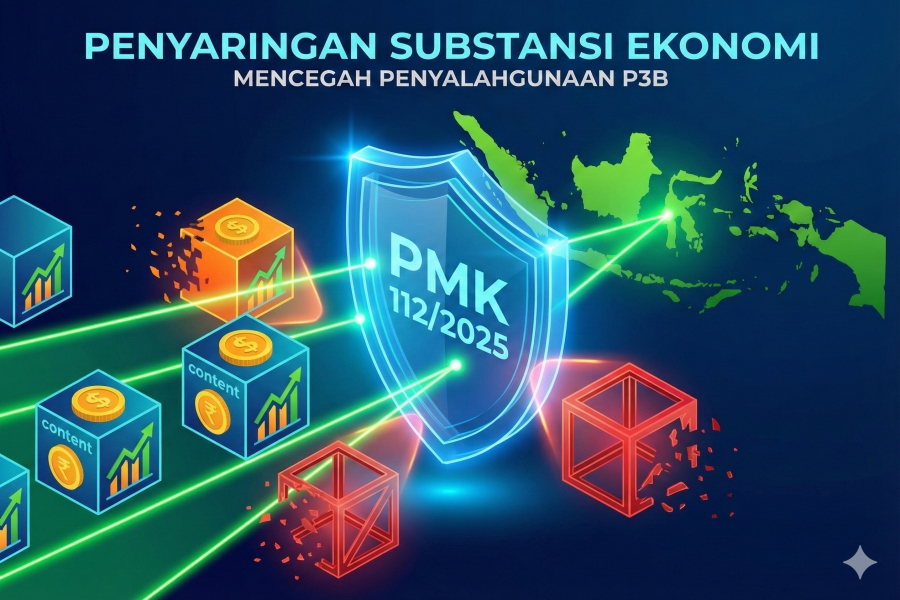
In the era of global tax transparency, the Government of Indonesia has taken a strategic step by updating its international tax provisions through the issuance of Minister of Finance Regulation Number 112 of 2025 (PMK 112 of 2025) concerning Procedures for the Implementation of Double Taxation Agreements. This regulation, serving as the implementing rule for Article 50 paragraph (2) of Government Regulation Number 55 of 2022, marks a fundamental shift from an administrative-based approach to one based on economic substance.
The primary focus of this regulation is not merely on the procedures for granting tax benefits, but on strengthening the defense of the national tax base through strict anti-abuse criteria. Article 2 paragraph (4) of PMK 112 of 2025 asserts that a Non-Resident Taxpayer (WPLN) is only entitled to Tax Treaty (P3B) benefits if they meet three cumulative conditions: they are not an Indonesian domestic tax subject, they are a resident of the treaty partner country, and they do not engage in treaty abuse. The definition of treaty abuse is formulated as an attempt to reduce, avoid, or defer tax payments contrary to the object and purpose of the P3B, which is to eliminate double taxation without creating opportunities for double non-taxation.
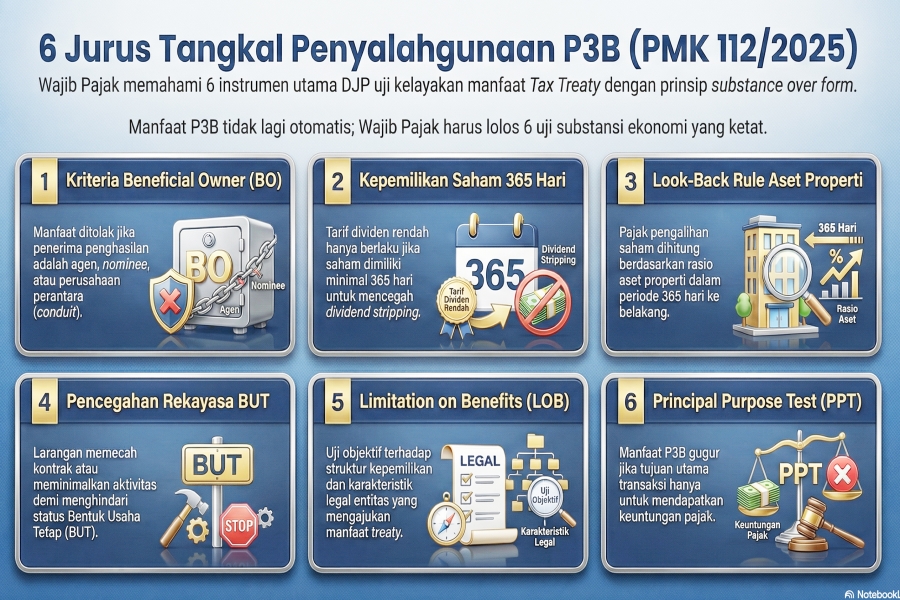
This article will detail the six main pillars of anti-abuse criteria regulated in Article 18 paragraph (3) of PMK 112 of 2025, which empowers the Director General of Taxes to deny P3B benefits if the WPLN fails to meet the established substance standards.
The concept of Beneficial Owner (BO) is the vanguard in preventing treaty shopping practices. Article 19 of PMK 112 of 2025 tightens the BO definition with more granular criteria. A WPLN is considered a BO only if they are not acting as an Agent, Nominee, or Conduit Company.
Specifically for Corporate WPLN, Article 19 paragraph (2) establishes a series of substance tests that must be met to be recognized as a BO:
If these criteria are not met, the WPLN is deemed a Conduit as defined in Article 1 number 24, which is a company obtaining P3B benefits while the actual economic benefit is owned by another party who may not be entitled to such facilities.
A common tax avoidance mode is the manipulation of share ownership prior to dividend distribution (dividend stripping) to obtain lower tax rates. PMK 112 of 2025 addresses this through Article 20.
Article 21 regulates anti-avoidance criteria related to Capital Gains from the alienation of shares in entities whose value is dominated by immovable property (land-rich companies). Taxing rights reside in Indonesia if the value of immovable property in Indonesia exceeds a certain percentage threshold of total assets.
The key criterion is the look-back period test. This percentage threshold must be met at any time within the 365 calendar days preceding the share transfer. This rule prevents asset dilution practices, where a Taxpayer injects liquid assets shortly before a sale to lower the property asset ratio.
PMK 112 of 2025 pays special attention to schemes designed to avoid Permanent Establishment (PE) status. Articles 22 to 26 detail various countermeasures:
To avoid time tests for construction projects, WPLN often split contracts among affiliated entities. Article 23 paragraph (1) closes this loophole by mandating the aggregation of time periods for project execution performed by the WPLN with periods of projects performed by "closely related persons" at the same location.
Article 24 targets agents who substantially play the principal role leading to the conclusion of contracts. If an agent in Indonesia habitually performs such a role and contracts are concluded without material modification by the head office, the WPLN is deemed to have a PE in Indonesia.
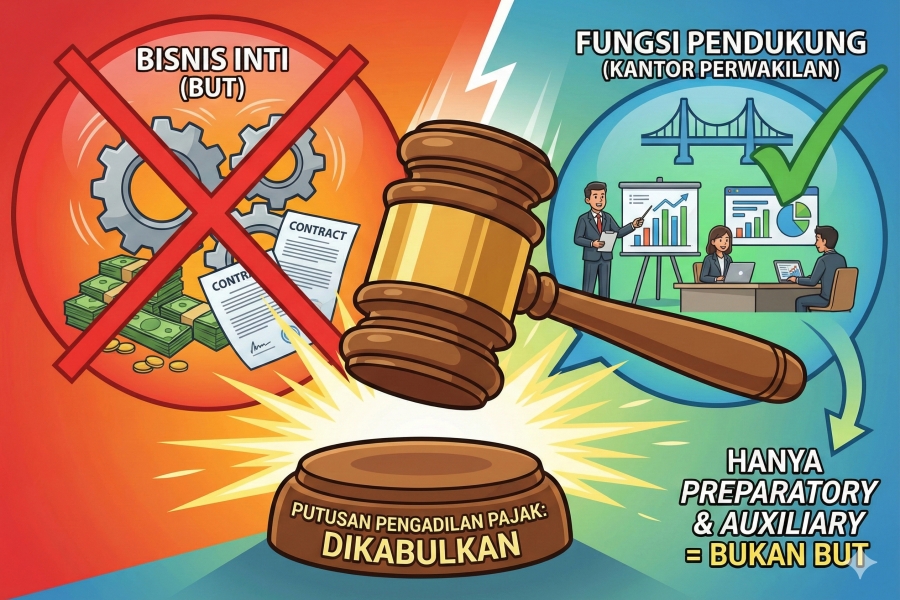
Article 25 prevents the abuse of the preparatory/auxiliary activity exemption. If cohesive business activities are fragmented into smaller "auxiliary" tasks across different locations, these will be combined and PE status cannot be avoided.
Article 27 regulates the application of Limitation on Benefits (LOB) clauses. LOB is an objective test to determine whether an entity has an "entitlement" to P3B benefits based on its legal characteristics. Criteria include whether the WPLN is a publicly traded company or if its majority shares are owned by residents of the partner country.
As the final and broadest safety net, Article 28 enforces the Principal Purpose Test (PPT). It is applied when other specific anti-abuse provisions are insufficient or aggressive schemes are indicated.
Minister of Finance Regulation Number 112 of 2025 sends a firm signal to the global business community that Indonesia prioritizes substance over formal form. By integrating strict Beneficial Owner provisions and broad PPT application, this regulation closes conventional tax avoidance loopholes. International tax compliance in Indonesia now demands that WPLN prove the validity of the commercial purpose and economic reality of every cross-border transaction.












 tpc.consulting
  tpc.consulting
  info@taxindo.co.id