


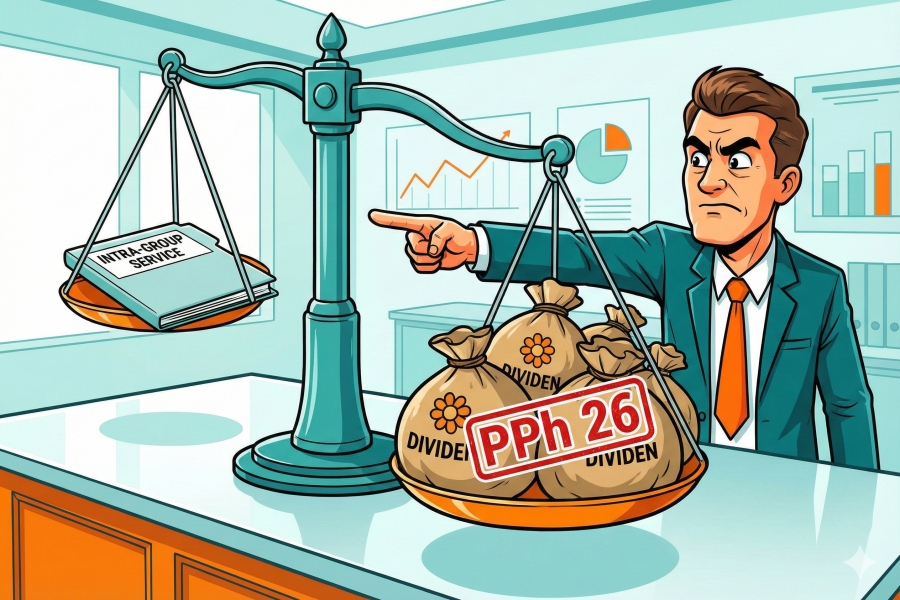
The application of the Arm's Length Principle (ALP) in affiliated transactions is once again the central focus of a major Transfer Pricing dispute in Indonesia. This Tax Court Decision affirms that a multinational taxpayer's (PT SIA) failure to substantiate the real economic benefits of its Intra-Group Services will trigger not only a primary Corporate Income Tax (CIT) correction, but also a secondary adjustment in the form of a Withholding Tax (WHT) Article 26 obligation on Constructive Dividends. This case essentially highlights the authority of the Director General of Taxes (DJP), supported by the Tax Court Panel, to utilize the substance over form approach to safeguard Indonesia's tax base, in line with Article 18 paragraph (3) of the CIT Law.
The core conflict revolves around the DJP's correction of approximately Rp. 18,669,113,455.00 in Intra-Group Service Fees paid to foreign affiliates. The DJP argued that these fees were non-deductible as they qualified as shareholder activity or duplicate services that provided no clear economic benefit to PT SIO. Furthermore, PT SIO's declining financial performance (drop in ROS and Profit) contradicted the significant 40% increase in service fees, suggesting underlying profit shifting. The immediate consequence of this primary correction was the reclassification of the unwarranted amount as a Constructive Dividend, pursuant to domestic regulations, specifically Article 22 paragraph (8) of Minister of Finance Regulation Number 22/PMK.03/2020, which explicitly treats the difference in a non-arm's length transfer price as a dividend. This reclassification automatically invoked PT SIO's obligation to withhold WHT Article 26 on the income paid to the foreign taxpayer.
PT SIO adamantly rejected the WHT Article 26 secondary adjustment. PT SIO's defense was formalistic: legally, the payment was for services, not a dividend, as the recipient was not the shareholder, and no General Meeting of Shareholders (GMS) decision for profit distribution was made, as required by the CIT Law and the Company Law. PT SIO also raised concerns about the risk of double taxation, where the affiliate's jurisdiction might not provide a tax credit for the constructive dividend withheld in Indonesia. Thus, this dispute became a classic conflict between the formalistic interpretation of regulations and the substance-based approach advocated by the tax authority.
In its legal considerations, the Tax Court Panel adopted a balanced position. The Panel upheld the DJP's authority to apply the WHT Article 26 secondary adjustment (Constructive Dividend), confirming that in substance, the excess payment to an affiliate constitutes a profit distribution and falls under the definition of "distribution of profits in any form" stipulated in Article 4 paragraph (1) letter g of the CIT Law. However, the determination of the correction amount was based on the judicial review of the related CIT primary dispute. Based on the CIT decision, the Panel ruled that only a portion of the service fee correction was sustainable (less than half of the DJP's initial correction). Consequently, the WHT Article 26 Tax Base and the tax payable had to be adjusted proportionally, ultimately leading to a Partially Granted decision.
The implications of this Tax Court Decision are crucial. It sets a strong precedent that the Indonesian tax authority has a solid legal basis (Article 18(3) CIT Law and PMK 22/PMK.03/2020) to enforce the WHT Article 26 secondary adjustment (Constructive Dividend) on non-arm's length affiliate transactions. The key takeaway for Taxpayers is that success in this type of WHT Article 26 dispute hinges on the ability to defend the arm's length nature of the transaction in the primary CIT dispute phase. Taxpayers must prepare Intra-Group Service Documentation that not only meets formal requirements but also comprehensively substantiates specific, non-duplicative economic benefits. Thus, this Decision serves as a stern reminder for every multinational corporation to prioritize proactive Transfer Pricing compliance to avoid the risk of double taxation and significant administrative penalties.
A Comprehensive Analysis and the Tax Court Decision on This Dispute Are Available Here
















 tpc.consulting
  tpc.consulting
  info@taxindo.co.id