


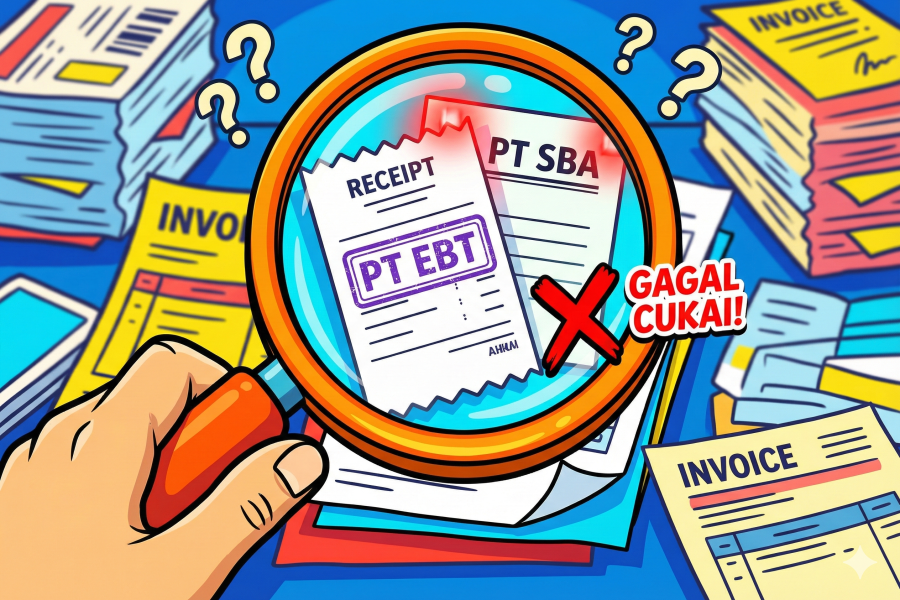
The tax dispute case involving PT PGL against the Directorate General of Taxes (DJP) provides a crucial lesson regarding the importance of precise bookkeeping administration when facing tax credit claims. In this Tax Court decision, the Panel of Judges of the Tax Court rejected PT PGL's appeal regarding an Input Value-Added Tax (VAT) dispute amounting to IDR 300,000.00, reaffirming the strict application of the Joint and Several Liability principle pursuant to Article 16F of the VAT Law (UU PPN).
The core issue began when the DJP made a correction on the Input VAT for the May 2021 Tax Period. The basis for this correction was the system's finding that PT PGL's counterparty, PT SBA, did not report the Output VAT on the disputed transaction. The DJP argued that since the output tax was not reported by the seller, and PT PGL was deemed uncooperative in providing data during the objection process, the validity of the transaction was questionable. The DJP utilized the authority of Article 12 paragraph (3) of the General Tax Provisions and Procedures Law (UU KUP) jo. KEP-754/PJ./2001 to cancel the tax credit, effectively shifting the burden of proof entirely onto PT PGL.
PT PGL insisted that the transaction was genuine and directly related to their business activities as a logistics service provider. They argued that they had complied with the provisions of Article 9 of the VAT Law (UU PPN) and submitted evidence in the form of invoices, bank statements, transfer proofs, and tax invoices during the trial. PT PGL emphasized that the tax reporting compliance of the counterparty was beyond their control and should not invalidate their rights as a good-faith buyer who had settled the payment, including the VAT.
However, during the material verification process (evidence test) in court, the Panel of Judges discovered fatal flaws in the evidence submitted by PT PGL. Legal facts showed that the Purchase Payment document lacked a valid signature and company stamp. More incriminating was the fact that the payment receipt submitted was stamped by "PT EBT", whereas the counterparty in the dispute was "PT SBA". Furthermore, the bank statements did not have sufficient detail to link the fund flow with specific invoices, and no evidence of goods flow (such as goods receipt notes) could be demonstrated.
The Panel of Judges decided that these evidentiary inconsistencies caused PT PGL to fail in proving that the VAT had truly been paid to the rightful counterparty. Therefore, the Joint and Several Liability mechanism (Article 16F of the VAT Law) was fully enforced. This decision serves as a stern warning to Taxpayers that holding a Tax Invoice alone is insufficient; the validity of cash flow and goods flow must be supported by documents where administration and identity are perfectly synchronized.
A Comprehensive Analysis and the Tax Court Decision on This Dispute Are Available Here





















 tpc.consulting
  tpc.consulting
  info@taxindo.co.id