



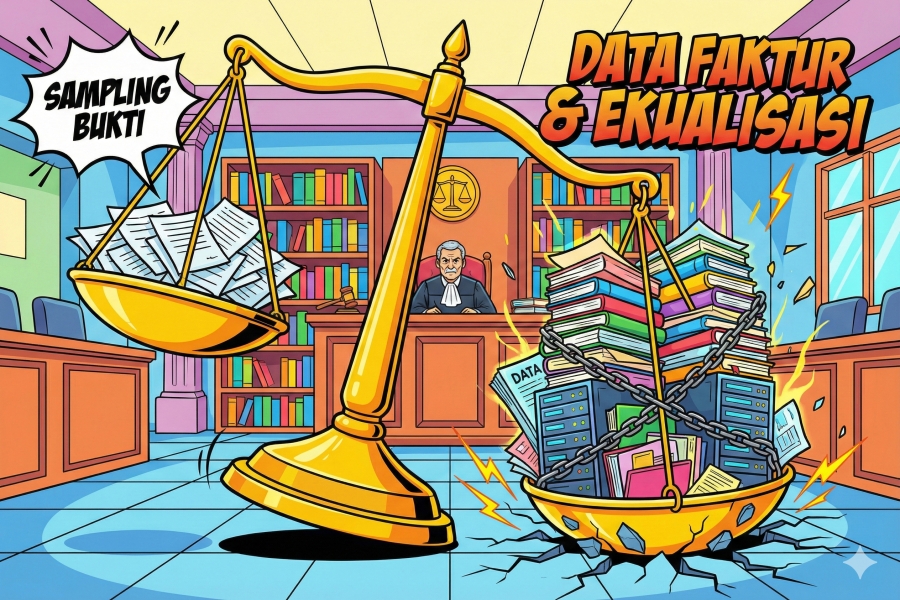
Legal certainty is once again in the spotlight in the taxation system through Tax Court Decision Number PUT-011945.99/2023/PP/M.XVIB Year 2025. This dispute originated from PT PC as the Plaintiff, which challenged the Director General of Taxes' Decision Number KEP-12546/NKEB/PJ/WPJ.09/2023. This case does not focus on the amount of tax owed, but on whether the DGT's administrative decision was issued in accordance with the law, procedures, and general principles of good governance. The Plaintiff argues that the decision does not provide adequate remedy for the fundamental flaws inherent in the SKPKB, thereby undermining justice and legal certainty.
This dispute is actually the culmination of a long series of polemics that began in 2009. On October 29, 2009, the DGT issued the 2007 Corporate Income Tax SKPKB, which was then challenged by the Plaintiff and won in the Tax Court on August 27, 2010. Following up on this decision, the DGT issued a new SKPKB on November 29, 2010, but this SKPKB was again challenged and again overturned by the Tax Court on December 21, 2011. The legal process continued to the level of Review at the Supreme Court, where the DGT's appeal against the first ruling was granted, but the DGT's appeal against the second ruling was rejected. The inconsistency in the legal status of the SKPKB caused prolonged uncertainty for taxpayers.
To end this complexity, on August 4, 2023, PT PC filed a request for the cancellation of the tax assessment based on Article 36 paragraph (1) letter d of the KUP Law, a discretionary mechanism that allows the DGT to cancel incorrect tax assessments. However, on November 15, 2023, the DGT issued Decision KEP-12546/NKEB/PJ/WPJ.09/2023, which rejected the request and upheld the 2009 SKPKB. This decision was then challenged in the Tax Court because it was considered to ignore a fundamental formal defect in the SKPKB, namely the absence of a Final Discussion of the Audit Results, which resulted in the taxpayer losing the opportunity to submit objections before the decision was made.
During the trial, the Plaintiff asserted that conducting an audit without a Final Discussion violated the principle of reciprocity (audi alteram et partem) and the taxpayer's right to be heard. According to the Plaintiff, the DGT should have canceled all consequences of the SKPKB, rather than simply upholding it through a formal administrative decision. The DGT, on the other hand, argued that it had issued the decision in accordance with the procedures and discretionary authority granted by law.
The Tax Court Judges ultimately took a firm stance by granting all of the Plaintiff's claims. This decision states that Decision KEP-12546/NKEB/PJ/WPJ.09/2023 does not meet the elements of legal validity and is contrary to the general principles of good governance, and therefore must be revoked. The ruling also provides new legal certainty for taxpayers, namely that the SKPKB that was the subject of the cancellation request is no longer valid. This ruling confirms that fiscal discretion is not an absolute authority: every administrative decision of the DGT remains subject to judicial review and must respect procedures, the principle of professionalism, the principle of fairness, and the protection of taxpayer rights.
A Comprehensive Analysis and the Tax Court Decision on This Dispute Are Available Here.



















 tpc.consulting
  tpc.consulting
  info@taxindo.co.id