



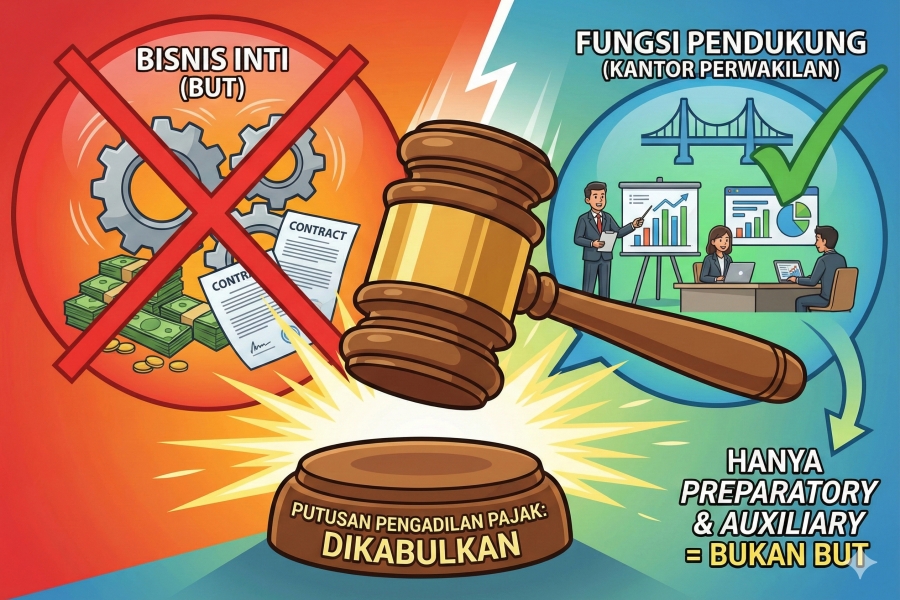
In the drama of tax dispute hearings, both Taxpayers and the Tax Authority often wonder: what actually drives the Judge's gavel to rule in favor of one party? Is it merely emotional argument, or is there a rigid standard? The answer lies in the concept of "Judicial Conviction" (Keyakinan Hakim), a crucial yet often misunderstood element specifically regulated in Article 78 of Law Number 14 of 2002 concerning the Tax Court.
Many assume that "conviction" is abstract and personal. However, the Elucidation of Article 78 shatters this assumption with a very strict and binding definition:
"The Judge's conviction is based on the assessment of evidence and is in accordance with tax laws and regulations."
This definition sets clear boundaries. Judicial conviction in the Tax Court cannot be built on empty intuition, subjective feelings, or mere assumptions. That conviction must be the result of a synthesis of two mandatory elements:
In other words, a Judge cannot be "convinced" that a Taxpayer is guilty if there is no valid evidence, or if the evidence contradicts the law.
Let us observe the real-world application of this concept in an appeal dispute, for instance, regarding Intra-Group Service Cost Corrections or Input VAT Credit disputes.
In a hearing, the Appellee (Tax Authority) might correct management fees paid by the Taxpayer to an overseas head office on the grounds of "not being convinced" that the services actually existed. On the other hand, the Appellant (Taxpayer) submits evidence in the form of contracts, invoices, and transfer proofs.
How does the Judge form their conviction pursuant to Article 78?
Conversely, if in a VAT dispute, a Taxpayer claims Input VAT Credit but fails to produce the original Tax Invoice or valid payment proof during the evidentiary test, the Judge lacks the material basis to form a conviction. In this condition, the Judge must reject the appeal because their conviction is constrained by the absence of legally compliant evidence.
Article 78 and its elucidation are a guarantee of legal certainty for justice seekers. It affirms that in the Tax Court, material truth is king. The Judge's conviction is the final product of a logical process combining trial facts with legal rules, ensuring that every resulting verdict is objective and accountable.













 tpc.consulting
  tpc.consulting
  info@taxindo.co.id