




The Cross-Border QRIS innovation won an international award at the UN General Assembly for its success in connecting cross-border digital payment systems and opening opportunities for MSMEs to serve foreign tourists. On another front, the stabilization of the rupiah exchange rate is considered not to always rely on interest rate hikes, but rather on optimizing instruments such as FX swaps, DNDF, liquidity management, and foreign capital flows. Meanwhile, the shift in global investment towards the technology and manufacturing sectors poses a challenge for Indonesia in the FDI competition within ASEAN, making the quality of human resources (HR) and regulatory certainty a primary focus..
The Cross-Border Quick Response Code Indonesian Standard (QRIS) won the "50-in-5 Awards 2026" in the Collaboration category, presented by the Digital Public Goods Alliance (DPGA) and Co-Develop. The award was handed over by Co-Develop Chief Investment Officer Lindsey Crumbaugh to the Deputy Governor of Bank Indonesia (BI) during the 50-in-5 Milestone Event at the 81st United Nations (UN) General Assembly in New York, United States, on September 21, 2026. The award highlighted the interoperability of Cross-Border QRIS, which allows payment systems from various countries to interconnect without requiring each country to have the exact same system.
The Deputy Governor of Bank Indonesia (BI) explained that payment system interoperability requires a shared goal, trust, agreed-upon standards, and a commitment to connect the existing payment systems of each respective country. Through Cross-Border QRIS, Indonesians can use QRIS to transact in partner countries, while foreign tourists can use their home country's payment applications to transact at QRIS merchants in Indonesia.
Since its initial implementation in 2022 up to July 2026, Cross-Border QRIS transactions by users from partner countries in Indonesia reached 21 million transactions valued at Rp5.90 trillion. Meanwhile, transactions by Indonesian users in partner countries were recorded at 4.67 million transactions valued at Rp1.73 trillion. As of July 2026, QRIS has reached 45.46 million merchants, with 96.69% of them being Micro, Small, and Medium Enterprises (MSMEs). BI continues to expand Cross-Border QRIS through collaborations with partner countries, including Thailand, Malaysia, Singapore, Japan, South Korea, and China.
Beyond the development of digital payment systems, the stability of the rupiah exchange rate is also a point of concern amidst global financial market conditions.
The Chief Economist of Trimegah Sekuritas assessed that the stabilization of the rupiah exchange rate does not always have to rely on interest rate hikes. According to him, when pressure on the rupiah primarily stems from high global yields, oil prices, and global monetary policy uncertainty, Bank Indonesia (BI) needs to optimize instruments such as foreign exchange (FX) swaps, Domestic Non-Deliverable Forwards (DNDF), liquidity management, and the management of foreign capital flows. In August 2026, BI maintained the BI Rate at 5.75% while simultaneously expanding the FX swap premium reduction incentive of 12.5%, which was previously aimed at portfolio inflows and later expanded to also cover foreign bank loans and Foreign Direct Investment (FDI).
The Chief Economist of Trimegah Sekuritas also highlighted the experience of the Reserve Bank of India (RBI) in using swap facilities to attract foreign exchange funding. Based on data as of September 18, 2026, cited in the news, India successfully attracted US$143.6 million through a concessional swap facility. According to him, Indonesia does not need to copy India's policy entirely, but it can consider increasing incentives on existing hedging facilities, particularly for fresh money with specific characteristics. He added that these facilities should be temporary, have specific limits, and consider the duration the capital remains in Indonesia.
In addition to exchange rate stability, the changing direction of global investments is also a focal point in the economic development of Indonesia and the ASEAN region.
The Chief Economist of Bank Central Asia (BCA) assessed that Indonesia is increasingly lagging in the competition to attract Foreign Direct Investment (FDI) in ASEAN, as global investment focus shifts towards the technology and manufacturing sectors. Investments in the technology sector, particularly data centers and artificial intelligence (AI), are growing rapidly and benefiting countries that possess the human resources (HR) and infrastructure suited to these industries' needs, such as Thailand, Malaysia, and Singapore. Meanwhile, Vietnam has an advantage due to its geographical proximity to China, which supports its role as one of the main countries in transshipment activities and regional supply chains.
Based on FDI data for the first half of 2026, Singapore recorded foreign investments of approximately US$86.2 billion, Thailand US$40.5 billion, Vietnam US$34.65 billion, and Malaysia US$30.2 billion. Meanwhile, Indonesia's FDI was recorded at US$28.45 billion, or around Rp507.6 trillion, assuming an exchange rate of Rp17,836 per US dollar. Indonesia's main attraction still relies on its large domestic market as well as the mining and crude palm oil (CPO) sectors, which are currently not the primary focus of global investors. Although Indonesia's economic growth slowed down in the second quarter of 2026, the growth rate remains above historical long-term growth trends.
Investors are also scrutinizing exchange rate stability, regulatory dynamics, and vulnerability to geopolitical turbulence, especially the dependence on oil. According to the Chief Economist of BCA, this change in the investment landscape indicates a growing investment focus in ASEAN on the technology and manufacturing sectors. Therefore, improving the quality and alignment of HR specializations with industry needs, alongside regulatory certainty, is deemed crucial to strengthening Indonesia's position in the ASEAN FDI competition.
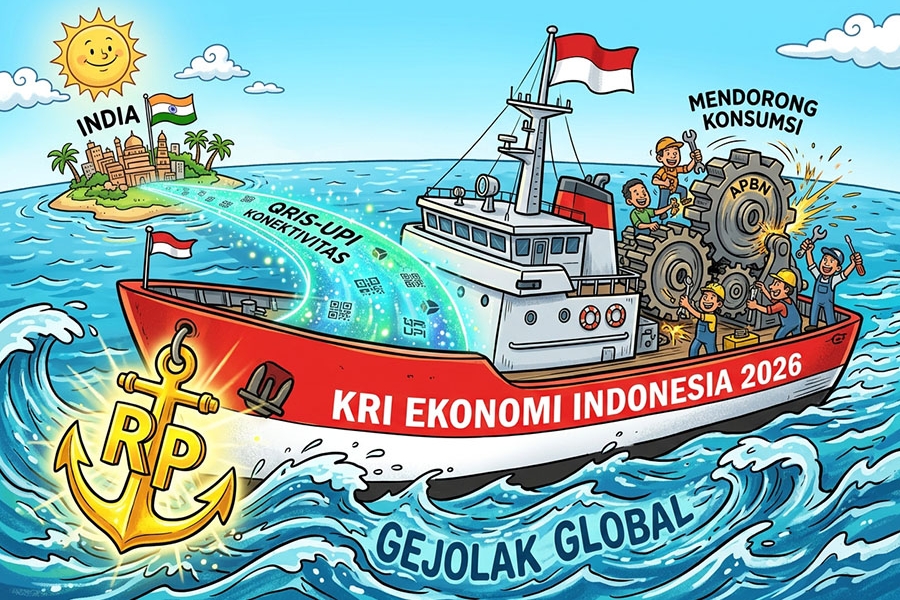
Overall, these three developments illustrate the dynamics of the Indonesian economy in terms of digital payment systems, exchange rate stability, and investment flows. Cross-Border QRIS continues to be expanded to connect Indonesia's payment systems with partner countries, earning an international award for its interoperability. On the other hand, the stabilization of the rupiah exchange rate remains a focal point amidst global financial market conditions, with various instruments such as FX swaps, DNDF, liquidity management, and foreign capital flows being discussed as part of stabilization efforts.
In the investment sector, the shift in global investments towards technology and manufacturing is a major concern in the FDI competition within the ASEAN region. Indonesia still possesses appeal in the form of a large domestic market, as well as the mining and CPO sectors, while investors also closely monitor exchange rate stability, regulatory dynamics, and geopolitical risks. These developments indicate that cross-border payment system connectivity, exchange rate stability, and the readiness of human resources and regulations are integral to Indonesia's economic dynamics in facing the shifting global economic and investment landscape.


















 tpc.consulting
  tpc.consulting
  info@taxindo.co.id