



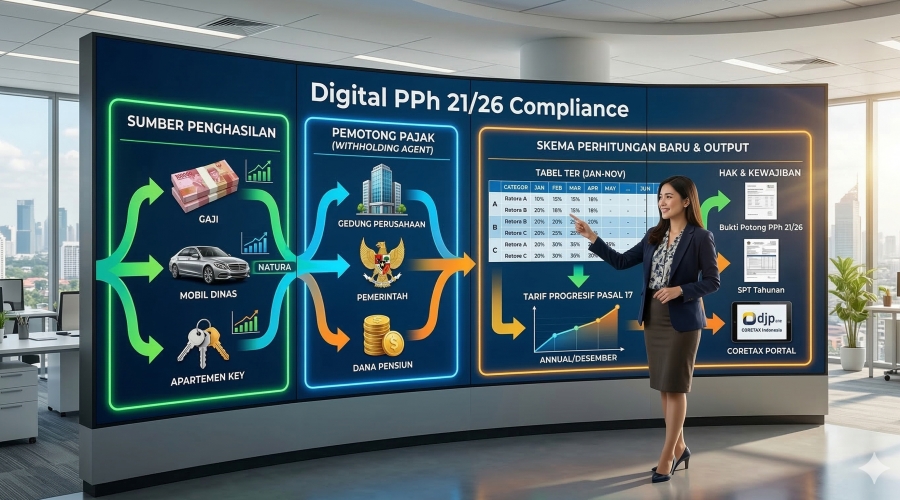
Welcome to the ultimate guide on Income Tax (PPh) Article 21 and Article 26 in Indonesia. The tax landscape is constantly evolving, including significant transformations through the Harmonization of Tax Regulations Law (UU HPP), Government Regulation (PP) Number 58 of 2023, and the implementation of the CoreTax system via PER-11/PJ/2025. This article will thoroughly explore everything you need to know about PPh 21 and PPh 26, from definitions and involved parties to tax objects and calculation schemes.
Broadly speaking, PPh 21 and PPh 26 are taxes levied on income related to employment, services, or activities performed by Individual Taxpayers. The primary difference between the two lies in the tax subject:
This tax collection system utilizes a Withholding Tax mechanism, where the income provider is obligated to withhold, remit, and report the tax to the state treasury.
Withholding Agents (Pemotong Pajak):
Parties Subject to Withholding (Pihak yang Dipotong):
The income subject to withholding includes all income received on a regular or irregular basis. This covers salaries, wages, honoraria, commissions, bonuses, gratuities, pension money, and severance pay.
The Revolution of Tax on Benefits in Kind (Natura dan Kenikmatan) One of the most revolutionary changes following UU HPP and Ministry of Finance Regulation (PMK) 66 of 2023 is the tax treatment of benefits in kind (goods) and benefits in use (facilities). Previously, facilities like company cars or apartments were not taxable objects for employees. Now, all compensation in the form of benefits in kind/use are Objects of PPh 21 and add to the employee's gross income. If a company bears the income tax of its employees (Gross-Up method or Tax Borne by Employer), the value of that borne tax is also recognized as a taxable benefit.
The government still provides exemptions (Non-Tax Objects) for specific types of receipts for the sake of fairness and propriety, including:
The calculation scheme for PPh 21 is now much simpler thanks to PP Number 58 of 2023 and PMK 168 of 2023. The previously highly complex calculations now utilize two main schemes:
Applied for monthly withholding during ongoing tax periods (January to November). The Monthly TER is divided into three categories based on the Taxpayer's Non-Taxable Income (PTKP) status:
This tariff is applied in the Last Tax Period (generally December or when an employee resigns). The employer calculates the total tax payable for the year using the progressive rate, then deducts the tax already withheld using TER in the preceding months. The progressive tariff currently features five brackets, ranging from 5% (for Taxable Income up to IDR 60 million) to a top tier of 35% (for Taxable Income above IDR 5 billion).
For Foreign Nationals (WNA) with non-resident tax subject status, PPh 26 withholding is far more concise. The applicable rate is 20% (final) of the gross income. However, this rate can be lower or adjusted if the Foreign National originates from a country that holds a Double Taxation Avoidance Agreement (P3B/Tax Treaty) with Indonesia.
For Companies (Withholding Agents): Companies must calculate, withhold, remit, and report PPh 21/26 every month. Even if in a particular month there is no tax withheld (Nil) or a 0% rate applies, the obligation to file the Periodic Tax Return (SPT Masa) and generate Withholding Slips (Bukti Potong) remains. Currently, the reporting system is digitally integrated through the e-Bupot module and the latest CoreTax DJP administration system.
For Employees/Income Recipients: Employees have the right to receive a PPh 21 Withholding Slip (Form BPA1 for permanent employees or BP21/BP26 for non-employees) from the company. If at the end of the year there is an Overpayment status (more tax was withheld than what is actually owed), the company must refund the excess money to the employee alongside providing the withholding slip. Subsequently, employees use this withholding slip as a tax credit when filing their Annual Individual Income Tax Return (SPT Tahunan).
By thoroughly understanding the provisions of Income Tax Article 21 and 26, both employers and income recipients can ensure optimal tax compliance, avoid penalties, and support the seamless execution of national development.


 tpc.consulting
  tpc.consulting
  info@taxindo.co.id